
Wisekey Advances Integrated Cybersecurity Platform With Post-Quantum and Satellite Innovations
Wisekey’s recent quarterly filings underscore momentum in deploying quantum-resistant semiconductors and progressing satellite-enabled quantum security services.
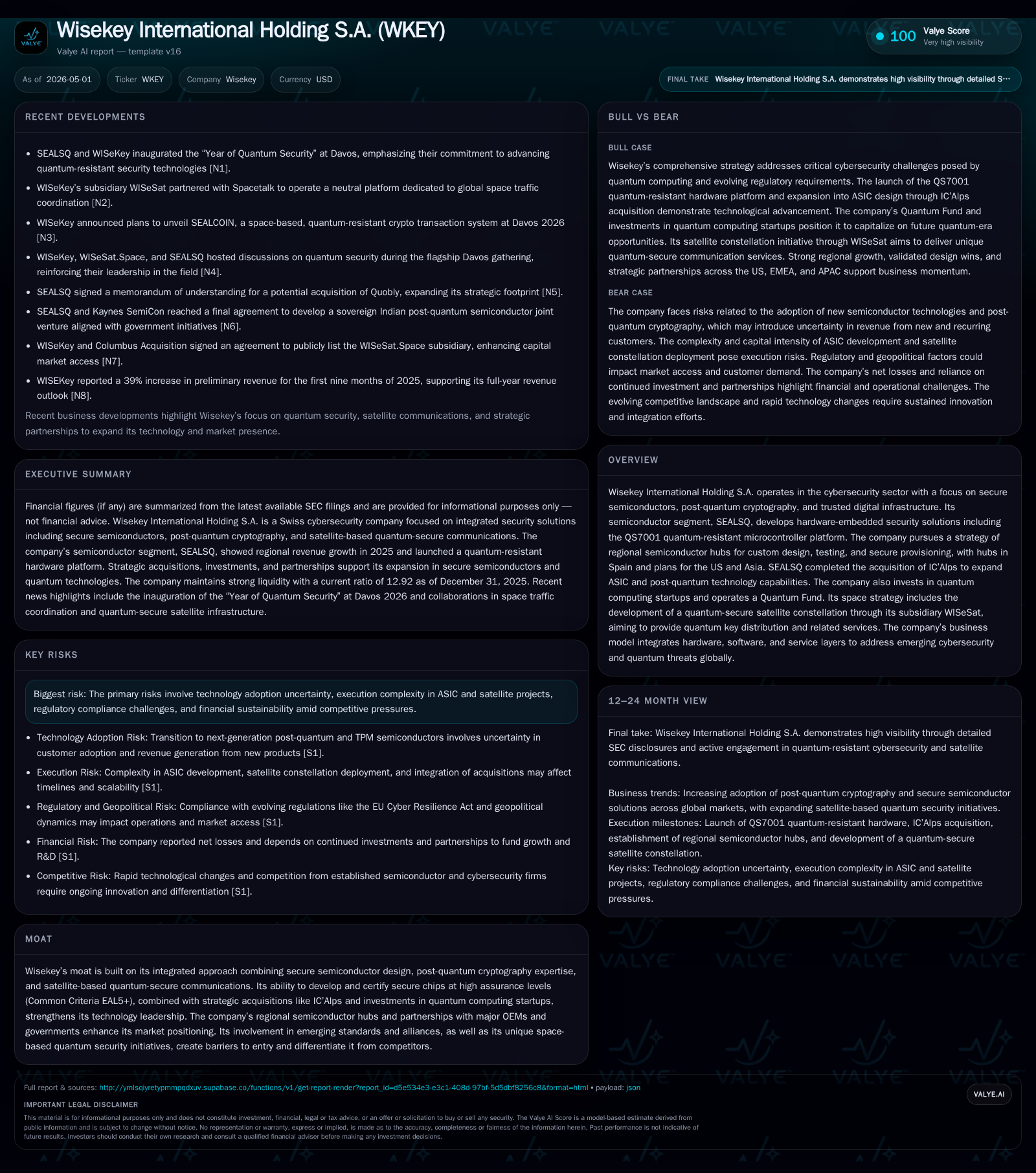
In the latest quarterly update ending April 2026, Wisekey highlighted accelerated deployment of its QS7001 post-quantum microcontroller platform and growing traction in PKI services, reflecting intensified customer adoption amid emerging regulatory drivers. The integration of IC’Alps enhances its ASIC capabilities, while space-based initiatives via its subsidiary WISeSat aim to establish a quantum-secure satellite constellation, complementing its semiconductor and cryptographic offerings. These developments reinforce Wisekey’s distinctive multi-domain security model but execution risks remain amid evolving standards and technology adoption uncertainties.
Latest Quarterly Operating Update Highlights Quantum-Readiness Push
Wisekey's most recent quarterly filing dated April 30, 2026 [S2] together with the April 9 interim filing [S3], show substantial operational progress anchored by the commercial ramp of SEALSQ’s QS7001 quantum-resistant microcontroller platform launched at the end of 2025. Customer adoption accelerated notably across the United States and EMEA in late 2025, aligning closely with tightening compliance deadlines such as the EU Cyber Resilience Act set for September 2026 and the CNSA 2.0 mandate encouraging post-quantum cryptographic algorithm adoption.
The filings report an expansion of PKI Services, which underpin recurring revenue through secure identity lifecycle management rather than episodic chip sales alone. This signals Wisekey's strategic shift to augment product sales with security services foundation fostering long-term customer engagement.
Moreover, the integration of IC’Alps—an ASIC design house acquired in 2025—is advancing custom chip development capabilities. This bolsters SEALSQ’s offering beyond standard TPMs into bespoke post-quantum ASIC solutions tailored for verticals requiring specialized secure silicon such as automotive and medical devices, enhancing time-to-market and scalability.
Business Model and Product Ecosystem: Secure Semiconductors and Beyond
Wisekey builds value through a uniquely integrated platform spanning high-assurance hardware semiconductors certified at Common Criteria EAL5+ (such as QS7001 embedding hybrid ML-KEM/ML-DSA PQC algorithms), cryptographic software frameworks including its INeS PKI platform for hybrid certificate issuance combining classical and post-quantum algorithms, as well as authenticated satellite communications providing quantum key distribution (QKD).
Revenue is generated from multiple streams: semiconductor product sales to OEMs and system integrators; professional services supporting design wins; wafer-level provisioning tied to secure personalization; PKI services offering device authentication and lifecycle key management on subscription models; plus emerging revenues expected from quantum-secure satellite communication capacity.
A critical feature is the “Security-by-Design” approach embedding unique cryptographic identities at wafer level using Hardware Security Modules (HSMs) during manufacturing, enabling zero-touch onboarding capabilities critical for IoT device scale-up under regulatory mandates like the EU Cyber Resilience Act.
Industry Structure and Competitive Dynamics in Post-Quantum Security
Wisekey operates at the confluence of several specialized markets: hardware security chip providers, PQC algorithm developers, PKI service platforms, and space-based quantum-secure networks. Competitive barriers stem from stringent certification requirements (EAL5+), regulated chip provenance needing secure provisioning factories (OSATs), growing geopolitical emphasis on digital sovereignty particularly in Europe and the US, and early mover advantage in emerging satellite QKD constellations.
Regulations including the European Quantum Act and CNSA 2.0 compel critical infrastructure vendors to adopt PQC solutions swiftly by end-2026 creating strong structural tailwinds. However, entry is expensive due to capital intensity of ASIC design/test facilities bolstered by regional hubs (Spain’s Quantix Edge Security backed by €40M government investment). The combination of IP exclusivity, partnerships with silicon providers, certifications, embedded ecosystem support, plus geographic-specific data sovereignty provisions yields defensibility.
Expansion Catalysts: Regional Hubs, Strategic Acquisitions, and Partnerships
Quantix Edge Security center in Murcia spearheads Europe's sovereign post-quantum semiconductor hub focusing on RISC-V based chip designs compliant with NIST standards. This facility is targeted to be fully operational by 2028 with revenue generation starting in 2026 from professional services licensing intellectual property within the joint venture framework.
Additional planned hubs in the US and Asia indicate an ambition for global reach dovetailing with acquisition strategy focused on securing complementary assets across eight strategic categories—from IP providers specializing in PQC embedded security to certification services ensuring compliance speed.
The IC’Alps deal exemplifies this playbook by infusing engineering talent (~100 personnel) skilled in ASIC design relevant to automotive/medical sectors — strategies designed both to accelerate custom silicon time-to-market and enhance silicon supply chain control.
Meanwhile, strategic partnerships under negotiation with major US silicon vendors aim at co-developing PQC-capable chips leveraging combined cryptographic expertise fostering domestic sovereignty ambitions — consistent with government procurement preferences currently rising worldwide.
Growth Risks and Operational Challenges in Cutting-Edge Security Ventures
While regulatory dynamics strongly favor Wisekey’s roadmap, technology adoption risks loom given typical slow procurement cycles for cutting-edge secure hardware where conservative IT buyers may hesitate on integrating relatively unproven PQC architectures amid multiple competing standards.
Operational execution complexity is non-trivial especially integrating bespoke ASIC designs within tight validation windows alongside scaling HIgh Assurance provisioning processes that must meet emerging "in-country injection" mandates securing device identities domestically post-manufacturing.
Satellite constellation ambitions via WISeSat plans targeting 2033 full operational capability carry inherent risks including launch scheduling uncertainties, regulatory approvals for space-based cryptography operations, plus technical integration of QSOC services within broad client ecosystems.
Revenue visibility suffers from customer concentration without long-term binding purchase commitments despite framework agreements limiting firm volume predictability — requiring careful pipeline monitoring as design-wins transition into production phases over extended timelines.
Forward-Looking Indicators: What Investors Should Monitor Next
Key milestones include:
- Completion of commercial agreements with US silicon foundries advancing PQC chip offerings;
- Scale-up metrics on MATTER protocol-based smart devices incorporating QS7001 chips across EMEA;
- Subscription growth trends within PKI services reflecting customer retention/sales cadence;
- Progress updates on WISeSat’s initial launches demonstrating service-level agreements (99.9% SLA commitment) around dedicated QSOC capacity;
- Certification achievements aligned with EU Cyber Resilience Act September deadline showcasing readiness;
- Design-win conversion rates particularly from Japanese HVAC OEMs leveraging local interoperability protocols Wi-SUN/ECHONET Lite;
- Integration progress post IC’Alps acquisition indicating reduced development cycle times or enhanced performance parameters. These KPIs will be critical barometers for validating commercial traction amid nascent but structurally expanding market segments.
Financial Profile Snapshot
Latest financial snapshot
| Metric | Value | Period |
|---|---|---|
| Cash & equivalents | $429mm | |
| 2025-12-31 | ||
| Total debt | $3mm | |
| 2025-12-31 | ||
| Net debt | $-426mm | |
| 2025-12-31 | ||
| Current assets | $456mm | |
| 2025-12-31 | ||
| Current liabilities | $35mm | |
| 2025-12-31 | ||
| Current ratio | 12.92x | |
| 2025-12-31 |
Source: SEC companyfacts cache [F1].
| Metric | Value (USD) |
|---|---|
| Cash & Equivalents | 429,244,000 |
| Total Debt | 3,213,000 |
| Net Debt | -426,031,000 |
| Current Assets | 455,778,000 |
| Current Liabilities | 35,266,000 |
| Current Ratio | 12.92 |
Wisekey maintains a robust liquidity position with approximately $429 million in cash equivalents against modest total debt just above $3 million as of December 31, 2025 [F1]. This results in a net cash position exceeding $426 million supporting ongoing multi-year investments into R&D as well as strategic acquisitions required for sustained innovation leadership. The strong current ratio near 13 underscores ample working capital cushioning near-term liquidity needs even amid some revenue volatility inherent to project-based semiconductor sales cycles.
Disclaimer: This analysis is based solely on information publicly available up to May 1st, 2026 including recent SEC filings and company facts [F1]. It aims to provide an objective assessment of Wisekey International Holding S.A.’s operating environment without making investment recommendations or price forecasts.
Disclaimer: This is research-only, informational analysis and not investment advice. It may include AI-generated interpretation and general industry context. Always verify important details using primary sources.

Comments