
First Merchants Corp Boosts Loan Growth with Steady Credit Discipline in Q1 2026
First Merchants Corp reported a $1.5 billion increase in loans during Q1 2026, accompanied by a measured rise in credit loss allowances reflecting ongoing credit quality vigilance.
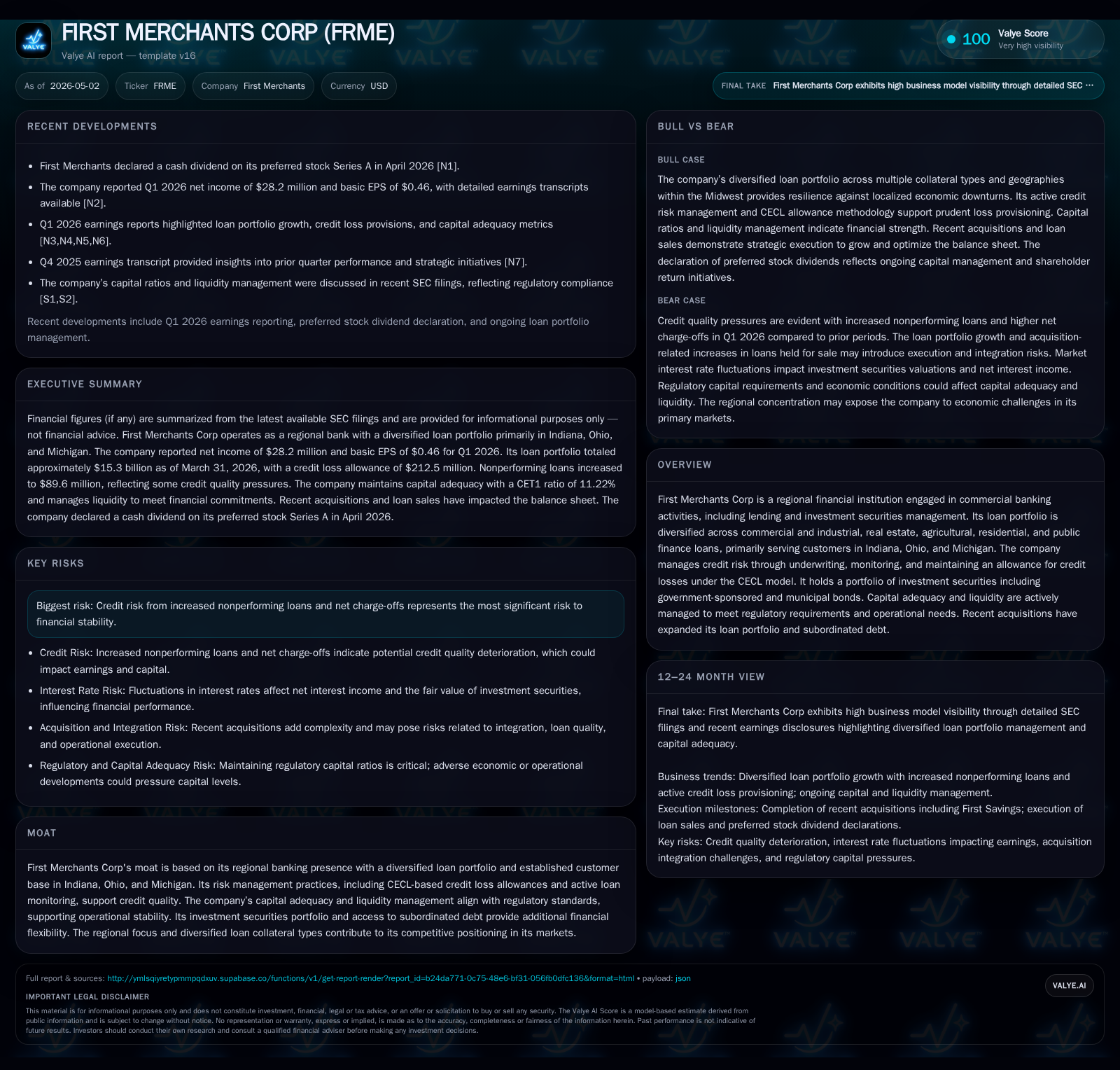
In Q1 2026, First Merchants Corp expanded its loan portfolio robustly to $15.3 billion, up $1.5 billion from year-end 2025, while the allowance for credit losses on loans increased to $212.5 million but remained stable as a percentage of total loans. This growth is underpinned by its regional commercial banking model focused on diversified lending in Indiana, Ohio, and Michigan. The bank’s active capital and liquidity management alongside disciplined credit risk controls support its competitive position in the Midwest banking sector. Near-term growth is driven by acquisitions and organic market penetration amid interest rate fluctuations, but credit risk and regulatory oversight remain key watchpoints going forward.
Q1 2026 Operating Update: Loan Expansion and Credit Metrics
First Merchants Corp posted significant operating momentum in the first quarter ended March 31, 2026, marked by a substantial $1.5 billion increase in loans outstanding (excluding loans held for sale), swelling the total portfolio to $15.3 billion from $13.8 billion at December 31, 2025 [S2]. This expansion underscores strong underlying loan demand complemented by the company’s strategic acquisitions completed recently.
While loan balances surged, the allowance for credit losses (ACL) on loans increased by approximately $16.9 million to $212.5 million during the same period [S2]. Notably, as a percentage of total loans, the ACL declined slightly from 1.42% at year-end to 1.39%, signaling that credit risk remains well-contained amid growth.
The adoption of the CECL accounting model guides management's approach to provisioning, which is forward-looking and incorporates historical loss experience combined with current conditions and reasonable forecasts [S23]. The careful balance between growing volume and maintaining prudent ACL levels demonstrates disciplined underwriting insured through active loan monitoring.
Despite an uptick in nonaccrual loans to approximately $89.6 million—primarily attributable to portfolio additions from recent acquisitions—overall asset quality metrics suggest manageable risk profiles across the company’s diversified loan book [S23].
Business Model and Product Mix: Regional Bank with Diversified Lending
First Merchants' business model centers on regional commercial banking services predominantly across Indiana, Ohio, and Michigan markets [S1]. Revenue is substantially derived from net interest income generated on its diversified loan portfolio encompassing commercial & industrial loans, real estate (including construction, commercial non-owner occupied, owner-occupied), agricultural loans, residential mortgages including home equity products, public finance, and consumer loans.
This diversification insulates the bank from sector-specific downturns while enabling cross-selling opportunities within its geographically concentrated yet economically varied footprint [S1]. Interest income streams benefit primarily from loan yield spreads with secondary contributions from investment securities holdings.
The strategy also includes managing liquidity prudently via holdings of government-sponsored agency securities alongside municipal bonds that serve both income generation and liquidity roles.
Competitive Positioning and Industry Context in Midwest Banking
Operating as a mid-sized regional bank within the competitive Midwest banking landscape presents both opportunity and challenge for First Merchants [S1,S3]. Its moat derives largely from entrenched customer relationships in small business lending segments coupled with broad collateral mix reducing concentration risk.
Relative to peers competing locally or against national banks’ footprints overlapping Indiana-Ohio-Michigan corridors, First Merchants emphasizes credit quality backed by CECL-based provisioning models supported through rigorous underwriting standards [S19]. Regulatory compliance frameworks further mandate capital adequacy which is well maintained above minimum thresholds guiding stakeholder confidence.
Recent subordination debt issuances tied to acquisitions signal financial resourcefulness that enhances scale while preserving regulatory capital ratios necessary for sustained lending capacity expansion [S2,S6].
Growth Drivers: M&A Activity, Market Penetration, and Interest Dynamics
Acquisition activity continues as a tangible growth engine—most recently evidenced by assumed subordinated notes linked to Level One (2022) and First Savings (February 2026) transactions that each contributed new loan volume alongside expanded deposit bases [S2,S6]. These deals complement organic growth avenues such as market share gains within core states fueled by favorable local economic conditions.
Additionally, First Merchants benefits structurally from rising interest rates prevalent throughout much of recent periods; net interest income simulations incorporate various rate scenarios demonstrating capacity to sustain margin expansion despite volatility risks [S11]. The concentration on commercial lending sectors sensitive to capital investments ensures responsiveness to business cycle dynamics while investment securities provide alternative revenue stabilization sources [S1,S16].
Risks and Headwinds: Credit Quality, Interest Rate Sensitivity, and Regulatory Environment
Credit risk looms as the principal watchpoint given elevation in nonaccrual loans (+$17.8 million QoQ largely due to acquisition integrations) balanced partly by declines in construction segment problem loans [S23]. Management maintains conventional outlooks but acknowledges uncertainty arising from macroeconomic factors including pandemic aftermath effects on borrower cash flows or collateral valuations potentially influencing future charge-offs.
Interest rate sensitivity modeled indicates exposure remains contained through sophisticated asset-liability committee oversight—however sharp policy shifts or market dislocations could pressure net interest margins adversely despite current hedging frameworks [S11,S19].
Regulatory capital requirements impose sustained pressure for maintaining CET1 levels near or above ~11%, compelling ongoing attention towards optimizing equity deployment versus dividend distributions or debt redemptions/performance allocations [S2,S12,S19].
Outlook and What to Watch Next: Earnings Guidance and Execution Milestones
Looking ahead into remainder of 2026 quarters, focus resides on sustaining loan growth trajectories above organic baselines factoring acquisition integrations effectively; quarterly updates on ACL movement vis-à-vis emerging nonperforming assets will be critical indicators given recent upticks seen in early 2026 results [N2,N3,S3].
Dividend announcements suggest steady shareholder returns without compromising capital buffers though vigilant re-assessment will be needed should economic conditions shift materially postelection cycles or inflation/investment climates alter markedly after quarter one disclosures [N1,N3].
Financial Condition Snapshot: Capital Adequacy, Liquidity, and Debt Profile
From a capital perspective at March 31st close: common stockholders’ equity recalibrated for goodwill/intangible adjustments stands robust near $2.67 billion contributing Tier 1 capital approximating $2 billion after preferred stock exclusions per regulatory framework; the CET1 ratio holds steady at approximately 11.22% down modestly from December levels due chiefly to asset base growth while total risk-weighted assets climbed accordingly alongside loan expansion [$15B+ scale] balance sheet augmentation activities [S2,S12].
Subordinated debt reductions totaling over $65 million redeemed per schedule through first half of last year along with reacquisitions aligned with acquisitions demonstrate calibrated liability management minimizing refinancing risks while preserving capital structure adequacy essential for supporting forward-looking growth ambitions without undue strain on earnings coverage metrics [S2,S6].
Disclaimer: This report is an independent analysis intended solely for informational purposes based on public filings dated no later than May 2, 2026. It does not constitute investment advice or recommendations.
Disclaimer: This is research-only, informational analysis and not investment advice. It may include AI-generated interpretation and general industry context. Always verify important details using primary sources.

Comments