
Health Catalyst’s Platform Integration Drives Competitive Edge and Innovation
Recent filings reveal Health Catalyst's operational pressures amid strategic innovation and a leveraged balance sheet, spotlighting growth opportunities and competitive challenges in healthcare analytics.
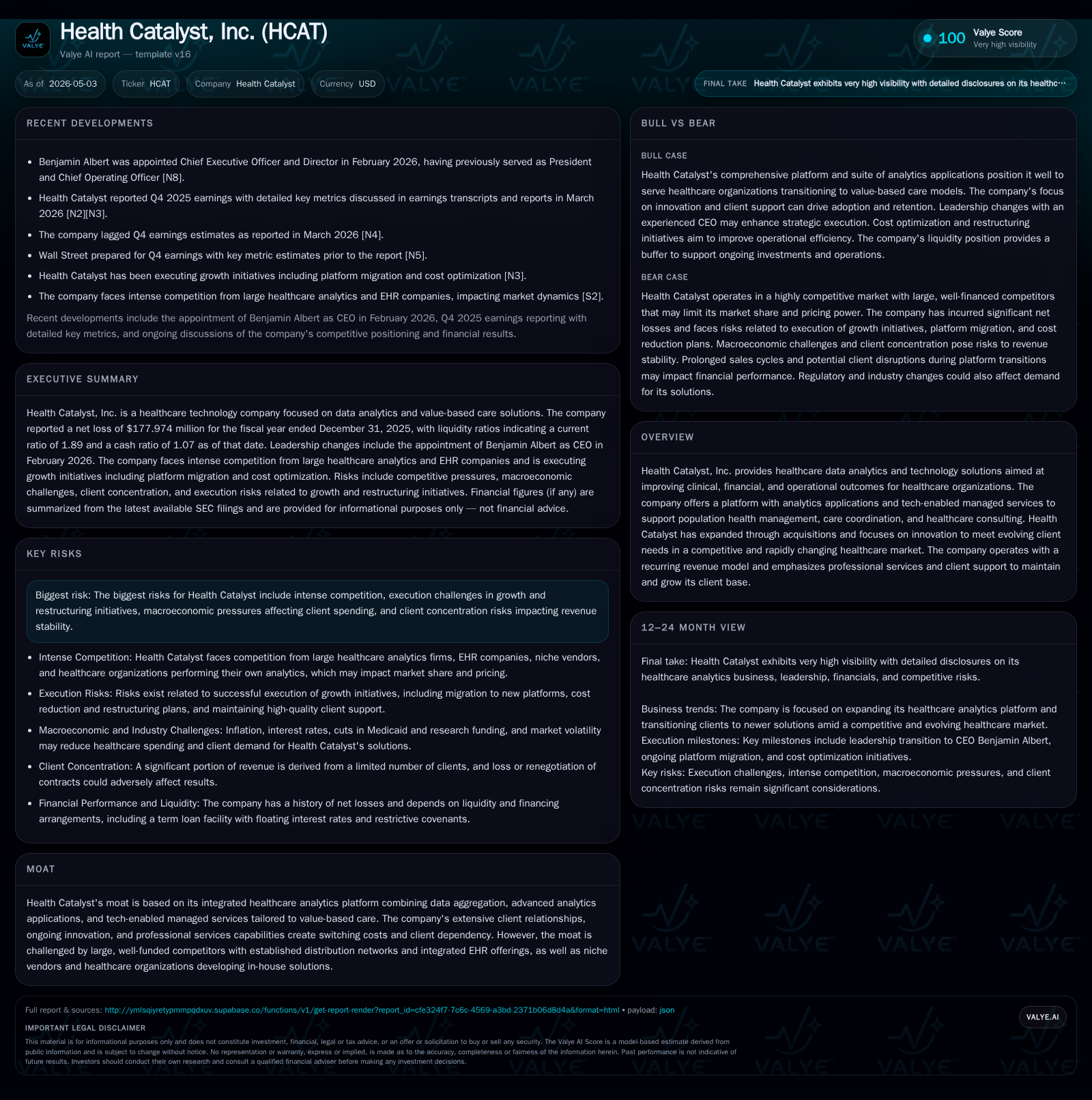
Health Catalyst’s latest 10-Q (November 2025) shows ongoing operational losses alongside increased leverage and liquidity constraints, underscoring tight capital flexibility. The company’s integrated platform combining analytics applications with managed services remains its strategic cornerstone amid fierce competition from large EHR vendors and specialized players. Growth is driven by rising demand for value-based care analytics, expanded services via acquisitions, and evolving regulatory mandates, though risks from execution complexity, client concentration, and interest rate exposure persist. Near-term milestones include consolidation of recent acquisitions and managing covenant compliance while pursuing innovation in population health management.
Operational Update from the Latest Quarterly Filing
Health Catalyst’s Q3 2025 filing (10-Q dated November 10, 2025) provides a pivotal snapshot of near-term operational realities. The company continues to operate at a significant net loss level, underscored by an operating loss approaching $161 million for the latest available fiscal year [F1]. Liquidity remains modest with cash and equivalents at just over $50 million against total current liabilities near $90 million—yielding a current ratio of approximately 1.89 [F1]. Total debt stood at roughly $161 million at year-end 2025 [F1]. This indebtedness exposes Health Catalyst to heightened interest rate risk due to floating SOFR plus 6.5% borrowing costs [S4][S5].
Operationally, these financial constraints coexist with heightened competitive pressures cited extensively within risk disclosures [S2], where the company stresses the necessity to continue innovating rapidly amid fast-changing client expectations and technology shifts. These factors collectively frame the immediate operational context as balancing aggressive innovation efforts while managing financial discipline.
Core Business Model and Solution Offering
Health Catalyst operates within an integrated healthcare data analytics framework that blends proprietary technology platforms with tech-enabled managed services and consulting capabilities tailored toward improving clinical outcomes and lowering healthcare costs [S1][S3]. Its solution suite comprises applications aimed at population health management, care coordination, clinical decision support, financial analytics, and broader operational efficiency improvements.
Revenue is primarily recurring through subscription licenses for software applications supplemented by professional services tied to deployment support, ongoing consulting engagements, and managed care facilitation [S1]. This hybrid model creates switching costs anchored both in technology integration within hospital workflows and ongoing advisory relationships. Its emphasis on enabling value-based care — where reimbursement increasingly depends on outcomes instead of volume — drives deepening client engagement. The company's "flywheel" concept stresses how team member engagement fuels client success which cyclically reinforces customer retention [S1].
This business model relies heavily on continued product innovation to maintain relevance amid evolving regulatory landscapes (e.g., increasing demands for quality reporting) while delivering measurable ROI for health systems seeking cost efficiencies without compromising care quality.
Competitive Landscape and Industry Positioning
Competition for Health Catalyst spans several fronts — large-scale electronic health record (EHR) vendors such as Epic Systems and Oracle Health command strong customer bases with bundled offerings tightly integrated into healthcare IT environments [S2][S27]. Additionally, Optum Analytics (UnitedHealth subsidiary) and IBM present formidable competition leveraging larger scale distribution channels and broader healthcare ecosystem footprints.
At the same time, numerous niche point-solution providers cater to specialized analytics or care coordination needs. Furthermore, some major health systems have invested heavily in developing internal analytic capabilities reducing reliance on third-party vendors. These overlapping competitive pressures limit pricing power across segments.
Despite these headwinds, Health Catalyst’s moat stems from its comprehensive platform approach — aggregating diverse clinical and financial data streams into unified dashboards combined with service delivery teams driving adoption [S2][S27]. This integrated solution supports complex workflows required for successful value-based care transitions that competitors offering more siloed or standalone solutions struggle to replicate adequately.
Regulatory dynamics also shape competitive advantages; as federal/state mandates increase reporting complexity or quality benchmarks tighten, vendors capable of rapid compliance enablement improve stickiness.
Key Growth Drivers Fueling Demand and Innovation
Several structural tailwinds support Health Catalyst’s medium-to-long-term growth projections. The accelerating adoption of value-based reimbursement models drives healthcare organizations’ need for sophisticated data insights beyond traditional fee-for-service analytics [S1][N1]. Population health initiatives that coordinate care across disparate providers require interoperable platforms like Health Catalyst’s to deliver actionable intelligence on patient risk stratification or outcomes measurement.
Acquisitions have expanded the breadth of Health Catalyst’s managed services portfolio enhancing scale effectivity in supporting complex client environments [S3]. These deals accelerate time-to-market for innovative capabilities but entail integration risks. Meanwhile, advancements in machine learning-driven predictive analytics applications are increasingly deployed for proactive patient interventions offering higher clinical impact potential.
Regulatory evolution — particularly around public payer programs — mandates more granular quality reporting incentivizing adoption of robust analytic tooling only offered by leading platforms. Demand intensifies for real-time actionable data which legacy EHRs often do not provide natively.
Risks and Constraints Impacting Strategic Progress
The latest filings highlight several critical cautionary points. Competition remains fierce with business threatened by larger players possessing more extensive financial firepower or entrenched channel relationships [S2]. Execution risks associated with integrating acquired assets could disrupt service delivery or delay realizing expected synergies [S3].
Macroeconomic uncertainties affect clients’ IT budgets possibly delaying purchasing or renewal cycles during contraction periods; this sensitivity constrains revenue visibility [S2][S6]. Client concentration poses risk since revenue dependence on a few large customers could materially impact financial stability if attrition occurs.
From a financial perspective, floating-rate debt exposes the company to rising interest expenses should SOFR increase further amid tightening monetary policy [S4][S5]. Negative profitability underscores ongoing challenges achieving sustainable earnings despite structural demand growth drivers.
Near-Term Milestones and What to Watch Next
Key upcoming indicators include successful integration progress updates relating to acquisitions first announced in the early months of 2026 filings ([S3] references imply recent corporate development activity). Market response through new client wins or renewals tied directly to enhanced solution offerings will gauge commercial momentum.
Product announcements focused on extending population health capabilities remain crucial as they signify technological leadership adaptation amidst evolving client needs.
Additionally, attention should be paid to commentary on macroeconomic trends influencing hospital IT spend patterns given their outsized impact on ordering behavior reflected in future results. Management’s articulation on cost discipline initiatives or margin improvement pathways will provide color on sustainability prospects beyond top-line expansion.
Financial Summary: Liquidity, Leverage, and Profitability
As reflected in year-end figures reported through the 10-K filed March 12, 2026 [F1], Health Catalyst maintains moderate liquidity with cash and equivalents of approximately $51 million and total current liabilities near $90 million, resulting in a current ratio of about 1.89. Total debt stood at roughly $161 million at year-end 2025, with net debt near $110 million after accounting for cash reserves [F1]. Operating income remains deeply negative due partly to continued investment in technology development along with sales and marketing spending necessary to sustain competitive positioning [F1].
Debt arrangements bear comparatively high interest rates linked to SOFR plus premium spreads that increase financing costs sensitivity amid market rate volatility [S4][S5]. Negative profitability underscores ongoing challenges achieving sustainable earnings despite structural demand growth drivers.
This financial profile demands disciplined cash flow management aligned with measured growth investing while carefully navigating debt servicing obligations under restrictive lending terms.
This analysis is based exclusively on information reported through official SEC filings up to April 30th, 2026 and publicly available news sources as cited. It aims to synthesize Health Catalyst's operational context without providing investment advice.
Disclaimer: This is research-only, informational analysis and not investment advice. It may include AI-generated interpretation and general industry context. Always verify important details using primary sources.

Comments