
Skyworks Solutions Advances RF Leadership with Strategic Moves and Solid Q2 Performance
The company reported robust Q2 2026 results alongside a key stockholder vote approving merger-related stock issuance, signaling strategic momentum.
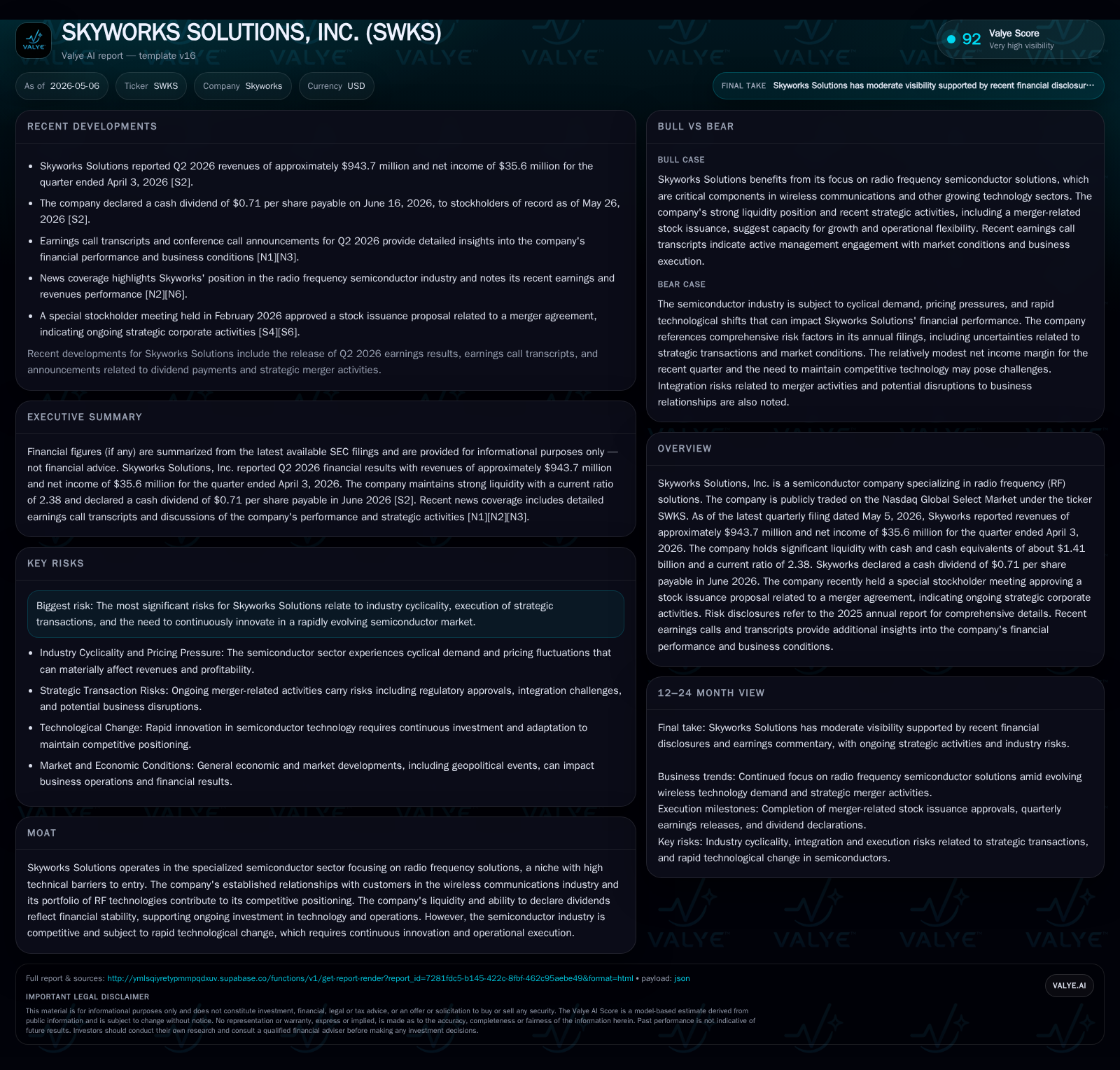
Skyworks Solutions delivered $943.7 million in revenue and $35.6 million in net income for Q2 2026, supported by strong liquidity and a stable financial position. The recent approval of stock issuance associated with a merger agreement marks an important step toward expanding scale and market presence in the RF semiconductor niche. Skyworks remains well-positioned within the wireless communications ecosystem, leveraging advanced RF component design and OEM partnerships amid evolving 5G/6G demand. Key growth drivers include technology innovation, rising wireless infrastructure investments, and potential merger synergies. Risks center on semiconductor cyclicality and execution challenges related to the pending transaction.
Latest Quarterly Results and Strategic Corporate Actions
Skyworks Solutions reported its fiscal second quarter ending April 3, 2026 revenues of $943.7 million alongside net income of $35.6 million reflecting continued operational strength within its targeted radio frequency semiconductor market segment [S2]. On May 5, 2026, the company’s special stockholder meeting approved key proposals for issuing common stock related to its ongoing merger agreement with Qorvo Inc., signaling a critical advancement in Skyworks' strategic corporate transformation efforts [S3,S11]. This event integrates capital-raising initiatives required for the anticipated deal closure while illustrating investor alignment with long-term scale ambitions.
Skyworks’ Business Model and Product Portfolio in RF Semiconductors
Skyworks monetizes primarily through designing, manufacturing, and selling high-performance RF components that serve as essential building blocks for wireless communication devices across multiple verticals such as smartphones, network infrastructure equipment (base stations), automotive systems including advanced driver-assistance systems (ADAS), and Internet of Things (IoT) applications [S1]. The company’s product portfolio includes power amplifiers, switches, filters, front-end modules, and integrated subsystems that help optimize signal fidelity and efficiency—an area requiring deep domain expertise given stringent size constraints and power consumption targets.
Its business model leverages durable design wins secured with major OEMs globally where customization demands elevate switching costs significantly due to embeddedness within device architectures. This technical complexity imposes high barriers for competitors attempting to displace Skyworks’ solutions post-integration. Moreover, dividend payments remain consistent (latest declared dividend is $0.71 per share payable June 2026), underscoring confidence in steady cash flows amid semiconductor sector cyclicality [S3,N1].
Industry Dynamics and Competitive Positioning in Wireless Components
Within the specialized RF semiconductor niche—a subset defined by rapid innovation cycles driven by ever-evolving wireless standards including pervasive deployment of 5G networks now advancing towards early development stages of 6G—the competitive landscape pressures suppliers like Skyworks to continually enhance product performance while managing cost structures tightly [S1,S4]. Supplier capacity constraints elsewhere in the semiconductor supply chain create both bottleneck risks but also opportunities for companies holding flexible scale or diverse manufacturing capabilities.
Competition centers around other specialized RF players including Qorvo—the merger counterpart—and Broadcom among others seeking greater scale economies amidst consolidations reshaping industry structure [N8,N9]. Regulatory scrutiny linked to antitrust reviews accompanies these M&A activities given their potential market impact [S11]. Maintaining technology leadership hinges on controlling intellectual property breadth while securing ecosystem partnerships that facilitate seamless interoperability with rising complex device demands.
Growth Drivers: Technology Innovation, Market Demand, and M&A Potential
Skyworks’ growth trajectory is anchored in several structural tailwinds: first is the broadening application of RF technology beyond traditional mobile telecom into automotive electronics where sensor fusion demands elevated RF front-end performance; second is IoT proliferation requiring diverse connectivity solutions often involving customized low-power wide-area networks; third involves adoption of advanced semiconductor process nodes and heterogeneous integration packaging innovations that promise improved functional density enabling new device form factors [N10,S4].
Key corporate growth enabler remains the pending merger with Qorvo which anticipates generating synergies through combined R&D investments, expanded product breadth especially in complementary frequency bands/subsystems, reduced redundancies yielding cost improvements potentially enhancing margin profiles over time [S4,N10]. Analysts have noted this consolidation could reshape competitive dynamics further favoring larger industry players able to absorb capital-intensive innovation cycles.
Risks and Constraints: Industry Cyclicality, Transaction Execution, and Competitive Pressure
The semiconductor industry’s inherent cyclicality exposes Skyworks to fluctuations in end-demand driven by macroeconomic conditions impacting OEM order cycles for smartphones and network infrastructure upgrades [S5]. Execution risk surrounding the completion of the Qorvo merger remains material given regulatory hurdles still outstanding alongside integration complexities that could disrupt existing customer relationships or operational continuity [S5,S11].
Additional pressure arises from rapid technological progress necessitating sustained R&D outlays; failure to innovate effectively or loss of key personnel could impair competitive standing. Pricing pressure from rivals or shifts in customer sourcing strategies could compress profitability particularly should competitors develop disruptive alternatives targeting similar applications [S5,N6]. Furthermore regulatory developments around mergers pose uncertain timing variables which investors monitor closely.
Upcoming Catalysts: Integration Plans, Product Launches, and Guidance Updates
Investors should track critical milestones such as regulatory antitrust clearance timelines relevant to finalizing the Qorvo acquisition that will substantively impact strategic direction forthcoming quarter [S3]. Product pipeline announcements aligned with emerging wireless standards—particularly early implementations of 6G technologies—will offer insights on Skyworks’ ability to sustain momentum post-merger integration [N3,S3]. Management commentary during subsequent earnings calls may also revise guidance reflecting initial merger-related cost synergies or restructuring expenses providing further visibility into medium-term financial outlook.
Financial Snapshot: Liquidity, Profitability, and Capital Structure
Liquidity remains robust with cash and cash equivalents at approximately $1.41 billion and a current ratio of 2.38 evidencing balance sheet strength not commonly seen in cyclical chipmakers [F1].
Latest financial snapshot
| Metric | Value | Period |
|---|---|---|
| Cash & equivalents | $1413mm | |
| 2026-04-03 | ||
| Current assets | $3.1bn | |
| 2026-04-03 | ||
| Current liabilities | $1316mm | |
| 2026-04-03 | ||
| Current ratio | 2.38x | |
| 2026-04-03 |
Source: SEC companyfacts cache [F1].
Disclaimer: This analysis is intended solely for informational purposes grounded on publicly available filings and does not constitute investment advice or recommendations regarding Skyworks Solutions securities or financial instruments.
Disclaimer: This is research-only, informational analysis and not investment advice. It may include AI-generated interpretation and general industry context. Always verify important details using primary sources.

Comments