
Ally Financial Boosts Revenue and Controls Costs in Q1 2026
Strong first-quarter results underscore Ally’s underwriting prowess and cost discipline amid automotive finance market shifts.
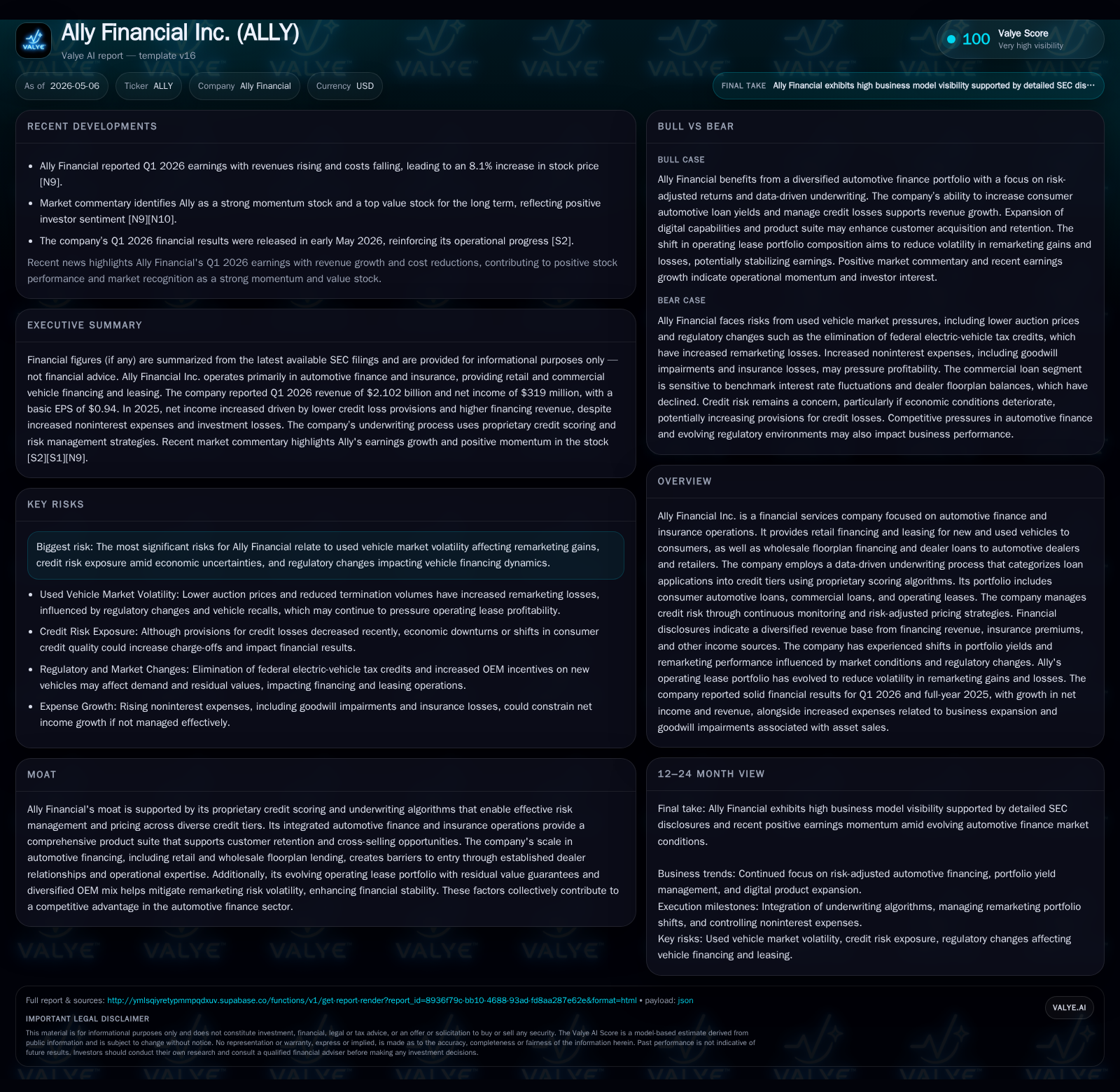
In Q1 2026, Ally Financial demonstrated notable revenue growth paired with effective cost management, signaling operational resilience. The company’s proprietary credit scoring and diversified automotive finance and insurance offerings continue to underpin its competitive moat. However, risks from used vehicle remarketing volatility and credit losses persist, necessitating close monitoring of macroeconomic influences and regulatory developments. Planned funding initiatives including Series D preferred issuance add strategic financial flexibility heading into upcoming quarters.
Q1 2026 Operating Performance: Key Developments
Ally Financial’s first quarter of 2026 reveals an encouraging operational performance marked by revenue growth coupled with disciplined cost control. The company reported higher total operating revenues compared to prior periods, indicating steady demand for its core automotive financing products despite macroeconomic uncertainties [S2]. Simultaneously, noninterest expenses were managed tightly with slight reductions in compensation costs and other operating expenses.
Critically, the provision for credit losses showed marked improvement relative to prior quarters reflecting continued portfolio quality supported by data-driven underwriting practices. Remarketing outcomes on off-lease vehicles exhibited areas of challenge due to fluctuating used car prices; however, diversification across OEMs and lease residual value guarantees mitigated adverse impacts somewhat [S2]. These results affirm Ally’s balanced approach to managing earnings volatility inherent in automotive finance.
Business Model Overview: Automotive Financing and Insurance
Ally operates principally across retail consumer automotive loans, commercial dealer floorplan financing, operating lease assets, and insurance operations providing vehicle-related protection products. The company’s revenue mechanics revolve around net interest income generated from financing receivables (including loan originations and held portfolios), fee-based income from insurance premium collection, and gains or losses linked to vehicle remarketing activities post-lease term or default.
A distinctive strength lies in Ally’s proprietary underwriting framework that segments borrowers into credit tiers via advanced scoring algorithms. This segmentation allows precise risk-adjusted loan pricing aligned with expected loss profiles; consequently enhancing returns while controlling credit risk exposure [S1]. Additionally, the integration of financing with insurance services enables cross-selling opportunities that improve customer retention and expand wallet share.
Competitive Positioning Within the Automotive Finance Industry
Ally benefits from scale advantages which manifest through its expansive dealer network relationships servicing thousands of automotive retailers nationwide. This entrenched position erects tangible barriers to entry for smaller competitors lacking extensive floorplan lending capabilities or robust remarketing infrastructure.
The firm’s capability to manage remarketing residual risk effectively—via a diversified operating lease portfolio backed by guaranteed residual values—and a mix of OEM partnerships leads to more stable cash flows amid used vehicle price volatility. Furthermore, Ally's investment in technology-driven underwriting differentiates it by enabling quicker decision-making and tighter risk control than many traditional lenders.
However, competitiveness remains contingent upon navigating external pressures such as auction market dynamics affecting off-lease vehicle resale values and regulatory scrutiny on lending standards.
Growth Drivers: Technology, Product Diversification, and Dealer Relationships
Growth at Ally is structurally supported by continual enhancements in data analytics powering more granular credit decision-making which promotes lower loss rates while expanding approval windows. The expansion of operating leases with better residual value management models presents an avenue for recurring yield plus long-term customer engagement.
Additionally, insurance operations benefit from growing volumes in ancillary products like Guaranteed Asset Protection (GAP) coverage alongside vehicle inventory insurance tied closely to dealer partners’ risk management needs [S2]. Strategic collaboration with automotive dealers facilitates deeper penetration into both prime and subprime consumer segments leveraging flexible product suites tailored to evolving customer preferences.
Accordingly, these factors culminate in durable demand drivers largely insulated from short-cycle economic fluctuations given their embeddedness within new vehicle buying processes.
Risks and Constraints: Market Volatility, Credit Exposure, and Regulation
The primary operational risks for Ally reside in the inherent volatility of the used car market which directly affects the profitability of remarketing activities post-lease or repossession. Significant declines in auction prices can exacerbate losses despite mitigation efforts via residual value guarantees.
Credit risk exposure remains notable especially amid rising interest rates or economic downturn scenarios which could elevate delinquencies or defaults within the consumer auto loan segment. Though Ally employs scenario analyses mirroring Federal Reserve Board severe downturn assumptions along with conservative underwriting limits especially in high-risk pools like nonprime borrowers [S1], adverse macro shifts cannot be fully ruled out.
From a regulatory perspective, evolving consumer protection laws or capital adequacy rules may impose additional costs or constrain product design flexibility.
Upcoming Catalysts and Monitoring Points
Investors should focus on key indicators such as subsequent quarter earnings releases emphasizing credit loss trends amid ongoing economic shifts. Remarketing price trajectories remain crucial as do changes in vehicle lease originations driven by consumer buying patterns or OEM incentives.
Monitoring progress on funding strategy is also essential particularly regarding additional issuances or redemptions related to the recently announced Series D Preferred Stock offering which introduces fixed-rate perpetual equity-like capital enhancing financial flexibility without near-term mandatory redemption obligations [S3].
Updates on regulatory guidance impacting capital buffers or lending practices will also shape medium-term outlooks.
Latest Financial Snapshot
Latest financial snapshot
| Metric | Value | Period |
|---|---|---|
| Cash & equivalents | $9.5bn | |
| 2026-03-31 | ||
| Total debt | $17.3bn | |
| 2026-03-31 | ||
| Net debt | $7.8bn | |
| 2026-03-31 |
Source: SEC companyfacts cache [F1].
| Metric | Amount (USD) |
|---|---|
| Cash & Equivalents | $9.52 billion |
| Total Debt | $17.35 billion |
| Net Debt | $7.83 billion |
This balance sheet positioning as of March 31, 2026 reflects a healthy liquidity buffer supporting ongoing loan origination capacity while maintaining a balanced leverage profile suited for an investment-grade rated financial institution [F1].
This analysis synthesizes the latest quarterly disclosures along with annual filing context to provide an integrated perspective on Ally Financial Inc.'s operational status within the evolving automotive finance landscape. It is intended solely for informational purposes without expressing investment advice or recommendations.
Disclaimer: This is research-only, informational analysis and not investment advice. It may include AI-generated interpretation and general industry context. Always verify important details using primary sources.

Comments