
Masimo Corp Advances Healthcare Monitoring with Strategic Merger and Platform Focus
Latest quarterly report highlights Masimo’s healthcare-centric operating model and strong cash position amid impending merger with Danaher.
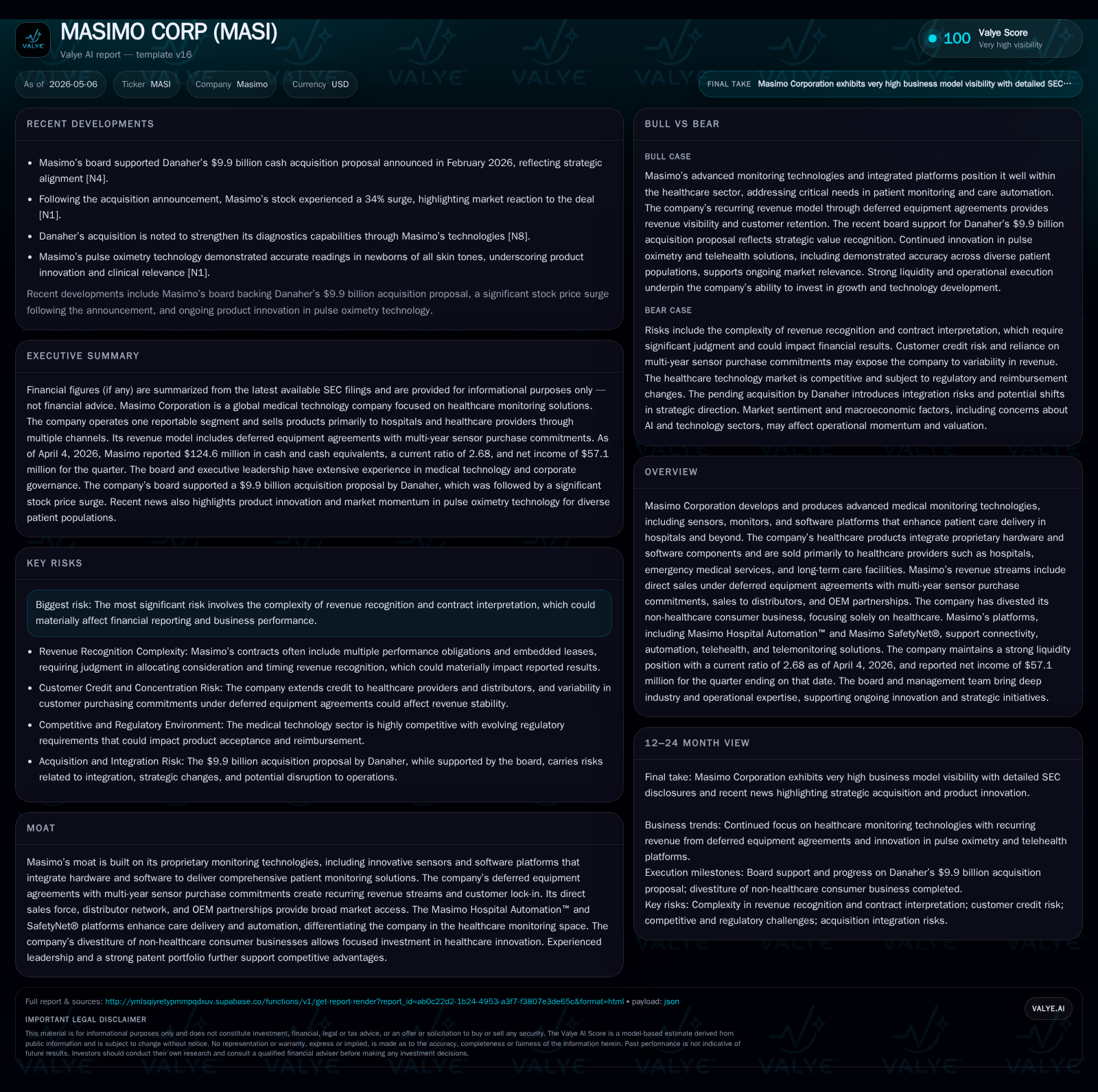
Masimo Corporation’s Q1 2026 filing confirms its focus on healthcare monitoring technologies powered by integrated hardware-software platforms such as Masimo Hospital Automation™ and SafetyNet®. The company operates a single healthcare segment, having divested non-healthcare consumer products, with revenue driven by deferred equipment agreements and multi-year sensor purchase commitments. In early May 2026, shareholders approved a pending acquisition by Danaher Corporation expected to reshape Masimo’s market positioning. Despite merger-related expenses, Masimo maintains robust liquidity (current ratio 2.68) and zero net debt, underpinning operational resilience. The firm’s moat stems from proprietary sensor technology, recurring revenue contracts, and telehealth integration, but contract complexity and regulatory approvals remain watchpoints.
Recent Operating Update
Masimo Corporation’s latest quarterly report (10-Q filed May 5, 2026 [S2]) highlights continued execution on its healthcare-only strategy. The company operates one reportable segment—healthcare—after divesting non-healthcare consumer businesses. It develops leading-edge patient monitoring devices including sensors, monitors, and integrated software platforms.
A major near-term development is shareholder approval of an all-cash merger agreement with Danaher Corporation on May 1, 2026 [S3][S20][S23]. This transaction is expected to complete during calendar 2026 pending regulatory approvals and customary closing conditions. With over 36 million votes for the merger agreement versus just under 18 thousand against, the vote was strongly supportive. Post-close, Masimo will be delisted from Nasdaq.
Merger-related advisory, legal, accounting fees elevated selling, general & administrative expenses by approximately $17.9 million in Q1 [S23]. Despite this one-time cost pressure, the firm reported net income from continuing operations of $56.3 million for the three months ended April 4, 2026 [S2].
Financial assets as of January 3, 2026 include $55.5 million cash and equivalents classified as Level 1 fair value plus $96.8 million in money market funds [S2]. There is zero reported total debt as of December 31, 2016 per company facts [F1], which combined with sizable cash holdings results in a net cash position of approximately $124.6 million at quarter end April 2026 [F1]. Current assets totaled $870.5 million against current liabilities of $325.4 million for a healthy current ratio of about 2.68 [F1]. These figures underpin strong liquidity despite increased merger integration spending.
Business Model
Masimo generates revenue primarily through direct sales under deferred equipment agreements paired with long-term sensor purchase commitments by hospitals and other healthcare providers. This structure creates recurring revenue streams facilitated by proprietary sensor replacements essential for accurate patient monitoring continuity.
Its hardware product suite encompasses advanced pulse oximeters and other vital signs monitors leveraging patented signal processing technologies that enhance clinical accuracy compared to competing products. The company further differentiates itself through proprietary software platforms—namely Masimo Hospital Automation™ and Masimo SafetyNet®—which connect medical devices into enterprise-level monitoring networks supporting automation workflows and telemonitoring beyond hospital walls [S2].
Distribution channels include a direct sales force targeting hospitals and EMS providers worldwide complemented by a network of distributors and Original Equipment Manufacturer (OEM) partnerships that embed Masimo sensors into third-party devices.
Strategically focusing solely on healthcare since exiting consumer audio businesses concentrates R&D resources on innovations that improve patient outcomes across acute care facilities as well as remote monitoring scenarios relevant to telehealth growth.
Industry Structure and Competitive Position
Masimo operates within the competitive med-tech sector dominated by specialized device makers who combine hardware innovation with software-enabled clinical insights. Its main competitors include companies such as Medtronic, Philips Healthcare, Dräger Medical, Nihon Kohden among others specializing in critical care monitoring.
The heart of Masimo’s moat is its proprietary sensing technology initially pioneered via Signal Extraction Technology (SET®) pulse oximetry that delivers superior performance particularly under challenging clinical conditions like motion or low perfusion. By developing both core technology components and scalable software platforms integrating across multiple care settings, Masimo secures high switching costs for customers reluctant to disrupt established workflow ecosystems.
Recurring revenue via multi-year sensor purchase contracts reduces volatility associated with transactional sales alone while providing ongoing touchpoints for system upgrades or cross-selling complementary products.
OEM partnerships expand market reach beyond direct sales territories enabling embedded use cases in diversified medical devices thereby broadening adoption without extensive Masimo brand presence required.
Growth Drivers
Key catalysts for Masimo’s future growth center on expanding adoption of digital health tools within hospital infrastructures alongside rising demand for remote patient monitoring post-discharge or in chronic disease management contexts:
- Telemonitoring Expansion: Growth in telehealth amplified during the COVID-19 pandemic continues driving investments into remote patient surveillance capabilities where Masimo’s SafetyNet® platform facilitates timely alerts outside hospital environments.
- Hospital Automation: Health systems aim to reduce clinician workload while improving alarm accuracy; Masimo Hospital Automation™ solutions address this by consolidating device data streams into intelligent monitoring alert frameworks supporting rapid clinical responses.
- Technology Innovation: Ongoing R&D efforts improve measurement accuracy (e.g., recent studies showing reliable pulse oximetry readings across diverse skin tones [N2]) fostering broader clinical indication expansions.
- Direct Sales Optimization & Global Penetration: Strengthening relationships with large hospital systems via customized deferred equipment contracts locks in long-term sensor revenues while expanding geographic footprint through distributor partnerships fuels incremental market share gains.
- OEM Collaboration: Embedding proprietary sensors into third-party devices opens new end-markets including emergency medical services equipment enhancements accelerating overall sensor unit volumes.
Risks & Watchpoints
Despite strengths there are notable areas warranting caution:
- Revenue Recognition Complexity: Diverse deferred equipment contracts combined with multi-year consumable sensor pledges require intricate revenue accounting interpretations which could impact reported financial results if assumptions or estimates change materially.
- Regulatory & Merger Approval Risks: Completion of the Danaher acquisition hinges on satisfying regulatory requirements; unforeseen delays or imposed conditions could defer or complicate deal closure impacting strategic plans [S8].
- Integration Costs & Distractions: Elevated administrative expenses due to merger activities may divert management focus from core innovation or market development priorities temporarily affecting execution velocity.
- Competitive Pressures: Advances by well-funded rivals developing alternative sensing technologies or comprehensive patient management suites could erode differentiation premiums over time.
- Pricing Dynamics: Hospitals under cost containment pressures may challenge pricing power on equipment or consumables despite differentiated technology advantage.
What to Watch Next
Investors should monitor several pivotal developments going forward:
- Merger Closing Milestones: Timely receipt of necessary regulatory approvals enabling Danaher acquisition completion remains central to near-term corporate outlooks.
- Post-Merger Integration Plans: Execution quality around combining sales forces, product roadmaps, R&D organizations will impact longer-term value creation potential.
- Platform Adoption Rates: Indicators such as backlog growth for Hospital Automation™ deployments or SafetyNet® subscriber expansions provide visibility into organic demand trends.
- Clinical Validation Outcomes: Continued publication of peer-reviewed data enhancing product credibility especially regarding accuracy improvements across patient demographics can support premium pricing sustainability.
- Financial Metrics Stability: Tracking gross margin trends amid integration costs plus recurring revenue contribution mix evolution will shed light on operational leverage progression.
Financial Snapshot from Latest Quarter (Q1 FYE Jan ‘26) [S2][F1]
Latest financial snapshot
| Metric | Value | Period |
|---|---|---|
| Cash & equivalents | $125mm | |
| 2026-04-04 | ||
| Current assets | $871mm | |
| 2026-04-04 | ||
| Current liabilities | $325mm | |
| 2026-04-04 | ||
| Current ratio | 2.68x | |
| 2026-04-04 |
Source: SEC companyfacts cache [F1].
*Note: No recent debt reported; historical figure used as best effort info.[F1]
Masimo maintains a net cash position given zero debt offsets against significant cash balances supporting liquidity amid planned investment spend related to integration costs approximating $17.9 million in Q1 alone linked to the Danaher transaction [S23]. The absence of borrowing provides financial flexibility while retaining low leverage risk profiles valuable in capital-intensive med-tech sectors.
Disclaimer
This analysis is intended solely for informational purposes reflecting SEC filings and publicly available data without providing any investment advice or endorsements regarding securities transactions involving Masimo Corporation or associated entities.
Disclaimer: This is research-only, informational analysis and not investment advice. It may include AI-generated interpretation and general industry context. Always verify important details using primary sources.

Comments