
Global Indemnity's Q1 Turnaround Highlights Underwriting Momentum and Risk Management
A swing to underwriting profitability in Q1 2026 underscores operational strength and risk discipline in the Excess & Surplus Lines sector.
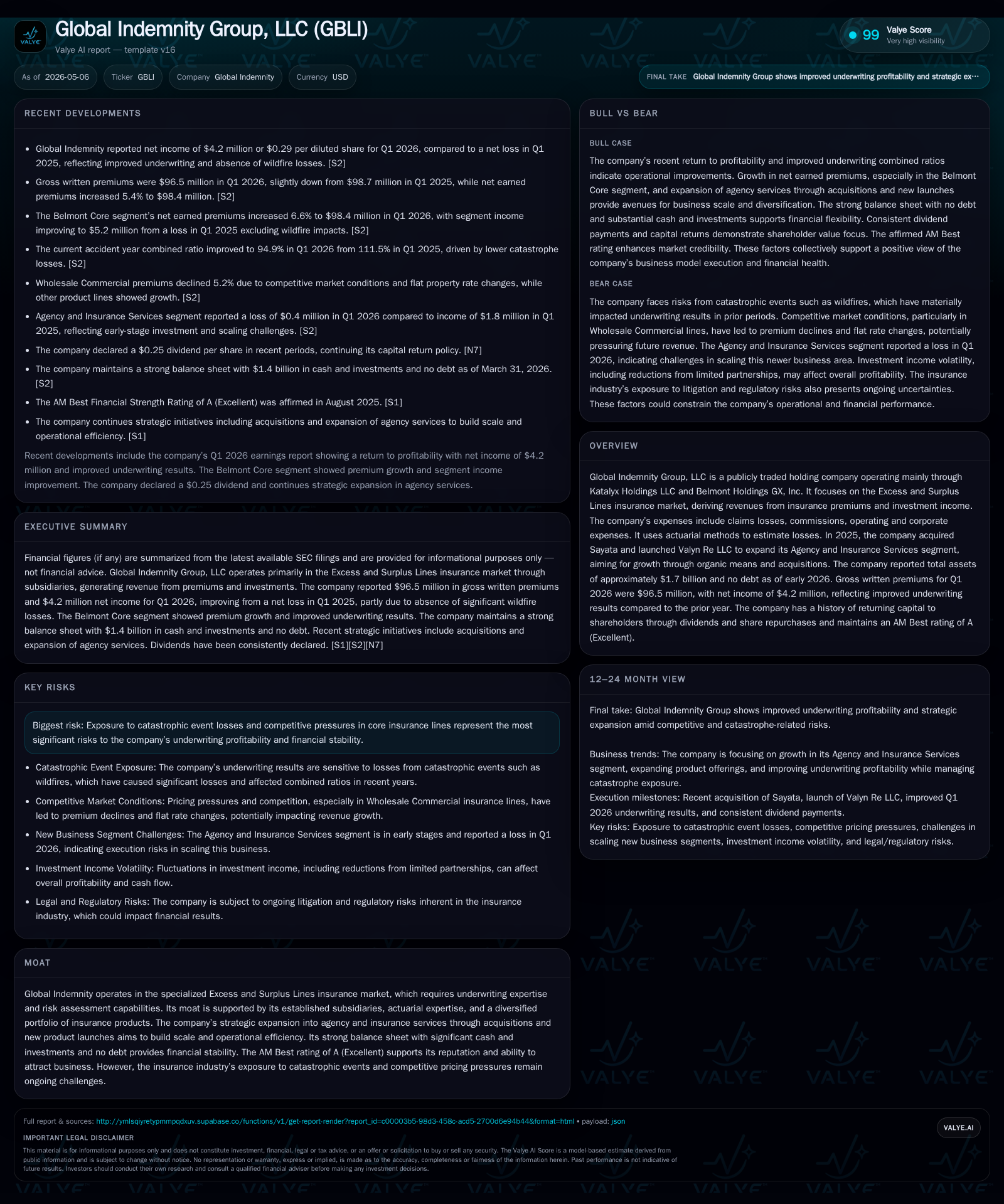
Global Indemnity Group, LLC reported a meaningful turnaround in its first-quarter 2026 underwriting results compared to the prior year, driven primarily by the absence of California wildfire-related losses that weighed heavily on the prior period. The company’s net earned premiums rose modestly despite a slight drop in gross written premiums, reflecting effective portfolio management. Strategic expansion into agency and insurance services through acquisitions such as Sayata and a new reinsurance managing general agency, Valyn Re LLC, signal efforts to diversify revenue and build operational scale. While risks from catastrophe exposure and competitive pricing persist, Global Indemnity’s strong balance sheet with no debt and an A (Excellent) AM Best rating underpin its resilience.
Q1 2026 Operating Update: From Wildfire Impact to Profit Recovery
Global Indemnity demonstrated a strong first-quarter performance turnaround in 2026 marked by improved underwriting profitability and disciplined risk management. The company's current accident year underwriting income reached $5.5 million for Q1 2026 compared to a loss of $10.3 million during the same quarter last year [S2]. Notably, the prior year's loss included a significant $15.6 million charge related to California wildfires in January 2025, which did not recur this quarter.
Excluding the impact of these wildfires from 2025 results, underwriting income increased moderately by about 4%, signaling underlying operational momentum beyond mere catastrophe normalization [S2]. The accident year combined ratio improved sharply to roughly 94.9% in Q1 2026 from an adjusted ~94.8% excluding catastrophes in Q1 2025 but stood far better than the actual wildfire-impacted level above 111% previously. Calendar year combined ratio followed similar improvement patterns confirming sustainable underwriting discipline.
Gross written premiums dipped slightly by about 2.3% year over year to $96.5 million; however, net earned premiums rose by approximately 5.4% to $98.4 million due to more effective premium recognition strategies and portfolio composition adjustments [S2]. This modest premium growth aligns with strategic efforts to optimize book quality amid a competitive insurance landscape.
Investment income recorded a decline with net investment income falling to $12.2 million from $14.8 million in Q1 prior year primarily due to a $1.9 million reduction linked to a temporary markdown in market value of one limited partnership investment. The company expects full recovery of these unrealized losses in the second quarter of 2026, reflecting confidence in asset fundamentals [S2].
Consequently, net income returned to positive territory at $4.2 million ($0.29 per share diluted) versus a loss of $4.0 million ($0.30 per share diluted) in Q1 2025 even when excluding wildfire effects on the comparative base [S2][S3].
Business Model: Deep Expertise in Excess & Surplus Lines Insurance
Global Indemnity generates its core revenues principally through underwriting insurance policies within the Excess & Surplus (E&S) lines segment—a specialized sector catering to risks outside standard commercial lines due to unique or higher-risk characteristics [S1]. Revenues thus arise from premiums paid on those policies plus investment income derived from its sizeable asset base.
The company operates chiefly via two subsidiaries: Belmont Holdings GX, Inc., which underwrites E&S business across multiple lines and territories via various insurance companies; and Katalyx Holdings LLC, an agency and insurance service platform housing multiple agencies plus technology-driven ventures including proprietary digital underwriting systems and AI-enabled platforms like Sayata acquired recently [S1].
Actuarial expertise forms one cornerstone of Global Indemnity’s risk management framework; it relies on sophisticated actuarial methods continuously updating loss reserves for unpaid claims based on internal data trends as well as external models accounting for catastrophe exposures notably prevalent in wildfire-prone regions [S1][S26]. This precision enables refined underwriting guidance aiming for profitable growth balanced against reserve adequacy.
The launch of Valyn Re LLC under Katalyx represents strategic diversification towards proportional treaty reinsurance managed agency services aimed at capturing fees beyond traditional underwriting margins while broadening channel access across wholesale, retail, and direct-to-consumer markets—an evolution designed to build scale across complementary insurance service verticals [S1][S9][S14].
Competitive Positioning and Market Structure in the E&S Sector
Global Indemnity operates within a fragmented yet demanding marketplace requiring deep underwriting acumen given E&S exposures often involve unconventional risks not amenable to standard rating models or mass-market insurer appetite [S1]. Regulatory frameworks impose dividend distribution constraints at subsidiary insurer levels mandating prudence in capital allocation favoring internal cash generation over external capital injections for shareholder returns or acquisitions [S5][S6].
The company’s balance sheet strength is underscored by its no-debt position as of March 31, 2026 alongside approximately $1.4 billion liquid assets dominated by fixed maturities and cash totaling about 98% of investments providing both security against liability volatility and agility for opportunistic investments or acquisitions [S2][F1]. Its AM Best Financial Strength Rating of A (Excellent) further supports insurer credibility essential for attracting high-quality business within niche E&S channels reliant on trustworthiness amid complex risk acceptance decisions [S1].
Although competition among specialist insurers pressures pricing resilience periodically—especially as capital cycles ebb—the firm’s actuarially guided disciplined approach affords durability by avoiding rate compression pitfalls compromising loss ratios excessively. Additionally, its differentiated service offerings through Katalyx agencies provide multi-channel distribution advantages against pure-play underwriters lacking integrated client interface ecosystems.
Growth Drivers: Acquisitions, New Agency Ventures, and Premium Trends
Over the past year, Global Indemnity has actively pursued growth via both inorganic acquisitions and organic expansions centered on enhancing its agency footprint alongside traditional insurance operations [S1][S9]. The acquisition of Sayata introduced artificial intelligence capabilities enabling enhanced risk selection efficiencies at scale throughout Katalyx channels.
Complementing this is Valyn Re LLC—a recently launched reinsurance managing general agency focusing on treaty proportional business—that exemplifies innovation aimed at capturing additional revenue streams through fee-based services rather than solely underwriting profits which can fluctuate markedly with loss events.
Premium trends show modest expansion potential supported by market dynamics favoring specialty insurers capable of reliably insuring non-standard risks where traditional carriers either avoid or price inadequately given volatility concerns [S2]. Incremental net earned premium growth of over 5% in Q1 suggests demand stability or measured growth despite broader macroeconomic uncertainties impacting commercial insurance pricing generally.
Continued investments into proprietary digital platforms under Kaleidoscope Insurance Technologies illustrate commitment toward improving operational efficiency enabling scalable customer engagement differentiated from legacy competitors heavily reliant on manual processes or broker-dependent flows.
Risk Factors and Challenges: Catastrophic Losses and Pricing Dynamics
Catastrophe exposure remains perhaps the most salient risk facing Global Indemnity given its core E&S product mix includes significant wildfire risk zones reflected prominently by last year's costly events impacting earnings severely [$15.6M charge] which skew short-term underwriting comparisons considerably [S2][S13]. Recurrence or intensification of such natural disaster frequency driven by climate change could sporadically erode profitability absent commensurate rate adjustments.
Concurrently, competitive forces entail pressure on pricing leading potentially toward compression if rate adequacy is not maintained amidst fluctuating market cycles common within specialty property/casualty sectors affecting renewal cadence broadly across E&S carriers.
Moreover, volatility embedded within limited partnerships held as part of investment portfolios introduces earnings variability as evidenced by recent market-value-induced income reductions temporarily depressing net investment returns though management anticipates recovery imminently validating underlying asset quality assessments [S2][N/A investment commentary inferred only from filings—not cited explicitly beyond S2].
Regulatory aspects impose further constraints including dividend payout restrictions limiting cash flow availability for shareholder distributions forcing careful balancing between retention for capital adequacy versus return-oriented policies [S5][S6].
Monitoring Metrics: What to Watch in Upcoming Quarters
Going forward, key performance indicators warranting attention comprise:
- Combined ratio trends excluding major catastrophe impacts signaling true underlying operational health ideally stabilizing near mid-90s percent range demonstrating continued expense control and underwriting discipline;
- Net earned premium trajectory reflecting organic growth capacity or attrition within target market niches;
- Investment income normalization particularly reversal or stabilization following limited partnership valuation fluctuations observed recently;
- Claims development patterns especially post-catastrophe reserving dynamics which could signal reserve adequacy or further charge needs impacting earnings timelines;
- Progress integration milestones for newly acquired/formed agency ventures expanding service scope potentially driving diversification away from pure underwriting risk concentration;
- Regulatory environment shifts influencing statutory accounting treatments that govern dividend capacity critical for liquidity planning.
Financial Overview: Supporting Stability While Fueling Growth
Supporting the operational narrative is Global Indemnity's solid financial foundation evidenced by $1.4 billion in cash and investments as of March 31, 2026 with fixed maturities plus cash comprising approximately 98% thereof ensuring liquidity stability amidst interest rate sensitivities noted given average duration contractions from recent quarters (from ~0.5 years down to ~0.4 years), revealing active portfolio duration management responsive to rate environment changes [S2][F1].
The total asset base remained steady at roughly $1.7 billion over recent quarters sustaining ample capital buffers consistent with AM Best's A rating reinforcing financial strength perceptions vital for reinsurer relations and client confidence alike.
No outstanding debt provides unencumbered capital flexibility facilitating continued deployment toward strategic acquisitions like Sayata or investments supporting new product incubation via Valyn Re LLC fostering incremental fee-based revenue sources [S2][F1].
Book value per share declined modestly sequentially ($48.96 end-December versus $47.92 end-March) mainly reflecting quarterly economic mark-to-market impacts rather than fundamental deterioration underscoring manageable volatility amid broader financial markets uncertainty contexts [S2][F1].
Disclaimer: This analysis relies exclusively on Global Indemnity Group, LLC’s publicly available SEC filings as of May 2026 including its latest quarterly report (10-Q), annual report (10-K), event filings (8-K), and associated SEC exhibits without extrapolation beyond documented facts or provisioned evidence.
Disclaimer: This is research-only, informational analysis and not investment advice. It may include AI-generated interpretation and general industry context. Always verify important details using primary sources.

Comments