
Talen Energy Advances Multi-Year Revenue Visibility with Robust PJM Market Position and Hedging Strategy
Q1 2026 results highlight Talen Energy's ability to navigate commodity price volatility through capacity market participation and diversified generation assets.
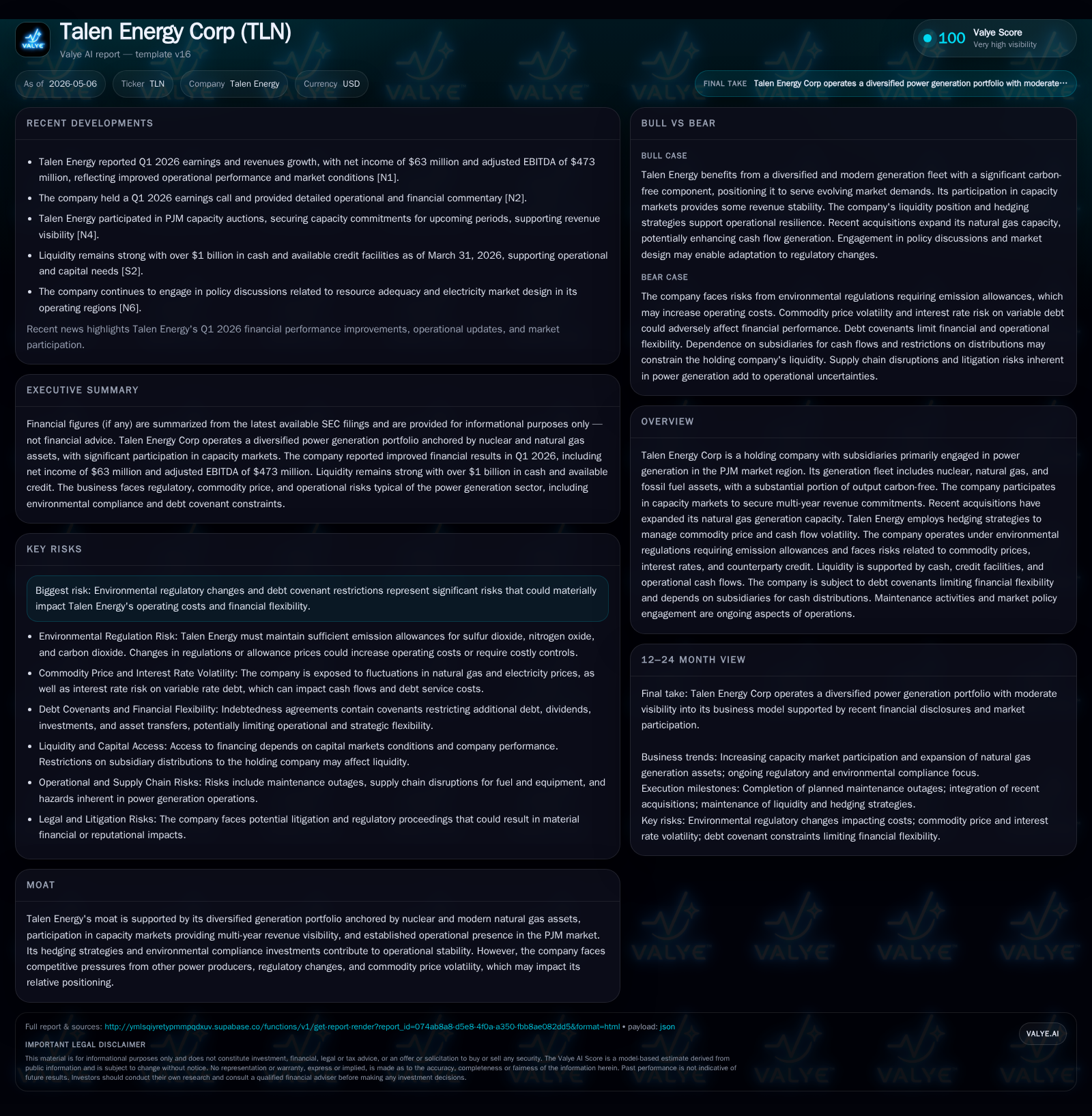
Talen Energy’s first quarter 2026 operating update reveals favorable capacity prices in PJM markets and higher generation volumes partly driven by recent acquisitions. Its diversified portfolio anchored by nuclear and modern natural gas assets allows the company to secure multi-year revenue streams via capacity auctions despite commodity price volatility. Environmental regulations and substantial leverage remain key challenges for its financial flexibility. Going forward, monitoring capacity auction outcomes, regulatory developments, and successful integration of acquired assets will be critical.
Recent Operating Update: Q1 2026 Performance
Talen Energy Corporation's Q1 2026 results underscore the firm's robust position within the PJM market amid volatile commodity price conditions. During the quarter, extreme temperatures spiked electricity demand across PJM, leading to settled on-peak power prices sharply rising—for example, PJM West Hub Day Ahead Peak prices rose to $102.98/MWh in 2026 from $60.50/MWh in 2025 [S2]. Correspondingly, natural gas prices at TETCO M-3 also surged during peak days.
These market dynamics translated into a favorable revenue environment for Talen. Realized power prices at key assets like Susquehanna nuclear plant and fossil fuel facilities increased alongside generation volume growth following strategic acquisitions such as Freedom and Guernsey which added gas-fired capacity [S2][S25]. Capacity revenues improved by $158 million driven mainly by elevated cleared capacity prices in PJM auctions despite somewhat lower volumes cleared compared to the prior year auction cycle [S25]. Notably, PJM's capacity auctions provide multi-year revenue commitments securing visibility beyond short-term spot market fluctuations.
To manage exposure, the company has prioritized a first-lien hedging program where counterparties receive a lien on the same collateral securing its secured debt. This reduces margin posting requirements inherent in exchange-traded hedges and stabilizes cash flows across its generation fleet [S7]. The combination of long-dated capacity contracts and derivative hedges acts as key buffers against energy market volatility.
Business Model and Revenue Mechanics
Talen Energy operates primarily in power generation within the PJM Interconnection territory. It is a holding company with subsidiaries owning generation assets spanning nuclear, natural gas combined cycle, and fossil coal plants—with a significant portion of output classified as carbon-free due to nuclear units [S1].
Revenue is fundamentally driven by two streams:
- Energy sales: Power generated is sold into wholesale markets with pricing influenced by hourly/daily spot market levels; these fluctuate based on demand cycles and fuel costs.
- Capacity auctions: Most important for stable cash flow; these multi-year forward auctions procure commitments from generators ensuring grid reliability. Pricing here reflects long-term supply-demand fundamentals including retirements, new builds, regulatory constraints, and reserve targets.
Volumetric revenue thus depends on plant availability/dispatch (influenced by fuel economics and environmental rules), while price is subject both to wholesale electricity markets and capacity clearing levels negotiated years ahead.
Margins are supported by operational efficiency—nuclear provides low variable cost baseload energy whereas gas plants offer flexible peaking capability. The position also benefits from hedges that lock in revenues or mitigate downside from power price dips or spikes in gas input costs.
Cash conversion is closely linked to operational availability as well as execution on hedge contracts which smooth earnings volatility.
Industry Structure and Competitive Position
Within the fragmented U.S. power generation ecosystem, Talen Energy stands out for its size and varied asset base concentrated in PJM—a large regional transmission organization spanning multiple states with a complex capacity market architecture.
Key competitive strengths include:
- Diverse generation portfolio: Anchored by nuclear plants (low carbon with stable output) complemented by modern gas turbine assets offering dispatch flexibility.
- Participation in capacity markets: Provides multi-year revenue visibility uncommon among pure merchant generators reliant solely on spot energy sales.
- Sophisticated hedging approach: First-lien collateralized hedging reduces liquidity strain and credit risk exposure.
- Established operational presence: Long tenure in PJM with streamlined asset management capabilities amid evolving regulatory headwinds.
Challenges arise from intense competition from other generators including renewables increasingly penetrating the grid mix, regulatory pressures imposing costly emission controls or forced retirements (particularly affecting coal facilities), and exposure to commodity price swings even after hedging.
Growth Drivers
Growth prospects hinge on several vectors:
Capacity Market Revenues
PJM’s Reliability Pricing Model auctions are central to earnings growth since cleared prices signal future capacity value amid balancing supply/demand fundamentals. Capacity auction results—held triennially but recently moved off traditional schedules—influence revenue visibility over multi-year horizons [S2][S25].
Asset Acquisitions
Recent acquisitions expanded natural gas combined cycle holdings (Freedom and Guernsey), boosting generation volume potential as well as geographic footprint within the PJM region [N2][S2]. Successful integration and optimal dispatch of these assets can improve margins.
Regulatory Adaptation
Investments addressing emission allowances compliance (NOx, SO2, CO2), water discharge regulations under EPA ELG Rule exemptions/revisions may reduce forced asset idling or premature retirements helping maintain production volumes [S1].
Hedging Discipline
Continued execution of lien-based hedge structures ensures stable cash flow buffering commodity price uncertainty—enabling focused capital allocation towards maintenance and growth projects rather than addressing liquidity shocks [S7].
Risks / Watchpoints / Growth Constraints
Several notable risks temper growth visibility:
Environmental Regulatory Pressure
Compliance with EPA clean air acts, waste handling laws including CCR rules for coal ash management, Revised Greenhouse Gas standards threaten increased operating costs or even necessitate early retirements of some thermal units e.g., Colstrip plant under scrutiny [S1]. Ongoing litigation creates compliance uncertainty while potential permit restrictions limit fuels used—or force capital-intensive retrofits.
Commodity Price Volatility
Despite hedges, significant swings in natural gas markets or power prices—especially extreme weather episodes—can disrupt margins or require large collateral postings adversely affecting liquidity [S2][S7].
Leverage and Liquidity Constraints
With total debt surpassing $6.9 billion offset partially by ~$1 billion cash as of March 2026 (net debt ~$5.9 billion), Talen operates under restrictive covenants limiting dividends, additional debt issuances, or asset divestitures without lender approvals [F1][S21]. These constraints restrict capital maneuverability demanding disciplined financial management.
Legal Proceedings
Past disputes involving FERC interconnection agreements (e.g., Susquehanna ISA Amendment) add complexity to certain arrangements; while largely resolved now, regulatory uncertainties persist affecting market participation rights [S1].
What to Watch Next
Key indicators for ongoing performance include:
- Upcoming PJM Base Residual Auctions (BRA): Outcomes will set capacity clearing prices critical for revenue planning beyond current contract windows [S2].
- Federal EPA Regulatory Developments: Progress on rulemakings around air emissions standards or water discharge permits impacting operating costs or asset eligibility for dispatch [S1].
- Capital Expenditure Execution: Efficiency in maintaining fleet availability particularly integrating new acquisition assets will influence volume growth trajectories.
- Hedging Program Status: Changes in counterparty appetite or collateral requirements affecting liquidity cushion amid evolving market conditions [S7].
- Dividend/Distribution Policies: Adjustments constrained by leverage ratios impacting cash flows accessible at holding company level given structural subordination of TES subsidiaries [S21].
Financial Profile Overview (Q1 2026)
Latest financial snapshot
| Metric | Value | Period |
|---|---|---|
| Cash & equivalents | $1025mm | |
| 2026-03-31 | ||
| Total debt | $6.9bn | |
| 2026-03-31 | ||
| Net debt | $5.9bn | |
| 2026-03-31 | ||
| Current assets | $1509mm | |
| 2026-03-31 | ||
| Current liabilities | $1210mm | |
| 2026-03-31 | ||
| Current ratio | 1.25x | |
| 2026-03-31 |
Source: SEC companyfacts cache [F1].
| Metric | Value | Period End |
|---|---|---|
| Cash & equivalents | $1.025 billion | |
| 2026-03-31 | ||
| Total debt | $6.903 billion | |
| 2026-03-31 | ||
| Net debt (Total debt - Cash) | ~$5.878 billion | |
| 2026-03-31 | ||
| Current assets | $1.509 billion | |
| 2026-03-31 | ||
| Current liabilities | $1.210 billion | |
| 2026-03-31 | ||
| Current ratio | 1.25 | |
| 2026-03-31 |
Operating cash flow improved significantly during Q1 driven by higher electricity prices combined with working capital changes totaling approximately $461 million versus $119 million year-over-year [S11]. Financing activities included normal course debt repayments alongside utilization of revolving credit facility preserving liquidity at nearly $1.9 billion total available including unused lines of credit plus cash reserves—providing adequate coverage over near-term obligations given stable adjusted EBITDA coverage metrics per filings [F1][S7][S11].
This analysis synthesizes Talen Energy’s latest disclosures including SEC filings through May 5, 2026 ([S2], [S3], [S1]) alongside news releases ([N1], [N2]) to construct an operationally grounded view without speculative forecasts. Financial figures used are strictly from verified companyfacts data ([F1]) or explicit SEC references consistent with policy guidelines.
Disclaimer: This report is for informational purposes only and does not constitute investment advice or recommendation.
Disclaimer: This is research-only, informational analysis and not investment advice. It may include AI-generated interpretation and general industry context. Always verify important details using primary sources.

Comments