
Kosmos Energy Advances Asset Streamlining and Development While Managing Elevated Leverage
Kosmos Energy's Q1 2026 update emphasizes strategic divestitures, disciplined capital expenditures, and ongoing growth in deepwater production amid financial covenant adjustments.
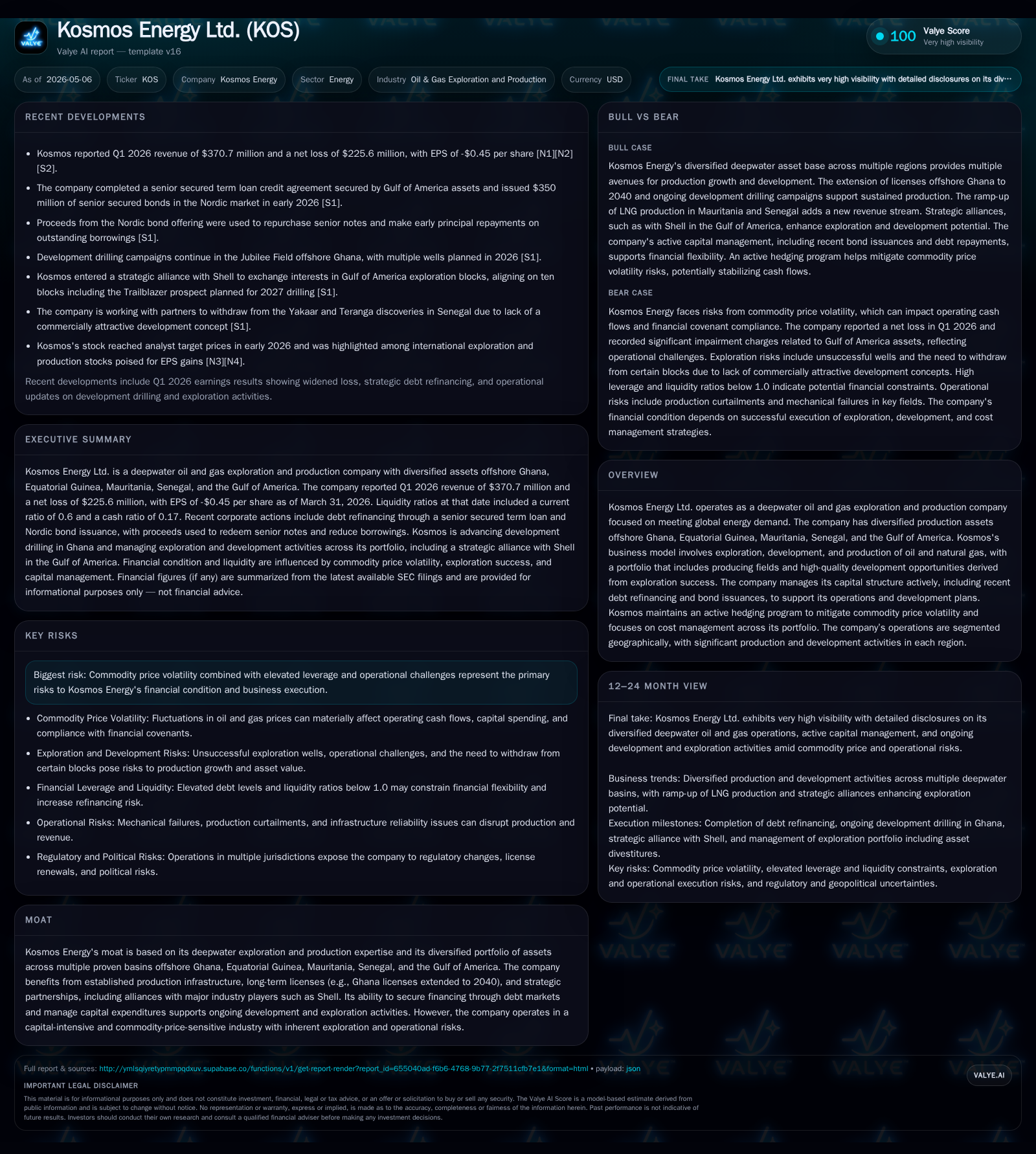
In Q1 2026, Kosmos Energy completed key asset sales in Equatorial Guinea while maintaining production growth through development drilling offshore Ghana and the Gulf of America. The company has refinanced debt to extend maturities and issued Nordic bonds to reduce near-term maturities, reflecting active capital structure management to support its multi-region portfolio. Despite elevated leverage due to recent investments and price volatility, financial covenant amendments provide temporary flexibility. Growth drivers are anchored in ongoing infill drilling, license extensions through 2040 in Ghana, and advancing greenfield developments in Mauritania and Senegal. Operational risks stem from commodity price fluctuations, execution complexity in deepwater projects, and high capital intensity inherent in offshore E&P.
Recent Operating Update
Kosmos Energy reported its Q1 2026 operational and financial results through its May 5th filing [S2][S3]. A notable near-term development was the divestiture agreement finalized in February 2026 for the Ceiba Field and Okume Complex (offshore Equatorial Guinea), where Kosmos sold a 40.375% working interest for $180 million upfront plus future contingent payouts depending on production performance and oil prices [S25]. This move reflects heightened portfolio discipline focusing capital towards higher returning assets.
Production momentum continues offshore Ghana with the Jubilee Field benefitting from a multi-well development drilling campaign initiated mid-2025. During the year ended December 31, 2025, gross production averaged approximately 93,100 barrels of oil equivalent per day (Boepd) with Kosmos’s net share around 31,100 Boepd [S1]. The company brought multiple infill producer wells online during Q3 and early Q1-2026 which should underpin near-term volume stability.
Capital project execution is progressing with an emphasis on maintaining facilities integrity in Equatorial Guinea while advancing exploration appraisal and development campaigns across other core regions such as Mauritania, Senegal, and the Gulf of America (GoA) [S1][S14]. The annual capital budget remains targeted near $350 million focusing on sustaining production through maintenance drilling (~$275 million), pushing forward new developments ($60 million), and system integrity ($15 million) [S14].
On the financial front, Kosmos actively managed its debt profile this quarter. The company fully drew down a previously announced $250 million GoA term loan facility structured over two tranches ($150 million in October 2025; $100 million in January 2026), using proceeds along with cash on hand to redeem higher coupon senior notes maturing imminently [S10][S18]. Additionally, Kosmos priced $350 million of senior secured Nordic bonds at an elevated coupon of 11.25%, deploying part of these proceeds toward repurchasing $182.5 million of its more expensive notes due in 2027 and making voluntary principal repayments on revolving credit borrowings [S10][S26].
To ease pressure from increased leverage associated with recent project ramp-ups (notably GTA Phase 1), Kosmos negotiated several amendments to its revolving credit facility covenants through September 2026 allowing temporary increase in allowable debt cover ratios from the original maximum of 3.5x up to a maximum permitted ratio of up to 4.5x at the March assessment date [S16]. This breathing room is critical given current oil market uncertainty.
Business Model
Kosmos Energy operates primarily in deepwater oil and gas exploration and production offshore West Africa (Ghana, Equatorial Guinea, Mauritania, Senegal) and the Gulf of America. Its business model focuses on exploration success followed by appraisal-led development culminating in production operations generating hydrocarbon sales revenue.
The company generates revenue by selling crude oil and natural gas extracted from its fields to downstream customers or regional intermediaries under contract terms that typically reflect prevailing commodity prices mitigated partly via hedging programs designed to smooth cash flow volatility [S1]. Revenue drivers hinge heavily on production volumes alongside realized commodity prices adjusted for quality differentials; price hedges further modulate realized pricing.
Cost structure includes exploration expense risk charges (capitalized where successful), development capital expenditures mainly for drilling wells plus facilities construction or upgrades, operating expenses comprising lifting costs plus fixed overheads, taxation obligations principally via profit-based royalties or production sharing agreements dependent on host governments’ fiscal regimes.
Kosmos manages liquidity needs via a combination of cash flows from operations supplemented by access to debt markets—including senior unsecured notes, revolving credit facilities backed by reserve-based lending formulas tied to asset valuations—and equity issuances if required [S9]. The company demonstrates active capital structure management aimed at refinancing shorter maturity obligations through bond issuances or credit facility amendments enabling smoother maturity profiles matching project lifecycles.
Industry Structure and Competitive Position
Within offshore deepwater exploration & production sector — notably West Africa — Kosmos positions itself as a mid-tier player leveraging technical expertise deployed across multiple proven basins rather than single large-scale mega-project exposure alone. Its diversified footprint dampens basin-specific geopolitical or geological risk events.
Strategic partnerships underpin competitive positioning: for instance Jubilee/TEN licenses offshore Ghana involve collaboration with major international energy firms like Shell which provide technical knowhow plus financial backing [S1]. The extension of licenses through government agreements until 2040 secures long operational horizons atypical relative to industry peers who face frequent licensing contests or expirations.
Furthermore, Kosmos holds leading edge knowledge accumulated over years in ocean bottom node seismic data assimilation supporting better reservoir characterization enhancing drilling success rates [S1]. This technical moat is partly responsible for converting exploration discoveries into commercially viable developments efficiently compared to newer entrants.
Pricing power remains limited given global crude oil market openness but operational cost control initiatives achieved via digital optimization efforts mitigate margin pressure amid fluctuating input cost inflation.
Growth Drivers
1. Reserve Life Extension Through License Renewals: The company's Memorandum of Understanding with Ghana's government extended key petroleum licenses covering Jubilee and TEN fields until mid-2040 [S1], securing long-term resource extraction rights which supports sustained production growth via infill drilling campaigns planned for up to twenty additional wells.
2. Development Drilling Program Execution: Active ongoing delineation and development drilling notably offshore Ghana—several new producer wells came online as planned starting July 2025 into early Q1-2026—with future wells scheduled during remainder of this year forecasts stable or modestly rising output volumes [S1].
3. Asset Portfolio Optimization: Capital recycling moves such as sale of Equatorial Guinea producing interests allow redeployment towards high-return projects or debt reduction enhancing balance sheet resilience while sharpening geographic focus [S25].
4. Multi-Basin Expansion: Advancing developments within Mauritania/Senegal lease blocks involving large-scale Gas-To-Africa phase one infrastructure projects open avenues for future LNG-linked growth opportunities supplementing upstream reserves growth trajectory [S1][N1].
5. Commodity Price Hedging: Ongoing hedging programs protect cash flow stability amid volatile global energy prices enabling prudent capital expenditure funding decisions without excessive reliance on external financing.
Risks / Watchpoints / Growth Constraints
Kosmos operates within a capital-intensive sector fraught with execution risks:
- Commodity Price Volatility: Fluctuations directly impact revenues; despite hedging buffers remain limited long term structurally given trading floors' positioning making earnings unpredictable during downturns leading to potential stress on liquidity [S1][N2].
- Leverage Profile: Elevated net debt levels (~$2.8 billion net debt vs ~$130 million cash as of March quarter-end) imply material fixed financial obligations with credit covenants only temporarily relaxed posing refinancing or covenant compliance risk if market conditions deteriorate sharply [F1][S16].
- Operational Execution Risk: Deepwater developments entail complex multi-year project schedules subject to geological uncertainty, supply chain constraints (e.g., rig availability), cost inflation risk potentially inflating projected Capex beyond budgets impacting returns.
- Regulatory / Geopolitical Risks: License renewals notwithstanding some asset jurisdictions possess political risk factors; contractual terms such as increasing government take shares post-2036 Ghana affect economics requiring ongoing stakeholder engagement [S1].
- Focus Shift Impact: Divesting producing assets may boost near-term liquidity but reduces immediate cash flow base necessitating timely successful new project commercialization without execution slippage.
What To Watch Next
Key upcoming milestones involve:
- Continued delivery against drilling schedule offshore Ghana potentially evidenced by quarterly updates confirming volumes uplift from newly drilled producers [N1].
- Regulators’ final approval processes for recent asset sales completion milestones especially Equatorial Guinea disposal transaction expected soon after customary CEMAC clearance steps concluded [S25].
- Financial covenant assessments scheduled for next quarters revealing whether amended terms suffice amid fluctuating leverage multiples post ramp-up period experimentation [S16].
- Progress updates on Phase One developments across Mauritania/Senegal including environmental permitting plus supply chain contracting markers presage medium-term expansions fueling next wave growth [N1].
- Commodity price environment sensitivity influencing realized pricing outcomes crucially shaping cash generation capacity essential for organic reinvestment versus external financing pace balance.
Financial Profile Summary
Latest financial snapshot
| Metric | Value | Period |
|---|---|---|
| Cash & equivalents | $130mm | |
| 2026-03-31 | ||
| Total debt | $2.9bn | |
| 2026-03-31 | ||
| Net debt | $2.8bn | |
| 2026-03-31 | ||
| Current assets | $453mm | |
| 2026-03-31 | ||
| Current liabilities | $757mm | |
| 2026-03-31 | ||
| Current ratio | 0.6x | |
| 2026-03-31 |
Source: SEC companyfacts cache [F1].
Per the latest March 31, 2026 snapshot:
- Cash & equivalents totaled approximately $130 million providing short-term liquidity coverage.
- Total debt stands near $2.95 billion reflecting sizeable borrowings mainly comprising senior notes, facility loans including GoA term loan fully drawn since January [F1][S2][S10].
- Current assets of about $453 million contrast against current liabilities exceeding $757 million yielding a current ratio near a stringent ~0.6 highlighting working capital tightness impacted by significant short-term debt maturities obligations within next year horizon [F1].
- Net debt near $2.82 billion reinforcing high leverage backdrop necessitating cautious liquidity management but mitigated via amended covenant headroom till fall/winter this year relieving refinancing pressure temporarily.
- Interest coverage ratios remain pivotal metrics monitored by lenders with Kosmos making prudent principal repayments as part of restructuring undertaken recently aimed at extending debt maturity curve improving medium-term balance sheet sustainability outlook [S16][S18][S26].
Overall, Kosmos Energy balances near-term operational progress marked by steady production growth initiatives alongside portfolio streamlining efforts against a challenging financial leverage landscape necessitating continued emphasis on execution excellence and disciplined capital allocation amidst sensitive macro energy market dynamics.
This analysis synthesizes public SEC filings alongside contemporaneous news disclosures without providing investment recommendations or price targets.
Disclaimer: This is research-only, informational analysis and not investment advice. It may include AI-generated interpretation and general industry context. Always verify important details using primary sources.

Comments