
South Plains Financial Expands Texas Footprint and Navigates Loan Demand Weakness in Q1 2026
Recent merger completion and moderate volume pressures shape the growth outlook for South Plains Financial in key regional markets.
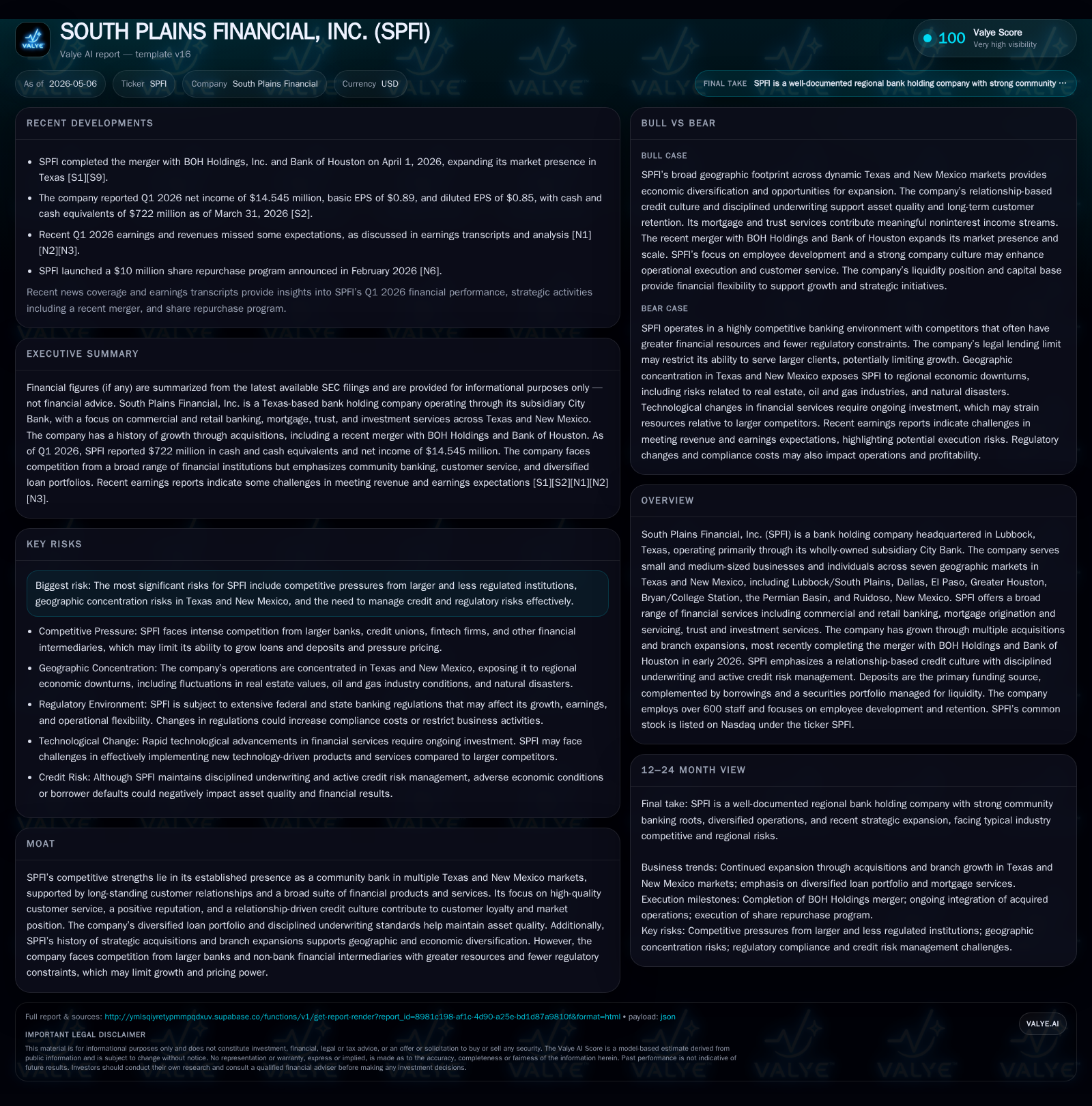
South Plains Financial, Inc. (SPFI) concluded its transformational merger with BOH Holdings and Bank of Houston in early 2026, enhancing its scale across seven Texas and New Mexico markets. The first quarter results showed pressures from a challenging loan demand environment amid elevated interest rates, though disciplined credit quality and deposit growth remain foundational. The company's relationship-driven community banking model, diversified yet regionally focused footprint, and broad financial services suite underpin competitive positioning despite intensifying pressure from larger banks and fintech entrants. Going forward, execution on integration, hiring loan originators, and maintaining asset quality will be critical growth levers.
Recent Operating Update
South Plains Financial (SPFI) filed its latest quarterly report on May 5, 2026 [S2], providing the first operating snapshot following its high-profile acquisition of BOH Holdings and Bank of Houston (BOH). This merger closed on April 1, 2026 [S12], expanding SPFI’s banking footprint especially in the Greater Houston area where it added three new branches and enhanced its scale. This consolidation moves SPFI closer to becoming one of the more significant community banks spanning multiple Texan metros plus New Mexico.
However, Q1 2026 also reflected the challenges facing mid-sized banks nationwide: loan originations softened due to weak demand exacerbated by elevated interest rates. The company noted that borrowers are increasingly cautious as economic uncertainty persists [S3]. While commercial and retail loan pipelines felt volume pressures, SPFI continues to emphasize strict underwriting discipline and proactive credit risk management — core tenets underpinning their relationship-driven lending approach.
On deposits, SPFI continues to rely heavily on local depositors as its primary funding source. Mortgage services maintain a strategic role with production offices deployed in key markets including Dallas and Permian Basin to capture residential lending opportunities.
Business Model
SPFI operates as a bank holding company with its main subsidiary City Bank servicing seven geographic markets: Lubbock/South Plains, Dallas, El Paso, Greater Houston, Bryan/College Station, Permian Basin in Texas plus Ruidoso in New Mexico [S1]. These regions house predominantly small to medium-sized business clients alongside individual consumers — reflecting a traditional community bank clientele.
The company’s revenue streams span commercial lending (loans), retail deposits (deposit fees), mortgage origination fees, trust and investment management fees. Loans generate net interest income—the largest income component—sensitive to interest rate fluctuations [S1]. Deposit accounts support liquidity while providing low-cost funding advantaging net interest margins.
Growth has historically been partly acquisition-driven; for example through prior mergers adding West Texas State Bank (2019) and now BOH (2026) [S26]. Branch expansions supplement footprint density enabling deeper customer relationships. SPFI leverages technology to improve underwriting efficiency without sacrificing credit quality [S1], balancing cost control against origination scalability.
Trust services complement core banking by generating fee income from managing nearly $435 million of assets under management [S27], enhancing product mix diversification.
Industry Structure & Competitive Position
Operating mainly as a regional community bank positioned between large national banks and smaller local institutions places SPFI in a competitive niche. Its competitive advantages stem from long-standing customer relationships cultivated over eight decades, deep local market knowledge particularly in West Texas areas such as Lubbock [S1], comprehensive financial services offering inclusive of trust/investment products [S27], disciplined underwriting emphasizing asset quality [S18], and extensive branch/loan production office network covering multiple metropolitan centers.
That said, competition is intense from larger banks which benefit from broader product suites and greater economies of scale enabling more aggressive pricing or wider digital capabilities. Moreover, emerging fintech firms pursuing niche lending or deposit capture add further pressure given their speed and fewer regulatory constraints [S16]. These dynamics compress SPFI’s pricing power on both loans and deposits while raising operational demands for efficiency.
Geographically concentrated mostly within Texas/New Mexico also exposes balance sheet performance to regional economic cycles dominated by energy sector fluctuations especially related to the Permian Basin market segment.
Growth Drivers
- Merger Integration: The recent acquisition of BOH adds scale particularly in Houston’s complex banking market improving deposit market share and cross-selling opportunities.
- Branch Network Expansion: Organic branch openings combined with focused deployment of mortgage loan production offices target residential lending growth despite recent softness.
- Loan Originator Recruitment: Success depends critically on hiring originators skilled at developing commercial and mortgage pipelines—a point management highlights explicitly [S1].
- Asset Quality Discipline: Relationship-based lending reduces credit losses providing foundation for steady earnings enhancing capital retention for reinvestment.
- Fee Income Diversification: Expanding trust & investment income provides lower volatility revenue supporting profitability amid fluctuating interest environments.
- Technology Adoption: Enhanced credit reporting tools aid underwriting throughput while containing expenses to protect margins amidst competitive pressure.
Risks & Watchpoints
- Interest Rate Volatility: Rapid rate changes affect net interest margin inversely depending on re-pricing mismatches between assets (loans) and liabilities (deposits) [S1]. Elevated rates dampen borrowing appetite worsening loan growth prospects.
- Regional Economic Concentration: Heavy Texas/New Mexico exposure ties credit risk cyclicality to oil & gas sector health plus broader state economic trends threatening loan performance during downturns [S28].
- Competitive Encroachment: Larger banks’ scale advantage could erode market share; fintechs may lure price-sensitive customers especially younger demographics requiring continuous innovation investment.
- Regulatory Compliance: Expanding footprint shifts CRA compliance complexity; consumer-facing operations subject mortgage/regulatory scrutiny introducing potential compliance costs or fines if not properly managed [S17].
- Integration Execution Risk: Post-merger integration failures risking customer attrition or inefficiencies could dilute expected synergies from BOH transaction.
- Deposit Stability Concerns: Top 20 depositors constitute over 20% total deposits; loss would trigger reliance on costlier alternate funding adversely impacting margins [S23].
What To Watch Next
Investors should monitor:
- Q2 operational metrics post-merger: deposit retention rates; branch-level profitability benchmarks; loan origination pipeline trends;
- Hiring progress for originators focused on new/existing markets;
- Asset quality indicators: nonperforming assets ratio evolution;
- Interest margin trends reflecting evolving Fed policies;
- Regulatory developments impacting capital adequacy or lending practices;
- Fee income trajectory from trust & mortgage services signaling diversification success;
- Communication from management regarding integration milestones versus initial projections.
Financial Profile Context
As of March 31, 2026, SPFI holds substantial cash reserves approximating $722 million with total debt minimal near $1.35 million as measured mid-2025 suggesting a highly conservative leverage stance [F1]. This liquidity buffer supports ongoing acquisitions or organic growth investments while mitigating refinancing risk. Net income for latest full year was $58.47 million through December 31, 2025 reflecting steady profitability before integrating BOH impact [F1].
Overall financial health appears solid but will require close monitoring as scaling operations post-merger might temporarily increase expenses or capital consumption until synergies materialize fully.
This analysis summarizes publicly available information drawn primarily from South Plains Financial's most recent quarterly filing along with annual disclosures contextualizing operating strategy. All numerical data presented aligns explicitly with SEC filings or companyfacts data ensuring accuracy without speculative extrapolation. This report does not constitute investment advice but aims to provide an informed industry-focused perspective on SPFI's business fundamentals amid current banking sector dynamics.
Disclaimer: This is research-only, informational analysis and not investment advice. It may include AI-generated interpretation and general industry context. Always verify important details using primary sources.

Comments