
Rivian’s Q1 2026 Growth Amid Production Scaling and Capital Intensity Challenges
Rivian posted revenue growth with narrowing losses in Q1 2026, highlighting execution progress balanced against ongoing production and financing headwinds.
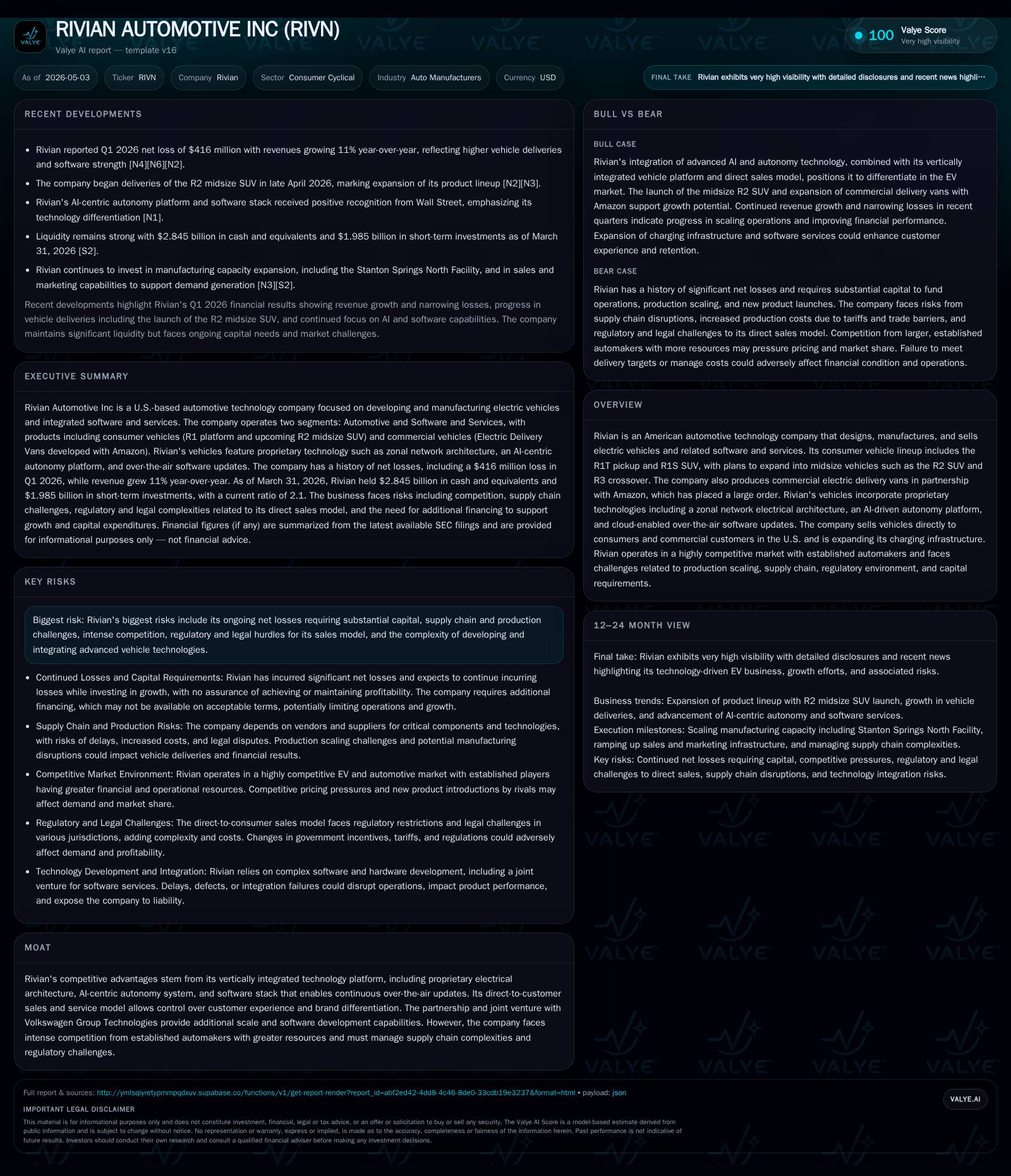
Rivian Automotive’s latest quarterly results show improving operational traction driven by stronger vehicle deliveries and software uptake, even as the company remains deeply unprofitable. The Q1 2026 filing details key developments around capital structure, supply chain constraints, and product expansion. Rivian’s vertically integrated EV platform combines proprietary technologies and a direct-sales model that underpins its differentiation in a competitive auto industry. Growth hinges on scaling manufacturing capacity, expanding its consumer and commercial product lines, and advancing its AI autonomy roadmap. However, heavy capital expenditure requirements, evolving regulatory landscapes, and intense incumbent competition pose persistent risks to timely profitability.
Recent Operating Update
Rivian Automotive’s Q1 2026 filing paints a picture of cautious progress during a capital-intensive growth trajectory. Revenue for the quarter rose approximately 11% from the prior year period as vehicle deliveries increased, signaling growing demand for its R1T pickup, R1S SUV, and commercial EDV vans made for Amazon logistics operations [S2]. Despite higher top-line figures, net loss narrowed but remained steep at $416 million compared to $541 million in Q1 2025 — reflecting continued heavy investment in production scale-up, research & development especially for autonomy systems, and expansion of its direct-to-consumer sales infrastructure.
Liquidity remains sufficient with cash reserves of $2.85 billion as of March 31, 2026; however, total debt stands at nearly $4.48 billion predominantly comprising long-term facilities including DOE-backed loans aimed at funding the Stanton Springs North Facility [F1][S3]. The company disclosed contingent equity contributions capped by sponsors to mitigate cost overruns on major projects [S3], underscoring the complex financing environment faced during aggressive capital deployment.
Business Model Overview
Rivian operates as an American automotive technology company specializing in electric vehicles (EVs) augmented by integrated software offerings. The business bifurcates into two principal segments:
- Automotive Segment: Produces consumer EVs like the award-winning R1T pickup truck and R1S SUV built on the proprietary R1 platform; commercially focuses on electric delivery vans designed collaboratively with Amazon (the EDV program).
- Software & Services Segment: Includes an AI-centric autonomous driving platform branded Autonomy+, cloud-enabled over-the-air (OTA) updates via Connect+, digital user experience management including Rivian Assistant, and emerging robotaxi ventures primarily targeting partnership deployments.
Key strengths lie in its vertical integration encompassing core electrical architecture — notably its zonal network wiring harness innovation — proprietary powertrain design, in-house autonomy stack trained on extensive real-world data collected through fleet telematics, and continuous software improvements delivered OTA. Unlike legacy automakers adopting somewhat modular strategies dependent on suppliers’ offerings, Rivian controls critical technology layers enabling rapid feature iteration and potential structural cost advantages over time [S1].
The company employs a direct-to-customer retail model without traditional dealer intermediaries allowing tighter control of customer experience, pricing strategy, service quality, data collection, and branding coherence. This approach goes hand-in-hand with investments in exclusive retail spaces to nurture brand loyalty particularly among adventurous lifestyle consumers attracted to their trucks’ off-road capabilities.
Strategic alliances also form part of Rivian’s moat: a joint venture with Volkswagen Group Technologies increases scale economies and software development resources while Uber partnerships target Level 4 autonomous robotaxi production leveraging the R2 platform [S1][S19]. Amazon's embedded commercial relationship via logistics fleet electrification continues as another significant pillar.
Industry Structure & Competitive Position
Rivian operates within the highly competitive automotive manufacturing space transitioning rapidly towards electrification. Its main competitors range from legacy OEMs such as Ford (with the Lightning series), General Motors (Chevrolet Silverado EV), Tesla’s Model X/Y lineup specializing in performance electric trucks/SUVs akin to Rivian’s R1 family, plus emerging startups focused on specialty EVs.
Competitive barriers arise from high capital intensity inherent in scaling EV production capacity including battery supply chains while meeting demanding safety regulations globally. Legacy automakers benefit from entrenched procurement networks and larger scale but often face organizational inertia limiting agility.
Rivian attempts differentiation through:
- Full-stack technology control enhancing digital user experiences,
- Proprietary autonomy features embedding AI innovations early,
- Direct sales/channel control permitting more flexible price/margin management,
- Cultivated brand image appealing to adventure/outdoor consumers.
However, execution risks are significant due to its relatively short operational history manufacturing vehicles at volume; normal factory output is still below target capacity while newer Stanton Springs facility construction faces permitting/operational milestones crucial for next-gen product launches [S25][S22].
Growth Drivers
Manufacturing Scale-Up & New Product Rollouts
Rivian is aggressively expanding its assembly footprint beyond its Normal Factory by developing the Stanton Springs North Facility aimed at supporting future products such as midsize platforms underpinning R2 SUV and the performance R3X crossover iteration. Successfully reaching volume targets at these plants directly correlates with revenue growth potential.
Autonomous Driving & Robotaxi Initiative
The Autonomy+ system represents a strategic bet extending beyond private passenger vehicles into shared mobility via partnerships like those inked with Uber. Robotaxi fleet commercialization could open sizable addressable markets beyond traditional EV retail channels if regulatory hurdles are overcome.
Software & Services Monetization
The company is building recurring revenue streams through advanced driver assistance subscriptions, OTA feature packages, connected vehicle services plus data-driven analytics—areas where competitors have shown margin expansion potential over raw hardware sales.
Commercial Fleet Expansion with Amazon & Others
Amazon’s ongoing commitment through substantial EDV deliveries anchors stable commercial vehicle revenue. Expanding similar fleet deals either geographically or with other large logistics operators could drive material volume increases while leveraging Rivian’s dedicated production line efficiencies.
Risks / Watchpoints / Growth Constraints
- Capital Intensity & Funding Needs: Ongoing net losses necessitate continued access to capital markets or sponsor equity injections capped but potentially sizeable given production ramp complexities [S3][S5].
- Production Delays & Supply Chain Risks: Persistent component shortages or tariff escalations could exacerbate manufacturing bottlenecks raising per-unit costs or delaying shipments [S25].
- Regulatory & Legal Environment: Direct-to-customer sales models face potential challenges varying across U.S. states complicating expansion plans; legal settlements around IPO-era securities claims remain unresolved but preliminarily settled indicating reputational risks [S4][S13].
- Competitive Pressure: More mature EV businesses like Tesla hold larger market share benefiting from scale advantages; major OEMs are speeding up electrification investments creating margin pressure.
- Technology Deployment Risk: Autonomy software development carries uncertainties around timeline to market-readiness amid evolving AI regulations such as EU AI Act introducing compliance burdens [S18].
- Customer Demand Volatility: Economic downturns or higher sticker prices driven by tariffs could dampen vehicle sales volumes affecting utilization rates and fixed cost absorption [S2].
What To Watch Next
- Manufacturing Output Metrics: Volume ramp-up figures at Normal Factory versus Stanton Springs will signal whether capital investments translate into scalable production.
- Delivery & Backlog Trends: Quarterly delivery growth aligned with bookings provides insight on demand sustainability versus inventory dynamics.
- Autonomy Roadmap Progress: Regulatory approvals milestones coupled with Uber partnership timelines for robotaxi deployment are critical catalysts.
- Capital Raise Activity: Updates regarding debt refinancing terms or equity issuances gauging financial runway extension will affect corporate flexibility.
- Software Subscription Uptake: Revenue contribution shifts towards SaaS-like models may influence valuation perceptions due to more stable cash flows.
- Price/Mix Changes: Ability to maintain or increase average selling prices amidst competition impacts gross margin expansion prospects.
Financial Profile Summary (As of Q1 2026)
Latest financial snapshot
Losses narrowed in Q1 to $416 million from $541 million in the comparable prior year quarter indicating better operational leverage but profitability remains elusive given elevated cost structure tied primarily to upfront investments in capacity expansion and technology development [F1][S2]. Strong current ratio suggests adequate liquidity but high overall leverage requires careful refinancing management going forward [F1][S5][S8].
Memo Disclaimer: This analysis is for informational purposes only based on publicly available filings and news reports as of May 2026 without investment recommendations or price predictions.
Disclaimer: This is research-only, informational analysis and not investment advice. It may include AI-generated interpretation and general industry context. Always verify important details using primary sources.

Comments