
BlueLinx Builds Market Momentum with Specialty Products and Strategic Growth
The company’s Q1 2026 results reflect stronger specialty product performance, operational resilience, and strategic progress amid geopolitical-driven supply challenges.
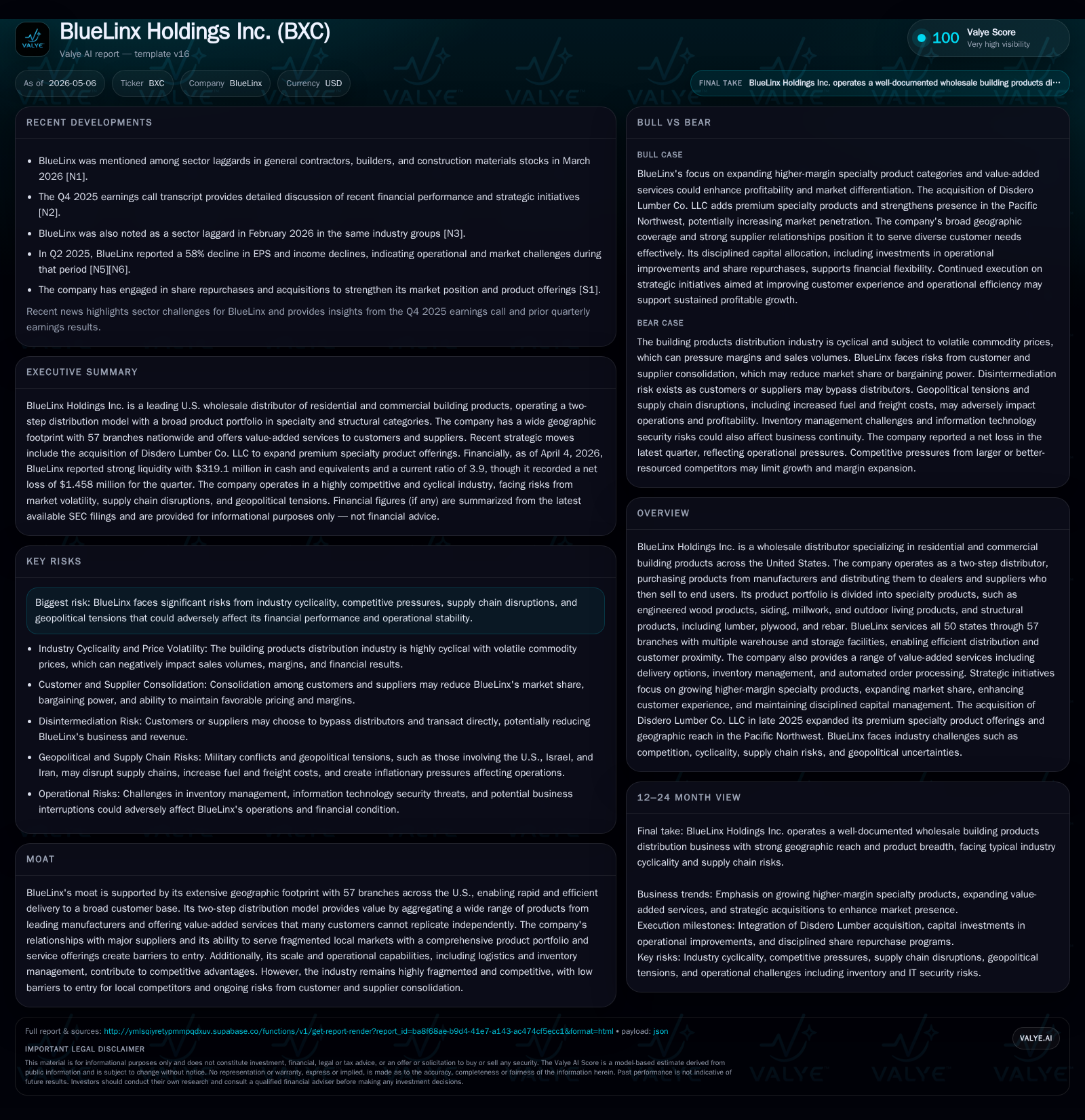
BlueLinx Holdings Inc. reported its latest quarter highlighting continued expansion of higher-margin specialty building products following the recent Disdero acquisition. Despite inflationary pressures on fuel and freight costs linked to global geopolitical tensions, the company’s extensive branch network and service offerings have helped sustain its competitive footprint across U.S. markets. Strategic emphasis on broadening local market shares, upgrading value-added services, and managing capital prudently underpins BlueLinx’s poised approach to growth in a cyclically sensitive industry.
Q1 2026 Operating Update: What Changed and Why It Matters
BlueLinx Holdings’ first quarter ending April 4, 2026 [S2][S3] underscores operational momentum anchored in specialty products expansion alongside rising input costs triggered by escalating geopolitical tensions involving the United States, Israel, and Iran. The company called out higher fuel and third-party freight expenses stemming from global energy market disruptions that influenced delivery costs.
The impact of these geopolitical risks manifested primarily in transportation expense volatility due to tight energy supplies affecting their owned fleet fueling and third-party carriers’ pricing models. While these increased costs posed margin headwinds, BlueLinx managed to partially offset the inflationary pressures via adjusted pricing strategies including fuel surcharges. The firm’s robust logistics infrastructure and nationwide footprint cushioned the operational impact amid the turbulent macro backdrop.
Additionally, the acquisition of Disdero Lumber Co., completed late in fiscal 2025 but maturing into full contribution this quarter, began delivering tangible benefits through expanded specialty product sales in the Pacific Northwest. This acquisition complements BlueLinx’s strategy to diversify into higher-margin building materials such as decking and millwork. Early signs show improved revenue mix quality and incremental market share gains in targeted regional segments.
Business Model and Product Portfolio: Market-Serving Capabilities
BlueLinx operates as a classic two-step distributor: purchasing building materials from manufacturers and redistributing them to dealers who ultimately serve builders and contractors [S1][S5]. This intermediate positioning creates value for both suppliers—who gain access to sprawling fragmented dealer networks—and customers—who benefit from consolidated purchasing options plus logistical convenience.
The product portfolio divides cleanly between:
Specialty Products (~69% of net sales): This includes engineered wood products (EWPs), siding, millwork, outdoor living components like decking and railing systems (significantly bolstered by Disdero), specialized lumber panels, and industrial items. These products cater often to customized residential or upscale multi-family developments where premium quality commands superior pricing.
Structural Products (~31% of net sales): Commodity-grade lumber, plywood, oriented strand board (OSB), rebar, and related basic construction inputs used for standard structural support needs in residential or commercial builds. Margins here tend to be thinner due to commoditization.
Beyond pure product distribution, BlueLinx provides extensive value-added services tailored to ease customer sourcing complexity [S12], such as less-than-truckload job site delivery programs, inventory stocking at branches close to market demand centers, automated EDI order processing linking manufacturer-to-customer flows directly, intermodal logistics including railcar services for imported goods handling, milling/fabrication services tailored to project specs, precise take-off assistance providing measurement accuracy for orders, EWP design consultative services, and backhaul optimizations using return trips for additional deliveries.
This multi-layered offering enhances switching costs by embedding BlueLinx deeply into customers’ workflows while expanding supplier reliance on its distribution scale—a particular advantage given the geographic breadth spanning all 50 states via 57 branches with multiple warehouse facilities.
Industry Structure and Competitive Dynamics
The building materials wholesale distribution industry is characterized by notable fragmentation at regional/local levels with many small independent dealers competing alongside larger national players like BlueLinx [S1][S16]. Barriers to entry remain moderate due primarily to:
- The capital intensity involved in establishing an extensive logistics network enabling rapid delivery of bulky products.
- Access to supplier relationships critical for obtaining competitive pricing or exclusive brands.
- Operational expertise in inventory management coupled with technology-enabled ordering systems facilitating complex sourcing needs.
Competition remains intense given the fragmented dealer landscape and evolving customer and supplier dynamics. Local dealers can replicate delivery capabilities albeit at smaller scale; new entrants may focus on niche geographies or product lines requiring less capital; customer consolidation empowers some buyers to bypass intermediaries by purchasing directly from manufacturers, creating disintermediation risks; supplier consolidation may also influence vendor terms.
Pricing power is thus volatile especially within structural commodity segments whose prices hinge sharply on manufacturing capacity utilization cycles. Distribution economics favor players like BlueLinx able to leverage scale for cost efficiency while also catering increasingly towards specialty products that are differentiated by design complexity or brand preference where margins are healthier.
The sector's cyclical sensitivity tracks housing starts trends intricately—with downturns compressing volumes swiftly—and is compounded by raw material price swings influencing pass-through pricing dynamics [S20].
Growth Drivers: Specialty Products, Expandable Markets, and Services
BlueLinx's growth strategy rests on several measurable pillars:
Specialty product penetration: Accelerating sales of engineered wood products combined with high-end millwork items (decking flooring etc.) caters to growing multi-family residential construction projects demanding customization [S4]. Disdero’s integration contributes immediately by injecting premium SKUs anchored in the Pacific Northwest—a region with notable housing activity—increasing overall margin profile.
Market share expansion: Leveraging a broad national footprint enables BlueLinx to pursue local market gains through intensified branding efforts including operating acquired businesses under legacy trade names (Disdero), deepening relationships with national home centers as well as professional contractors across regions [S5].
Value-added service innovation: Investments in automated EDI order processing and inventory stocking programs reduce customer procurement friction while enhancing loyalty. Job site delivery flexibility likewise improves customer satisfaction by matching smaller order sizes with timely shipments minimizing builder inventory holding costs [S12].
Operational leveraging of scale: Through improved pricing programs pre-negotiated with key suppliers combined with judicious capital deployment aimed at modernizing warehouse facilities and fleet vehicles—Budgeted investments totaled $26.9 million recently plus additional financed equipment acquisitions—the company aims for sustained margin enhancement alongside volume growth [S15].
Overall these initiatives aim not just for raw volume growth but more importantly profitable revenue mix improvement measured via segment margin contributions within quarterly performance reports.
Risks and Constraints: Cyclicality, Geopolitical Exposure, and Competitive Pressure
BlueLinx faces a landscape fraught with intertwined risks:
Cyclicality: Highly dependent on residential construction activity affected by macroeconomic conditions such as interest rates affecting mortgage affordability; demographic trends influencing household formation rates; weather patterns impacting timing of repairs/remodels; shifts in regional population growth affecting local demand pools [S13]. Downturns depress volume sharply given fixed cost structures impairing earnings stability.
Geopolitical cost shocks: Direct exposure arises from fuel-price inflation linked clearly to ongoing conflicts in the Middle East involving US-Israel-Iran hostilities [S2]. Supply interruptions along vital shipping routes such as Strait of Hormuz cause global oil price surges increasing trucking fuel costs internally consumed onsite or paid through third-party carriers—risks compounded if surcharges cannot be fully passed down—for both owned fleet operations and outsourced deliveries.
Competitive intensity & disintermediation: Fragmented competitors remain numerous with low entry barriers in certain markets; customer/supplier consolidation increases bargaining power leading potentially to lost contracts or eroded favorable price terms [S11][S16]. Suppliers might bypass distributors entirely opting for direct sales within strategic regions reducing BlueLinx’s market participation scope.
Supply chain vulnerabilities: Reliance on international manufacturers subjects company operations to tariffs fluctuations trade policy changes customs delays—all potential disruptors exacerbating volatility around inventory availability or inbound shipping costs [S11].
In aggregate these factors necessitate careful margin management plus operational agility while constantly monitoring external developments affecting cost inputs or demand elasticity.
Near-Term Milestones and What to Watch Next
Investors should monitor the following signals over upcoming quarters:
- Further integration outcomes from Disdero acquisition assessing revenue lift trajectory versus pro forma expectations including regional market penetration data shared during earnings calls or investor materials [S3].
- Progression on mitigating fuel/freight inflation impacts via dynamic pricing models inclusive of fuel surcharges balancing competitive positioning against rising operating expenses highlighted in Q1 disclosures [S2].
- Expansion execution success into new or underpenetrated markets backed by strategic vendor partnerships reflecting broader geographic coverage strength [S4].
- Technological service enhancements uptake metrics such as automated ordering adoption rates or improvements in inventory turns tied foremost to value-added service differentiation capability addressing customer stickiness concerns.
- Broader cyclical indicators such as housing starts trends released externally providing context around volume drivers shaping forthcoming quarters’ top-line comparisons.
Corporate guidance updates expected during May 2026 webcast may disclose further managerial outlook refinements keyed towards anticipated macro uncertainty resolution or capital deployment plans under evolving industry conditions.
Current Financial Profile Snapshot
Supporting this operating narrative is a stable financial posture detailed in the latest quarterly filing dated May 5th reporting results through April 4th 2026 [S2][F1]:
| Metric | Value |
|---|---|
| Cash & Equivalents | $319.1M |
| Total Debt | $295.0M |
| Current Ratio | 3.9x |
| Operating Income | $32.5M (Q1) |
BlueLinx sustains strong liquidity evidenced by a current ratio near four times current liabilities facilitating operational flexibility amid cyclical fluctuations. The net debt position is negative approximately $24 million reflecting prudent leverage management despite ongoing investment activities including recent acquisition financing partially funded by existing cash reserves. Operating income remains positive signaling core business profitability even against cost inflation headwinds described earlier. Short-term financial strength combined with sustained operating cash flow generation underpins BlueLinx’s ability to invest strategically without compromising balance sheet health.
Disclaimer: This analysis is based solely on publicly available SEC filings up through Q1 2026 along with proprietary Valye report excerpts. It is intended as an industry-focused business review rather than investment advice or recommendation regarding BlueLinx Holdings Inc.'s securities.
Disclaimer: This is research-only, informational analysis and not investment advice. It may include AI-generated interpretation and general industry context. Always verify important details using primary sources.

Comments