
Bowhead Specialty Holdings Strengthens Quota Share Framework While Scaling Specialty Insurance
Bowhead’s Q1 2026 filings reveal strategic refinements to its reinsurance agreement alongside robust execution of its hybrid underwriting model, positioning it for sustained growth in specialty P&C insurance.
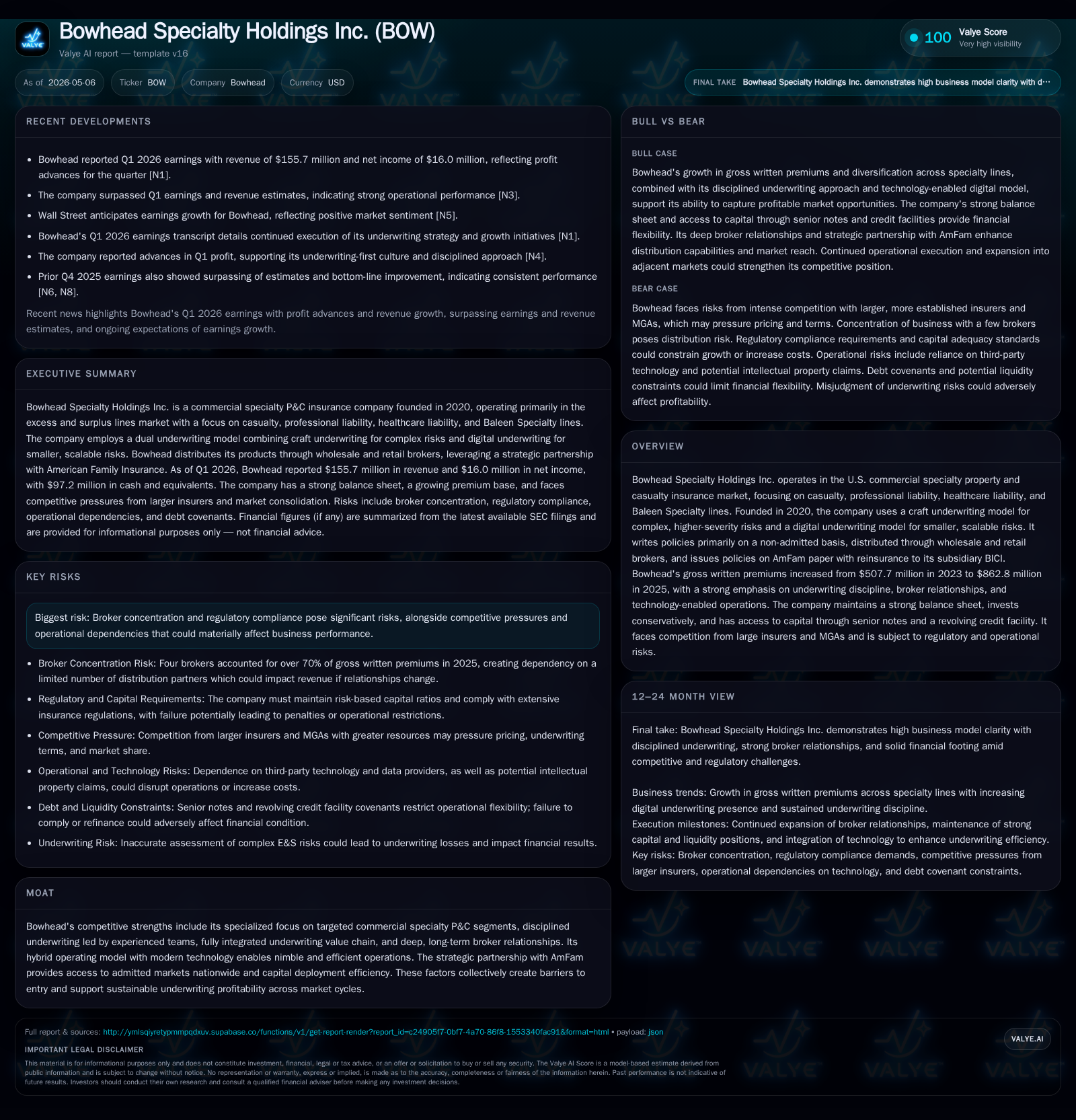
In its latest quarterly filing and concurrent event update, Bowhead Specialty Holdings refined its quota share reinsurance agreement with American Family Mutual, enhancing strategic flexibility tied to premium thresholds. Its dual underwriting platform — combining craft expertise for complex risks and a digital model for smaller policies — remains core to expanding market share in specialty casualty, professional, and healthcare liability segments. The company continues leveraging its scale, broker relationships, and technology to drive disciplined underwriting profitability amid competitive and regulatory challenges. Going forward, monitoring quota share renewal terms, GWP growth trajectories, and reserve developments will be critical indicators of execution momentum and risk management efficacy.
Latest Quarterly Operating Highlights and Strategic Agreement Update
Bowhead Specialty Holdings’ May 5, 2026 quarterly report (Form 10-Q) [S2] alongside a contemporaneous Form 8-K [S3] disclosed an important amendment to the company's amended and restated quota share reinsurance agreement with American Family Mutual Insurance Company (AmFam). Effective May 4, 2026, this amendment notably revises AmFam’s termination rights linked directly to the aggregate gross written premium (GWP) generated by Bowhead Underwriting Services.
This adjustment strategically enhances Bowhead’s operational flexibility by recalibrating threshold triggers which dictate AmFam’s ability to terminate the agreement — a key contractual lever influencing Bowhead’s capital deployment capacity and underwriting scale. By securing greater stability or predictability around quota share tenure tied to Bowhead’s production levels within its managing general agency (MGA), the company safeguards an essential backbone of its distribution ecosystem.
At the same time, this episode underscores Bowhead’s collaborative relationship with AmFam. Issuance of policies on AmFam paper granted via BSUI is integral not only for access to admitted markets nationwide but also as the structural foundation underpinning Bowhead's efficient risk transfer mechanism where risks are retroceded fully to Bowhead Insurance Company Inc. (BICI). This partnership enables nimble scaling while prudently managing regulatory compliance challenges associated with excess & surplus (E&S) lines underwriting.
Bowhead’s Dual Underwriting Model: Craft Expertise Meets Scalable Digital Execution
Bowhead differentiates itself through a bifurcated underwriting architecture balancing craft underwriting expertise with technology-powered digital processes [S1]. The "craft" model centers on experienced underwriters who deploy deep technical knowledge and long-tenured broker relationships to underwrite complex casualty, professional liability, and healthcare liability risks — segments characterized by higher severity exposures requiring nuanced risk evaluation.
Contrastingly, the digital model encompasses Baleen Specialty lines alongside express offerings targeting smaller or standard commercial risks that can be priced consistently at scale. This technology-enabled channel emphasizes efficiency via clear submission criteria, standardized policy forms on a non-admitted basis free from rate constraints, streamlining throughput without sacrificing disciplined risk selection.
Technology forms a core strategic asset through proprietary tools such as the Bowhead Risk Analysis Tools (BRATs). These facilitate accelerated yet precise pricing decisions informed by internal loss data collated continually across both models. The focus on minimizing repetitive tasks allows underwriters across cohorts to apply judgment where it matters most while maintaining operational discipline critical for sustainable profit margins.
The distribution strategy leverages wholesale and retail brokers as principal conduits into specialty niches. Broker relationships not only enhance deal flow but also create switching costs vital in specialty lines where trust in customized risk solutions commands premium pricing power.
Industry Positioning: Specialty P&C Market Dynamics and Competitive Moat
Operating within U.S. commercial specialty P&C—a sector encompassing casualty insurance including professional errors & omissions and healthcare liability—Bowhead navigates a space defined by fragmented competition yet bounded by barriers involving underwriting technical complexity [S1][S24].
The company's focus on E&S lines written mostly on a non-admitted basis permits nimble policy form customization beyond standard market rate regulation constraints but necessitates stringent regulatory adherence given disparate state frameworks. Regulatory environments continue evolving toward heightened enterprise risk management scrutiny under NAIC guidelines such as Own Risk Solvency Assessment (ORSA), implying sustained compliance investments.
Bowhead's moat is fortified through several interlaced factors: the deeply integrated underwriting value chain blending data analytics with seasoned risk assessors; long-term broker partnerships embedding Bowhead as trusted specialty solutions provider; an agile tech platform enabling rapid adaptation; plus access to robust admitted paper via AmFam that fuels capacity expansion without incremental capital strains.
These strengths collectively bolster sustainable underwriting profitability even amid cycles of increased competition or economic uncertainty that often depress pricing or increase claims severity in specialty casualty sectors.
Drivers Behind Sustainable Underwriting Profitability and Growth Potential
Growth levers revolve around disciplined origination expansion emphasizing quality over volume within targeted casualty specialties [S1][N2]. The quadra-model approach scales smaller risks through express offerings while preserving craftsmanship standards on larger policies with bespoke coverage needs.
Technological integration reduces unit costs allowing margin improvement as volume scales without linear expense growth. GWP leapfrogged from approximately $507.7 million in 2023 to $862.8 million in 2025 validating positive market reception across both models.
Capital efficiency gains accrue materially from issuing policies on AmFam paper enabling risk transfer inwardly via quota share retrocession to BICI without each incremental policy requiring standalone capital buffer buildup. This construct preserves regulatory capital while accelerating balance sheet leverage to revenue.
Further tailwinds stem from ongoing enhancements in BRATs facilitating better loss anticipation feeding tighter pricing controls that protect combined ratios against adverse development or social inflation trends prevalent in professional liability sectors.
Risks and Watchpoints: Broker Dependencies, Regulatory Factors, and Market Cyclicality
Broker concentration remains a pronounced vulnerability given their outsized influence over access to end customers [S1][S24]. Any dilution or shift away from key broker partners could constrict new business inflows markedly. Similarly, regulatory complexity especially in E&S lines exposes Bowhead to compliance cost inflation or license risks if oversight tightens or interpretations shift unfavorably.
Reserve adequacy poses perennial watchpoints owing to unpredictability around social inflation driving claim frequency/severity surges beyond modeled actuarial assumptions potentially pressuring loss reserves [S26]. Also material is timely reimbursement from reinsurers; delays here can strain liquidity unexpectedly.
Insurance inherently displays cyclicality; hard markets can quickly invert upsetting growth trajectories as competition intensifies or pricing softens leading to margin compression quarter-to-quarter affecting earnings stability.
Forward-Looking Triggers: What to Monitor in Coming Quarters
Key metrics will include continued GWP momentum disaggregated by craft versus digital channels as lead indicators for sustainable top-line growth post-quota share amendment implementation [S2][S3][N4]. Monitoring claims reserves movements will illuminate loss development trends critical for assessing reserve adequacy sustainability.
Renewal terms under the amended quota share agreement warrant close scrutiny for any hint of tightening or potential termination moves by AmFam as this underpinning relationship governs distribution capability significantly. Additionally, progress reports related to technology adoption enhancing underwriting cycle times could presage improved operational leverage amplifying margin expansion potential.
Earnings calls may provide guidance updates or insights into capital deployment intentions aligning with growth plans triggered by recent strategic flexibility gains afforded through the reinsurance amendment.
Concise Financial Profile: Balance Sheet Strength and Capital Access
Latest financial snapshot
| Metric | Value | Period |
|---|---|---|
| Cash & equivalents | $97mm | |
| 2026-03-31 | ||
| Total debt | $147mm | |
| 2026-03-31 | ||
| Net debt | $49mm | |
| 2026-03-31 |
Source: SEC companyfacts cache [F1].
As of March 31, 2026 ([F1]), Bowhead maintains approximately $97.2 million in cash & equivalents contrasted against about $146.5 million total debt yielding net debt near $49.3 million. This moderate leverage level strikes a balance between fueling expansion initiatives while preserving financial flexibility.
The company benefits additionally from a senior secured revolving credit facility amounting up to $35 million with accordion capacity plus publicly issued senior notes totaling $150 million due in 2030 ([S4][S5][S6]). These capital instruments collectively provide liquidity buffers enabling prudent underwriting portfolio scaling without immediate pressure on external funding dependence.
Disclaimer: This analysis is based solely on publicly filed SEC documents dated through May 5, 2026 ([S1]-[S29]) along with corroborating news transcripts ([N1]-[N5]) provided herein. It does not constitute investment advice but rather an informational review grounded exclusively in disclosed operating facts without speculative projections beyond stated evidence.
Disclaimer: This is research-only, informational analysis and not investment advice. It may include AI-generated interpretation and general industry context. Always verify important details using primary sources.

Comments