
Oil States International fortifies custom-engineered project backlog amid evolving oil and gas demand
Latest quarterly filings reveal Oil States International’s stable backlog and strong liquidity position underpinning its specialized oilfield services amid a cyclical market.
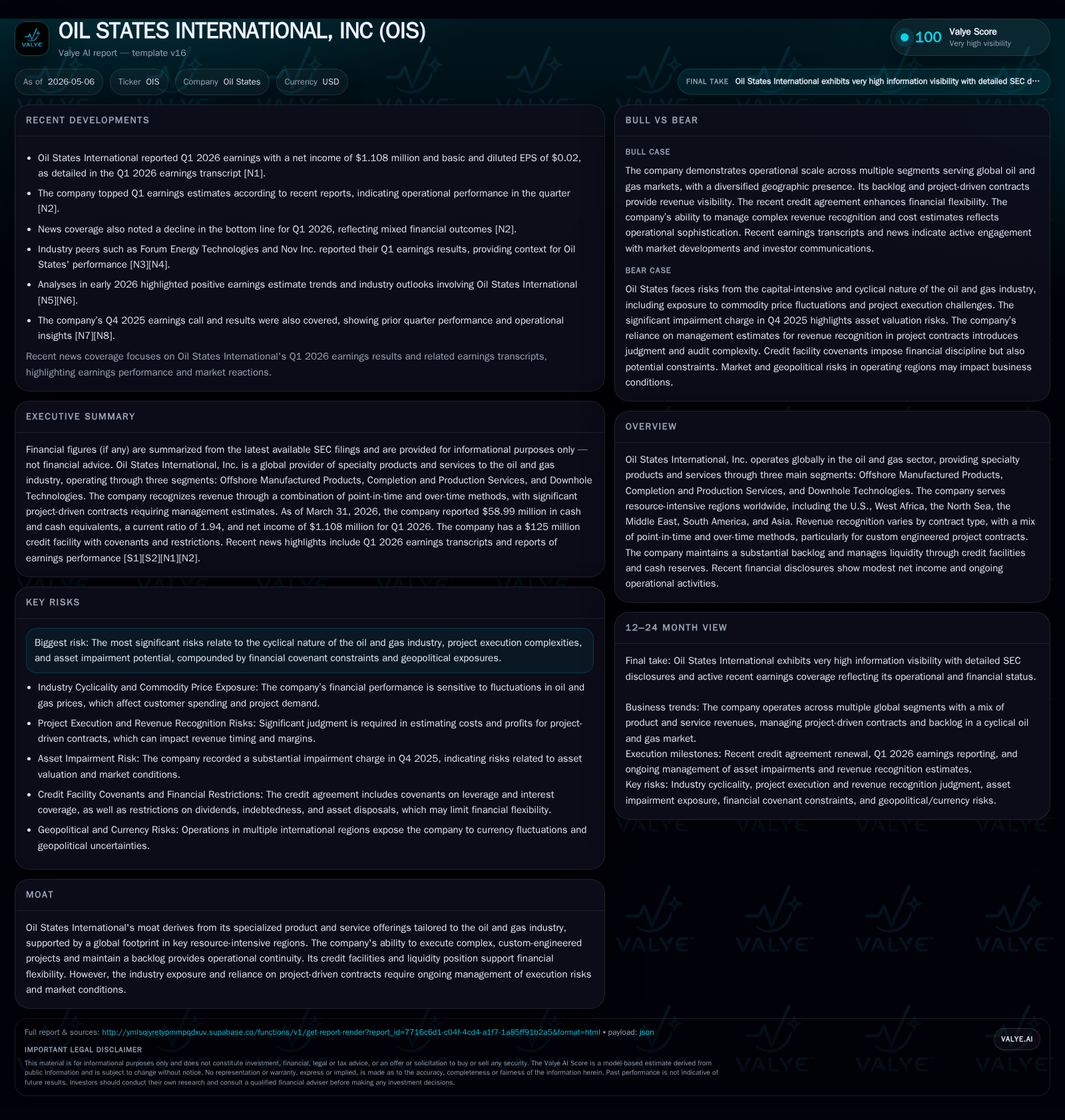
Oil States International’s first-quarter 2026 disclosures confirm operational resilience through a healthy backlog and disciplined liquidity management, supported by a global footprint in key oil and gas regions. The company’s business model centers on three specialized segments that emphasize engineered solutions and project execution, which sustain customer switching costs and revenue visibility. While industry cyclicality and project execution risks persist, the company’s backlog and contract mix provide a level of demand stability. Key growth will depend on capital spending patterns across geographical zones and successful contract awards.
Latest Quarterly Operating Update and What It Signifies
Oil States International’s Q1 2026 Form 10-Q filing dated May 5, 2026 [S2] reveals continued operational stability characterized by a robust backlog that underpins revenue visibility into future periods. The company utilizes varied revenue recognition methodologies aligned with contract types—off-the-shelf product sales are typically recognized at a point in time while custom-engineered project contracts employ over-time recognition methods based on project milestones or completion percentages. This nuanced revenue accounting aligns cash flows more closely with project progress for enhanced predictability.
The filing details modest net income levels consistent with ongoing investment in operations amidst a backdrop of fluctuating end-market demand. Liquidity remains healthy with $58.99 million in cash and equivalents against minimal total debt of roughly $1.53 million as of quarter-end [F1]. This net cash positioning (-$57.46 million net debt) supports working capital needs for executing backlog projects which contain significant engineering complexity requiring upfront expenditure.
The current ratio of 1.94 reflects adequate short-term asset coverage over liabilities facilitating smooth operational funding [F1]. Notably, the simultaneous 8-K filing [S3] emphasizes no material changes to risk factors or liquidity constraints reinforcing management's confidence in navigating both cyclical headwinds and expanding select project scopes.
Business Model and Specialized Product Offerings
Oil States International generates revenue via three primary operating segments delineated in their latest annual report amendment (10-K/A) from March 26, 2026 [S1]:
- Offshore Manufactured Products: Custom-engineered equipment predominantly for offshore drilling platforms including risers, tension legs, and related structural components.
- Completion and Production Services: Specialized services supporting well completion phases including pressure control equipment rental, testing services, and intervention technologies.
- Downhole Technologies: Proprietary tools and technologies deployed within the wellbore such as packers, perforating systems, and logging tools.
These segments collectively serve high-value, technically demanding areas of upstream oilfield activity—with products often involving bespoke engineering design creating high customer locking points. Contractual structures range from product sales to long-term service agreements that necessitate sophisticated revenue recognition approaches reflective of project delivery timelines.
Given the capital-intensive nature of their offerings, Oil States’ ability to execute complex manufacturing projects globally—across the US Gulf Coast, North Sea, West Africa, Middle East, South America, and Asia—positions it as a valued partner in capital spending cycles of large energy providers [S1]. The geographic diversification mitigates exposure to regional downturns although macro oil price cyclicality imposes overarching demand constraints.
Industry Context and Competitive Positioning
The broader oilfield services sector is cyclical with spending heavily correlated to commodity price trends influencing upstream capex budgets. Oil States competes among specialized mid-tier companies focusing on engineered product niches where technical expertise limits direct competition with broader-service entities like Schlumberger or Halliburton.
Recent industry earnings releases highlight competitive pressures balanced by regulatory influences affecting tender awards especially in mature fields like the North Sea or West Africa [N3]. Oil States' international presence is complemented by an established reputation for delivering turnkey engineered solutions which offer differentiation compared to commoditized offerings. A peer comparison including Forum Energy Technologies reinforces Oil States’ niche focus on manufactured offshore products versus multi-service completions providers [N3].
Regulatory environments remain an ongoing factor in market access; however, Oil States' compliance track record supports continued bidding eligibility across key basins. This regulatory acceptance combined with deep customer relationships builds barriers for new entrants focused on these specialized segments.
Growth Drivers: Backlog, Global Footprint, and Market Demand
The company’s sizable backlog disclosed in filings serves as a near-term growth indicator providing revenue visibility beyond quarterly cycles. This backlog predominantly consists of custom contracts employing over-time revenue recognition reflecting milestones achieved rather than point-in-time product delivery alone—a strategic element supporting stable cascading cash flows despite underlying cyclicality [S2].
Geographic diversity enables participation in multiple recovery phases globally—from North Sea reactivation programs to emerging deepwater projects in South America or Asia—providing multi-market options should certain regions experience localized downturns [S1], [N1].
Commodity price stabilizations have supported a partial recovery in offshore capex cycles driving customer authorization delays lower while stimulating new orders for complex engineered components integral to drilling platform refurbishments or expansions [N1]. Order intake velocity as reflected in subsequent earnings releases acts as a barometer for shifting end-user spending priorities tied closely to upstream activity levels.
Longer-term growth levers could also derive from leveraging technological innovations within downhole tools or expansion into adjacent service lines though these remain less emphasized currently relative to core backlog execution themes.
Key Risks and Operational Constraints to Monitor
Despite positive backlog signals, Oil States must actively manage chronic risks inherent to its capital-intensive model. The cyclical nature of oil prices directly impacts client capital allocation decisions potentially delaying projects or compressing pricing power [S25]. Project complexity introduces execution risks including schedule slippages or cost overruns that can diminish margin realization particularly under fixed-price arrangements.
The latest Annual Report amendment highlights prior instances where asset impairments occurred within Downhole Technologies indicating sensitivity to market value adjustments under weaker demand scenarios [S1]. Further risks include geopolitical developments that can disrupt operational zones—West Africa and Middle East exposures require ongoing monitoring.
Finally, customer concentration risk exists but is partly offset by geographic dispersion.
Catalysts and Milestones to Watch Next
Future quarters will reveal whether sustained order book growth materializes particularly through contract awards in high-growth emerging markets such as South America or Southeast Asia where infrastructure pipelines for offshore development are expanding [N1], [N2]. Monitoring order intake pace relative to backlog conversion rates will signal demand momentum or softening.
Technological advancements announced regionally may reinforce competitive moats if they translate into improved operational efficiency or expanded service suites — though no specific launches are currently flagged publicly. Commodity price trajectories remain critical macro signals modulating customer procurement timing hence aligning OIS updates around earnings calls becomes important.
Additionally, watching management commentary regarding any strategic shifts toward diversified product lines or increased aftermarket service penetration could refine the growth outlook.
Current Financial Profile and Balance Sheet Strength
Latest financial snapshot
| Metric | Value | Period |
|---|---|---|
| Cash & equivalents | $59mm | |
| 2026-03-31 | ||
| Total debt | $1529000 | |
| 2026-03-31 | ||
| Net debt | $-57mm | |
| 2026-03-31 | ||
| Current assets | $480mm | |
| 2026-03-31 | ||
| Current liabilities | $248mm | |
| 2026-03-31 | ||
| Current ratio | 1.94x | |
| 2026-03-31 |
Source: SEC companyfacts cache [F1].
As per the latest quarter ending March 31, 2026 data pulled from companyfacts [F1] alongside SEC filings:
| Metric | Value |
|---|---|
| Cash & Equivalents | $58.99 million |
| Total Debt | $1.53 million |
| Net Debt | -$57.46 million |
| Current Assets | $480.27 million |
| Current Liabilities | $248.09 million |
| Current Ratio | 1.94 |
Disclaimer: This analysis is based strictly on publicly available SEC filings and news sources up to May 6, 2026. It does not constitute investment advice but aims to evaluate Oil States International’s operating position grounded on recent data without speculative forecasts or unverified assumptions.
Disclaimer: This is research-only, informational analysis and not investment advice. It may include AI-generated interpretation and general industry context. Always verify important details using primary sources.

Comments