
Qwest Completes $5.75B Mass Markets Fiber Sale, Focuses on Network Modernization and AI-Driven Growth
Qwest Corp’s Q1 2026 report marks a strategic pivot post-divestiture, concentrating on enterprise digital networking amid legacy service erosion and competitive pressures.
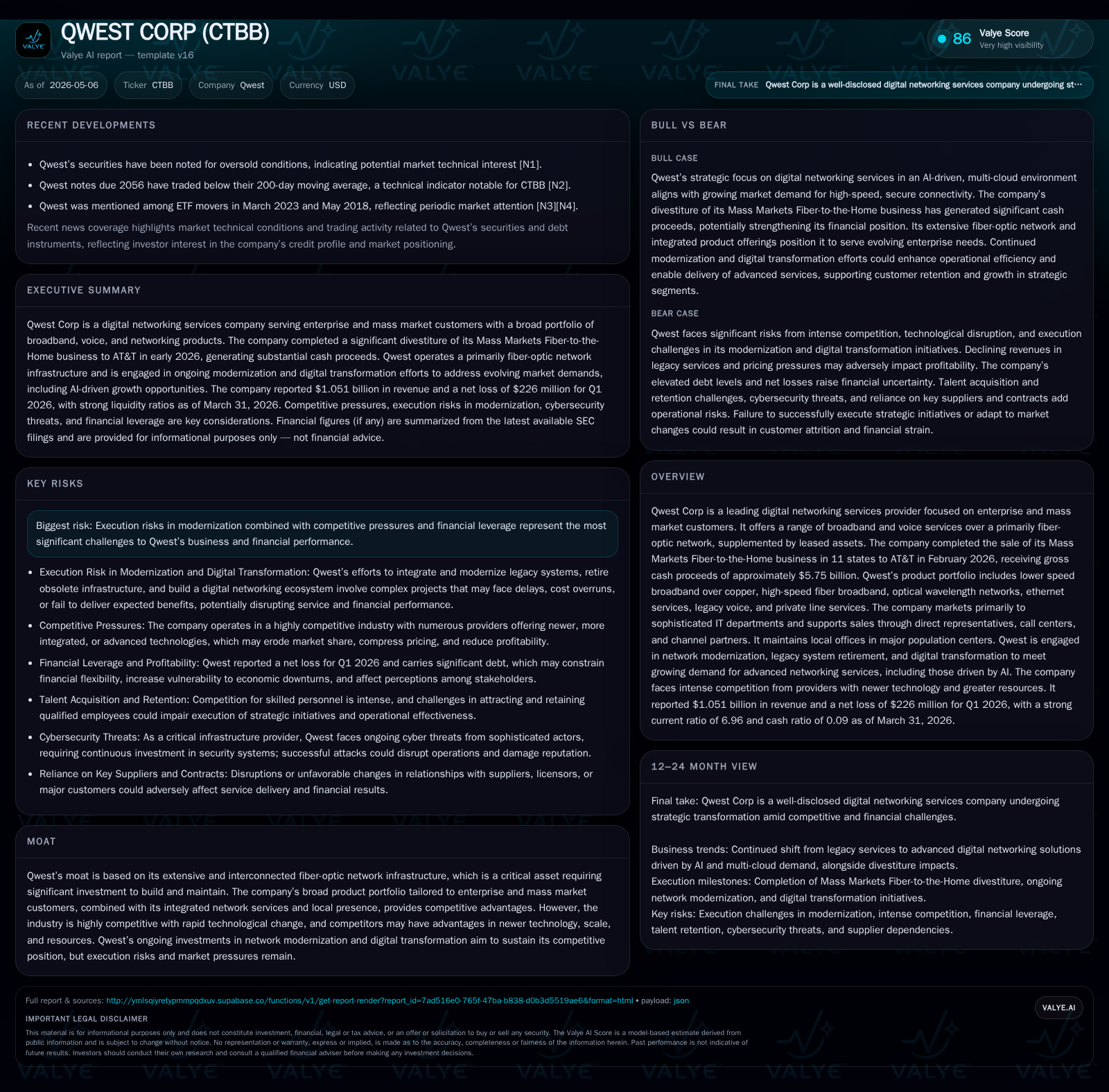
In Q1 2026, Qwest Corp finalized the divestiture of its Mass Markets Fiber-to-the-Home assets in 11 states to AT&T for approximately $5.75 billion in gross cash, refocusing its business on serving enterprises with next-generation digital networking solutions. The company faces ongoing challenges in transforming legacy infrastructure and navigating intense industry competition while betting on AI-driven demand growth to sustain its fiber network’s relevance. Although financial leverage remains substantial, Qwest’s execution on modernization and customer migration will determine its resilience and growth trajectory.
Recent Operating Update
Qwest Corporation’s May 2026 quarterly filing ([S2]) reveals a pivotal moment following its February completion of the Mass Markets Fiber-to-the-Home divestiture in 11 states to AT&T for gross proceeds of approximately $5.75 billion. The transaction crystallizes Qwest’s strategic refocus from broad consumer broadband to a more concentrated emphasis on enterprise-centric digital networking services tailored for the burgeoning multi-cloud and AI-driven marketplace. Operationally, Qwest has entered into transition services agreements that position it to work closely with AT&T during asset handoffs while maintaining certain long-term reciprocal commercial arrangements. This structural change tightens Qwest’s product set around high-speed fiber broadband aimed primarily at business customers alongside complementary legacy voice and Ethernet-based services [S2][S21].
The company reports navigating ongoing macroeconomic headwinds including inflationary pressures on labor and materials costs as well as supply chain constraints impacting network transformation projects. Despite these challenges, management underscores a commitment to advancing network modernization initiatives designed to retire obsolete platforms and automate service delivery through a digital ecosystem aligned with AI-era connectivity requirements [S2].
Business Model
Qwest derives revenue by providing telecommunications and data networking services predominantly over an extensive fiber-optic backbone supplemented by leased assets where needed. Its offerings span lower speed copper broadband (primarily residual from legacy infrastructure), high-speed fiber broadband, optical wavelength networks for ultra-high capacity transmission, Ethernet services for business connectivity solutions, traditional voice products, and private line circuits.
Revenue mechanics consist of contracts primarily with sophisticated corporate IT departments seeking reliable high-throughput connections with secure network characteristics essential for multi-cloud applications. Pricing levers include volume commitments with some contractual bundling across services enabling integrated solutions. Margins underpinning the business are sensitive to product mix shifts; fiber offerings command higher returns than declining legacy voice or copper broadband revenues which face commoditization pressure.
Customer engagement occurs via direct salesforces targeting enterprise IT professionals familiar with complex telecom procurement supported by inbound call centers and third-party channel partners including telecom agents and system integrators. Local offices dispersed within major population centers enable timely support and foster trust relationships. The blend of direct and indirect channels provides some insulation against rapid market share loss but also reflects a cost base requiring efficient deployment of sales resources [S18].
Industry Structure and Competitive Position
The telecommunications industry that Qwest operates in is characterized by heavy capital intensity due to infrastructure buildout and maintenance demands along with rapid technology evolution significantly impacting competitive dynamics. Competitors include national carriers maintaining newer integrated networks as well as hyperscale cloud providers who have increasingly deployed their own backbone connectivity reducing reliance on incumbent networks.
Qwest’s moat is anchored in its entrenched interconnected fiber-optic infrastructure—a critical barrier given the high investment required to duplicate such assets—combined with its breadth of managed network products designed for enterprise needs. However, competitors often wield advantages stemming from larger scale operations, deeper financial resources permitting accelerated modernization investments, or broader integrated product portfolios incorporating wireless or cloud-native services.
Price competition remains fierce; commoditization particularly impacts legacy voice offerings and lower-tier broadband where substitution from wireless or alternative technologies accelerates erosion in pricing power. Technological obsolescence risk mandates swift migration capabilities away from copper-based products toward fiber-centric solutions alongside the cultivation of new AI-enhanced connectivity demands [S27].
Growth Drivers
Key growth vectors center around increased demand for high-speed reliable digital connections driven by:
- AI-Enabled Services: The anticipated rise of generative AI workloads imposes stringent low-latency requirements coupled with enhanced bandwidth needs that fuel upgrades in optical wavelength networks and Ethernet domains.
- Multi-Cloud Integration: Enterprises accelerating cloud migrations require connective fabric simplifying hybrid cloud-to-on-premise communications which Qwest aims to fulfill through agile network offerings.
- Network Modernization: Digital transformation investment unlocks operational efficiency gains potentially improving margins while enabling faster time-to-market for new product variants.
- Customer Migration: Moving clients from declining legacy voice/copper broadband onto fiber-based platforms supports revenue sustainability despite shrinking traditional lines.
These drivers tie directly to measurable outcomes such as technology refresh cycle completions, backlog growth in fiber-related service orders, customer retention rates among migrated accounts, pricing lift within premium product categories, and utilization rates across modernized network assets ([S1], [S2]).
Risks / Watchpoints / Growth Constraints
Execution hazards loom large given the complexity inherent in integrating modern digital platforms while decommissioning entrenched legacy systems that may disrupt service continuity or inflate costs if mishandled. Inflationary pressures further strain capital budgets amid rising labor/material expenses necessary for transformation projects.
Competitive pressures could accelerate price compression especially if larger rivals exploit scale economies or cloud providers internalize more network carriage reducing Qwest’s addressable market segments. Regulatory uncertainty—highlighted by federal/state investigations into lead-sheathed cables embedded within older copper infrastructure—poses potential liability exposure inflating repair or remediation costs.
Financially elevated leverage constrains flexibility; net debt near $1.683 billion requires vigilant cash flow management to fund ongoing capex without compromising liquidity metrics ([F1]). Supply chain vulnerabilities for essential fiber optic equipment represent another structural risk delaying rollout plans.
Finally, fluctuating demand assumptions tied to the pace at which AI application adoption materializes introduce forecast sensitivity; slower-than-expected uptake risks misallocation of scarce resources [S1][S25][S26].
What to Watch Next
Market participants should monitor several critical inflection points:
- Legacy Customer Migration Progress: Rate at which customers transition off legacy products towards Qwest’s strategic portfolio indicates success in mitigating revenue erosion trends.
- Transition Services Execution: Effective cooperation with AT&T under transition agreements post-sale may impact operational efficiency and customer experience.
- Network Upgrade Milestones: Completion timelines for infrastructure modernization schemes directly affect ability to serve emerging bandwidth-intensive AI workloads effectively.
- Bookings/Backlog Trends: Increases in contracted orders within fiber broadband segments reflect growing demand validation.
- Capex Spending Trajectory vs Efficiency Gains: Balancing repair/replacement capital requirements against realized productivity improvements foreshadows margin evolution.
- Guidance Updates: Explicit management commentary around demand patterns for next-gen networking products amidst evolving macro conditions remains crucial [S2][S21].
Financial Profile Summary
Latest financial snapshot
| Metric | Value | Period |
|---|---|---|
| Cash & equivalents | $56mm | |
| 2026-03-31 | ||
| Total debt | $1739mm | |
| 2026-03-31 | ||
| Net debt | $1683mm | |
| 2026-03-31 | ||
| Current assets | $4.45bn | |
| 2026-03-31 | ||
| Current liabilities | $640mm | |
| 2026-03-31 | ||
| Current ratio | 6.96x | |
| 2026-03-31 |
Source: SEC companyfacts cache [F1].
As of March 31, 2026 ([F1]), Qwest holds cash & equivalents totaling approximately $56 million against total debt approaching $1.739 billion yielding net debt near $1.683 billion.
Given these elements, Qwest maintains access to capital markets through intercompany financing arrangements under parent Lumen Technologies’ umbrella but must navigate leverage prudently amid an aggressive capex program required by rapid technological shifts ([S2],[S19]).
This analysis incorporates public SEC filings up through May 5th, 2026 alongside recent news briefs reflecting secondary market activity but does not constitute investment advice or recommendations.
Disclaimer: This is research-only, informational analysis and not investment advice. It may include AI-generated interpretation and general industry context. Always verify important details using primary sources.

Comments