
Estrella Immunopharma’s Clinical Momentum and Capital Strategy Underpin Pipeline Value
Recent Phase II trial advancements and a $100 million capital raise anchor Estrella Immunopharma’s near-term operational narrative amid financial constraints.
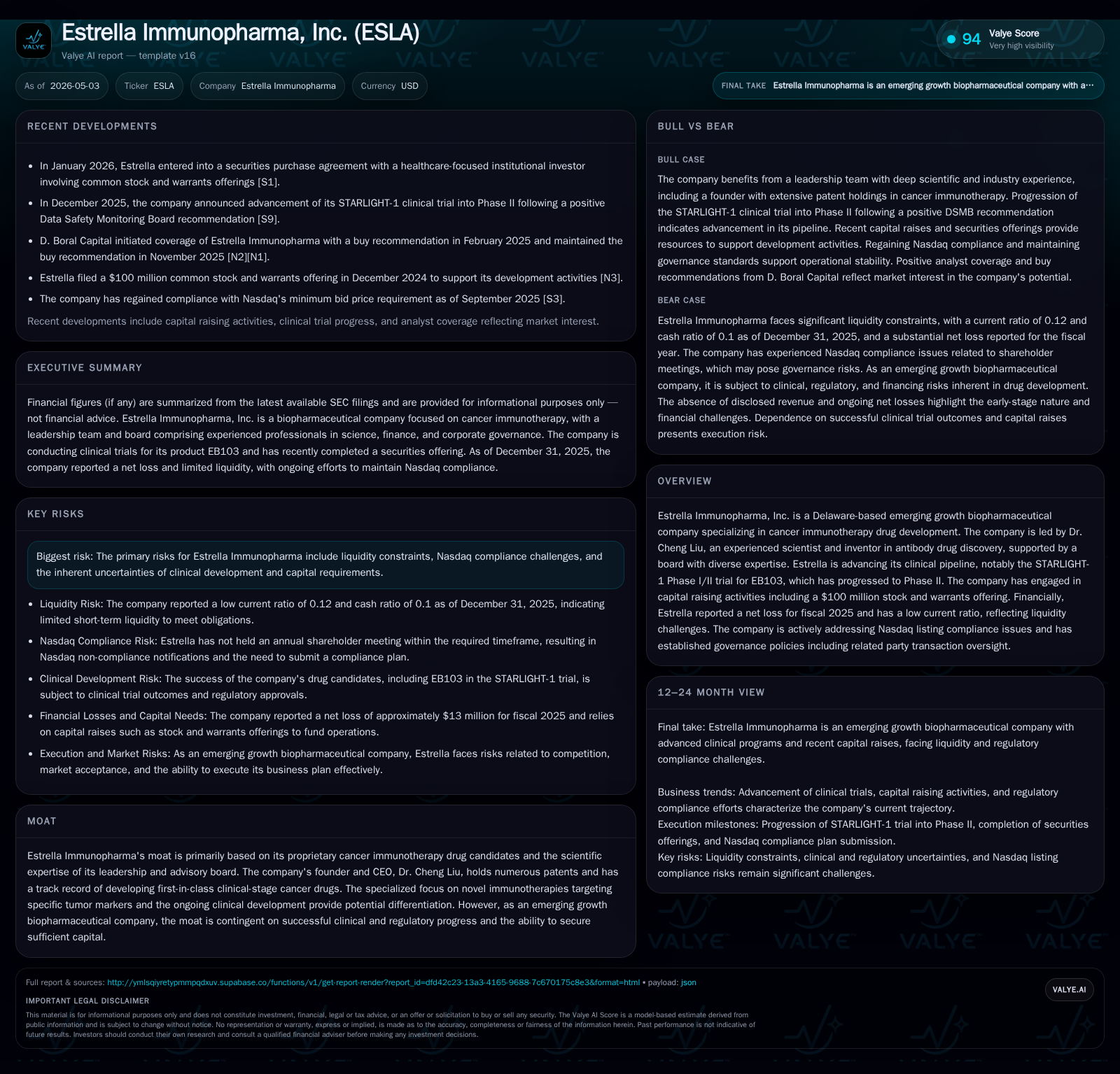
Estrella Immunopharma recently announced the advancement of its STARLIGHT-1 Phase I/II trial of EB103 into Phase II, supported by positive DSMB recommendations. Concurrently, the company secured approximately $100 million through a combined stock and warrant offering, vital for supporting its cash-intensive clinical development in cancer immunotherapy. While the company’s proprietary antibody-based immunotherapy candidates and experienced leadership position it within a competitive biopharma landscape, its severely negative current ratio and Nasdaq compliance challenges highlight material liquidity and execution risks. Upcoming milestones around trial readouts and regulatory steps will be key to validating pipeline prospects and sustaining investor interest.
Latest Operating Update: Clinical Progress and Capital Raise
In its November 2025 quarterly report [S2], Estrella Immunopharma disclosed pivotal developments that reset its near-term operational outlook. The company has advanced its lead asset EB103 into the Phase II portion of its ongoing STARLIGHT-1 Phase I/II trial [S3,S8], following a favorable safety and efficacy recommendation from the Data Safety Monitoring Board (DSMB). This internal milestone not only validates the therapeutic premise of EB103 but also signals readiness to assess preliminary efficacy endpoints in an expanded patient cohort.
Complementing this clinical progress, Estrella completed a substantial capital raise totaling nearly $100 million through a combination of registered direct common stock issuance and warrants private placement executed in early January 2026 [S15,S18]. This funding infusion is critical given the company's constrained liquidity position detailed later, enabling continuation of costly clinical trials without immediate dilution risks inherent in more frequent financings.
Together, these events — the transition to Phase II studies backed by DSMB endorsement and an extensive financing round — serve as operational catalysts that underpin Estrella’s strategic efforts to advance its immunotherapy pipeline amidst capital markets pressure.
Business Model and Product Innovation in Cancer Immunotherapy
Estrella’s business model revolves around discovery, clinical development, and eventual commercialization or licensing of monoclonal antibody therapies designed to modulate immune responses against solid tumors. The company's lead candidate EB103 is part of a broader pipeline rooted in novel antibody constructs that target specific tumor-associated antigens expressed across several malignancies.
Underpinning this innovation is Dr. Cheng Liu’s extensive patent portfolio in antibody engineering and a leadership team blending scientific expertise with commercial acumen [S1]. The firm operates with typical early-stage biotech economics: no product revenue yet, reliance on equity financing for R&D outflows, and focus on advancing assets through regulatory milestones which unlock valuation inflection points.
Revenue potential post-approval hinges on successful licensing deals or direct product sales in highly competitive immuno-oncology markets characterized by payers’ increasing scrutiny. Switching costs for customers—principally oncology providers—will depend on demonstrated incremental efficacy or safety advantages of Estrella’s therapies relative to approved immune checkpoint inhibitors or emerging combination regimens.
Competitive Positioning within the Emerging Biopharma Industry
Positioned within the crowded oncology immunotherapy space, Estrella competes with numerous emerging biotechs poised at similar developmental inflection points as well as large pharma incumbents with marketed PD-1/PD-L1 inhibitors. Its differentiation derives from a concentrated focus on unique tumor markers and proprietary antibody engineering strategies that might yield first-in-class or best-in-class agents if clinical proof-of-concept is achieved.
However, the industry remains heavily regulated with stringent FDA approval pathways demanding extensive clinical data sets. The company's innovation corridor leverages patent protection as a primary moat lever but depends on timely progression through phases I/II/III trials supported by substantial capital availability [S1]. Supply chain considerations are minimal currently given outsourced manufacturing typical of early-stage biotechs, while competitive pressures center overwhelmingly around accelerating trial timelines rather than price competition at this stage.
Growth Drivers: Pipeline Advancement and Market Opportunity
Estrella’s prospects hinge on successfully navigating clinical development milestones—especially interim Phase II readouts for EB103 that confirm safety profiles and preliminary efficacy signals [S3,S4]. Regulatory submissions contingent on these data will facilitate broader market evaluations and potential strategic partnerships or out-licensing arrangements.
Further expansion opportunities include pursuing additional indications for EB103 or devising combination therapies alongside established checkpoint inhibitors to capture larger oncology patient segments. These approaches align with biopharma trends favoring multi-modal immunotherapeutics for enhanced durable responses.
Investor sentiment often pivots on measurable KPIs such as enrollment rates in trials, DSMB safety endorsements (recently received), achievement of primary/secondary endpoints, new IND submissions, and capital raise success to fund these activities. Sustained R&D investment backed by recent fundraising underwrites these growth vectors.
Risks and Constraints: Financial Health, Regulatory Hurdles, and Execution
Despite promising operational developments, Estrella faces acute financial constraints evidenced by a distressingly low current ratio near 0.12 as of December 31, 2025 ([F1]), signaling a significant liquidity gap with current liabilities substantially exceeding short-term assets. This disparity underlines imminent cash runway concerns requiring careful cash management even after the recent $100 million capital infusion [S2,F1].
Concurrently, the company must comply with Nasdaq listing rules which it has struggled to fulfill timely—in particular delays in hosting annual shareholder meetings triggered formal notices from Nasdaq January 2026 [S14]. While these infractions have not led to delisting yet, continued noncompliance could impair access to capital markets or investor confidence.
Operational risks remain inherently high for any emerging biotech developing cancer immunotherapies due to long timelines for clinical validation, possibility of negative trial data setbacks, manufacturing scale-up challenges post-approval, and ever-evolving competitive landscapes with rapid innovation cycles.
Monitoring Milestones: What Investors Should Watch Next
Key near-term catalysts likely to influence Estrella’s trajectory include:
- Readout of Phase II data from the STARLIGHT-1 trial assessing EB103 safety/tolerability/efficacy outcomes [S3,S4]
- Regulatory communications including Investigational New Drug (IND) updates or filings for subsequent trials
- Progress on Nasdaq compliance plan submissions related to annual meeting scheduling enforcement [S14]
- Execution of further financing rounds or strategic partnerships building on recent $100 million offering closure [S18]
- Expansion announcements for additional indications leveraging existing antibody platforms
These milestones offer measurable indicators directly impacting valuation perceptions and operational momentum.
Financial Overview: Historical Trends and Liquidity Challenges
Historical performance (annual)
Capital returns and efficiency (annual)
Estrella's financials emphasize an intensifying investment phase typical for emerging biopharmaceutical companies betrothed in arduous drug development:
Operating losses grew nearly threefold year-over-year as R&D expenses ballooned alongside clinical activities [F1]. Despite lower operating cash outflows compared to prior year reflecting timing effects or milestone-driven spending cadence changes, the overall cash depletion trend persists.
This financial profile conveys high risk associated with sustaining operations absent successful clinical progress or incremental funding sources; burn rate acceleration mandates vigilant liquidity management going forward.
This analysis synthesizes public SEC filings through April 2026 alongside industry context customary for emerging biopharmaceutical enterprises specializing in cancer immunotherapy drug development. No investment advice is offered; readers should interpret content strictly as informed commentary based on disclosed corporate developments.
Disclaimer: This is research-only, informational analysis and not investment advice. It may include AI-generated interpretation and general industry context. Always verify important details using primary sources.

Comments