
Syntec Optics Raises $20 Million to Fuel Acquisitions and Operational Stability
Recent capital raise positions Syntec Optics for strategic growth amid ongoing financial losses and operational challenges.
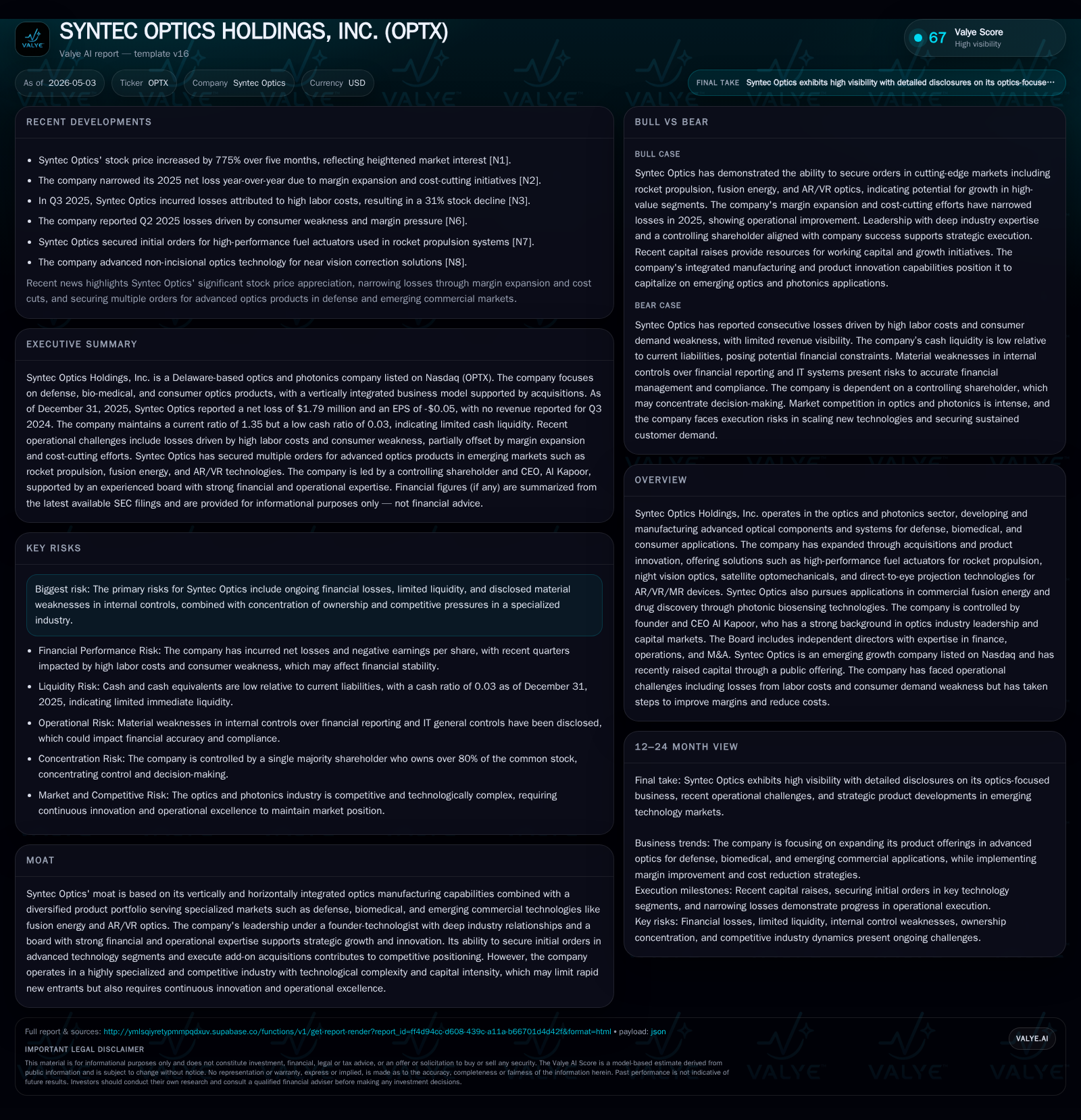
Syntec Optics Holdings, Inc. recently priced a $20 million public offering to strengthen its balance sheet and pursue acquisitions in complementary optics technologies. The company specializes in advanced optical components for defense, biomedical, and emerging commercial applications, leveraging a vertically integrated manufacturing model. Despite ongoing net losses and internal control weaknesses, the new capital aims to fund expansion while addressing debt. Growth hinges on successful integration of acquisitions, innovation in niche photonics segments, and operational improvements under experienced leadership.
Recent Operating Update
On April 28, 2026, Syntec Optics Holdings executed an underwritten public offering of approximately $20 million gross proceeds by selling common stock at $7.00 per share [S3]. The offering is expected to close imminently with potential upsize via an over-allotment option granted to underwriters. Net proceeds are earmarked primarily for acquisitions or investments in complementary optical technologies and businesses aligned with Syntec's multi-sector focus areas. Additionally, the company intends to allocate a portion of the funds towards working capital needs, capital expenditures, and optimizing its capital structure—explicitly including repayment of a $1.27 million subordinated term note held by its majority stockholder [S3]. This financing marks a critical step given ongoing operating losses and liquidity constraints.
Business Model
Syntec Optics operates as a developer and manufacturer of advanced optical components serving defense systems (notably fuel actuators for rocket propulsion), biomedical photonics (for drug discovery biosensing), consumer-oriented AR/VR/MR devices (direct-to-eye projection optics), satellite optomechanics, and emerging commercial fusion energy sectors [S1]. The firm's revenue mechanics revolve around project-based orders concentrated in specialized markets requiring both volume customization and high precision fabrication capabilities.
Its vertically integrated manufacturing approach combines design innovation with control over critical production steps—from lens fabrication to assembly—which aids quality assurance across diverse applications. Customers typically pay based on customized contract terms that factor in volume commitments, complexity (mix), and occasional milestone-linked deliverables. Pricing power is nuanced: strong in defense-related contracts due to high technical barriers but potentially more competitive in emerging commercial segments where technology cycles are faster.
Retention is supported through technical collaboration with key accounts—particularly government agencies—but sales cycles can be elongated given product complexity and certification processes. The company's diversified portfolio reduces reliance on any single sector but demands agile capacity management to align with varied demand rhythms.
Industry Structure and Competitive Position
The optics and photonics industry is capital intensive with significant R&D requirements addressing evolving technology nodes such as free-space optics for satellites or novel projection methods for AR devices. Syntec's moat arises from its combined vertical/horizontal integration along with a diversified end-market presence that spans defense contracting—often less price-sensitive but highly regulated—and commercial innovation-driven segments.
Competition includes both established optics manufacturers able to leverage scale in standard components, as well as nimble specialists targeting niche applications like direct-to-eye waveguides or satellite platforms. Barriers to entry are raised by the precision required in manufacturing processes plus stringent regulatory compliances—especially in aerospace/defense—but continuous innovation remains essential.
Syntec is positioned as an ecosystem builder under CEO Al Kapoor's leadership; the Board’s participation brings deal-making prowess crucial for executing the planned add-on acquisitions that will expand technological reach and broaden customer base [S1].
Growth Drivers
- Strategic Acquisitions: The freshly raised capital targets bolt-on acquisitions to enhance proprietary tech stacks or access new end markets; these will accelerate growth if effectively integrated without dilutive overhead.
- Defense Contracts Expansion: Increased government spending on advanced propulsion systems and night vision optics supports structural demand growth with durable contract inflows.
- Biomedical Photonics Adoption: Growing interest in photonic biosensing solutions for drug discovery presents sizable long-term opportunity tied to healthcare innovation trends.
- AR/VR Market Dynamics: Rising consumer device penetration fuels demand for direct-to-eye optics; success depends on staying ahead of rapid product development cycles within this segment.
- Operational Margin Improvements: Focused cost controls alongside scaling manufacturing throughput should gradually improve margin profiles observed narrowing loss trends reported earlier [N1].
Risks / Watchpoints / Growth Constraints
- Financial Health: Despite the recent equity infusion, Syntec still faces ongoing net losses ($-1.79 million in 2025) amidst limited cash balances (~$325K) creating short-term liquidity pressures [F1]. Debt levels remain material relative to the balance sheet with over $2.68 million outstanding [F1].
- Internal Controls Weaknesses: Material deficiencies have been disclosed across accounting processes and IT controls which could undermine financial reporting reliability until remediated fully [S18].
- Industry Competition & Technological Complexity: Maintaining differentiation demands continuous R&D investment; failure risks commoditization or losing ground in fast-moving commercial tech segments.
- Customer Concentration & Long Sales Cycles: High dependence on large government/proprietary customers can lead to revenue lumpy variability.
- Execution Risk of Acquisitions: Integration missteps could strain management bandwidth or dilute strategic focus.
What to Watch Next
Key milestones include:
- Successful closing of the April 2026 equity offering and deployment of proceeds toward identified acquisition targets.
- Confirmation of repayment or restructuring of the subordinated note held by majority ownership.
- Quarterly updates on margin trends post-capital raise highlighting any impact from increased scale or cost efficiencies.
- Progress reports on remediation efforts surrounding internal control weaknesses affecting audit readiness.
- Evolution of backlog or bookings data signaling traction within defense or biomedical pipelines.
Financial Profile Contextualized
Latest financial snapshot
| Metric | Value | Period |
|---|---|---|
| Total debt | $3mm | |
| 2025-12-31 | ||
| Net debt | $2mm | |
| 2025-12-31 | ||
| Current assets | $15mm | |
| 2025-12-31 | ||
| Current liabilities | $11mm | |
| 2025-12-31 | ||
| Current ratio | 1.35x | |
| 2025-12-31 |
Source: SEC companyfacts cache [F1].
The latest comprehensive financial snapshot indicates total reported debt stood near $2.68 million as of December 31, 2025 with cash reserves at approximately $0.33 million three months prior [F1]. Current assets stand at over $15 million against current liabilities near $11.2 million delivering a current ratio of about 1.35 — suggesting moderate short-term liquidity coverage but constrained by the composition of those assets [F1]. Reported operating income was negative ~$518K for full year 2025 while net losses approached $1.8 million reflective of ongoing investment phases typical for growth-stage technology firms [F1]. The capital raise directly addresses these challenges by boosting working capital buffers and reducing leverage through repayment plans tied to shareholder loans [S3].
This analysis integrates recent SEC disclosures alongside external market context without issuing investment recommendations or forecasts. It aims to illuminate Syntec Optics Holdings' current operating environment, business model dynamics, competitive factors, growth prospects, risk exposures, and upcoming developmental focal points based strictly on documented evidentiary sources.
Disclaimer: This is research-only, informational analysis and not investment advice. It may include AI-generated interpretation and general industry context. Always verify important details using primary sources.

Comments