
374Water Inc. Advances Commercial Leadership with CEO Incentive Alignment
New executive compensation terms underscore focus on operational and strategic execution amid commercialization of patented waste treatment technology.
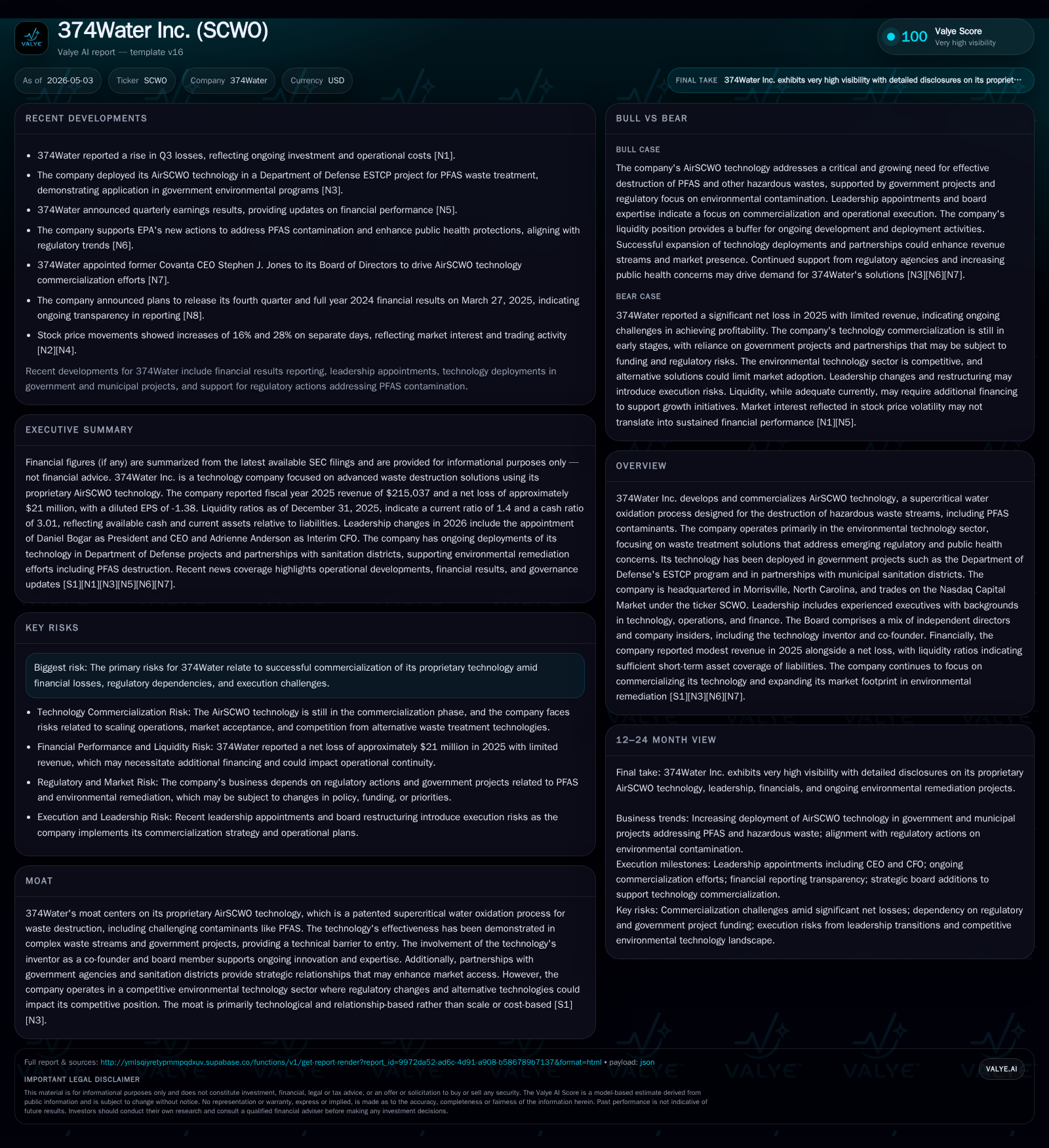
In its April 2026 8-K, 374Water Inc. formalized a performance-based employment agreement with CEO Daniel Bogar, aligning leadership incentives with operational and strategic milestones. This signals an intensified corporate emphasis on delivering commercial progress for its proprietary AirSCWO technology, a supercritical water oxidation process targeting hazardous and emerging contaminants such as PFAS. Supported by a solid technological moat and strategic government partnerships, the company is positioned in a regulatory-driven environmental remediation sector, though financial losses and execution risks persist. Near-term growth depends on licensing expansions and operational validation while liquidity remains sufficient to sustain development efforts.
Recent Leadership Update and Its Strategic Implications
On April 27, 2026, 374Water entered into a formal employment agreement with Daniel Bogar following his February appointment as President and Chief Executive Officer [S3][S28]. The agreement establishes an annual performance bonus target up to 100% of his base salary (pro-rated for 2026) split evenly between operational objectives — such as project milestones or commercial deployment benchmarks — and strategic goals encompassing broader corporate initiatives. This explicit alignment between compensation and measurable performance metrics represents a significant step in fortifying leadership accountability during the critical commercialization phase of the company's core AirSCWO technology.
Separately, substantial equity awards vested over quarterly installments starting June 2026 further incentivize sustained engagement from management [S28]. The severance provisions directed at protecting continuity but disincentivizing premature departure reinforce board confidence in stabilizing executive continuity amidst a complex operating backdrop.
This development reduces ambiguity around leadership’s mandate to deliver tangible outcomes beyond early-stage proof points that have characterized investor relations historically.
Business Model and Technology Overview: The AirSCWO Advantage
374Water's commercial offering centers on its patented AirSCWO (supercritical water oxidation) process designed to safely destroy toxic waste streams including persistent chemical pollutants like per- and polyfluoroalkyl substances (PFAS) [S1][N3]. The core chemical-physical mechanism leverages supercritical water conditions (above critical temperature and pressure) to achieve rapid oxidation reactions that mineralize contaminants without producing secondary hazardous residues common in conventional treatment methods.
Revenue generation primarily arises from licensing arrangements with municipal wastewater treatment facilities (as evidenced by the City of Orlando license approval), government-sponsored demonstration programs such as the Department of Defense's Environmental Security Technology Certification Program (ESTCP), and potential direct service contracts [S1][S4]. Pricing structures likely reflect contracts or licensing fees varying with throughput volumes, compliance scope, maintenance provisions, and duration.
Customer adoption is driven strongly by tightening regulatory mandates around PFAS and other emerging toxins alongside increasing public scrutiny demanding environmentally responsible disposal practices. Thus, demand is structurally supported by long-term regulatory trends rather than transient cyclical effects.
The complexity underpinning AirSCWO’s efficacy creates hurdles for would-be competitors, bolstered by intellectual property protection and the continued involvement of the original inventor as co-founder—a dynamic promoting ongoing innovation tailored to evolving waste profiles [S1]. Such embedded technological know-how provides a durable moat centered on expertise differentiation.
Competitive Landscape and Industry Dynamics
Within the environmental technology sector focused on hazardous waste remediation, 374Water competes against alternative chemical destruction technologies including plasma reactors, advanced oxidation processes relying on ultraviolet or ozone systems, incineration variants, and emerging biological treatments [S1][N3]. Its unique proposition—a fully oxidizing system operating under supercritical conditions—offers notable advantages in complete contaminant breakdown without toxic combustion byproducts.
Yet competition is nuanced: regulatory frameworks remain fluid globally influencing investment willingness by municipal authorities or defense agencies; pricing power is moderated given tight public budgets; specialized supply chains needed for pressure-resistant reactor vessels impact scalability; lastly, procurement cycles driven by grant funding waves foster project timing variability.
The company’s moat is thus predominantly technological rather than cost-scale based. Strategic government contracts form essential credibility nodes facilitating broader market penetration but also introduce dependency risks should policy priorities shift abruptly [S1].
Identified Growth Drivers and Market Expansion Opportunities
Growth prospects pivot heavily on expanded adoption within government sectors actively combating PFAS contamination alongside municipal wastewater entities seeking validated solutions [S4]. Specific catalysts include:
- License agreement approvals similar to the recently secured City of Orlando arrangement which concretizes revenue pathways through regional service mandates.
- Scaling manufacture and deployment capacity for AirSCWO units enabling multi-site rollouts amplifying volume-based revenue [S4][N3].
- Continued partnership expansions leveraging Department of Defense programs establishing technical credibility that can be cross-leveraged into civilian infrastructure domains.
- Incremental innovations enhancing unit efficiencies or adaptability broadening customer appeal across diverse industrial effluents.
These drivers are underpinned by growing global urgency around regulatory compliance deadlines coupled with limited well-proven alternatives for challenging contaminants. Measuring success through KPIs such as license application pipeline size, backlog of service contracts awarded versus bid submissions, unit utilization rates post-installation, or extension agreements would provide actionable insight into commercialization momentum.
Material Risks and Commercialization Challenges
Principal risks loom large considering early-stage commercial status:
- Persistently negative operating income (-$21 million in fiscal 2025) indicates high R&D costs concomitant with limited revenue ($215k in same period) casting uncertainty over near-term profitability [F1].
- Customer adoption remains contingent upon confirmed regulatory backing ensuring project financing; adverse policy shifts could dampen demand.
- The proprietary technology faces pressures from alternative methods advancing rapidly; however patents offer time-limited exclusivity necessitating continuous innovation [S1][N3].
- Execution risk remains non-trivial even with enhanced CEO incentives given historical volatility in project timelines characteristic of environmental tech deployments.
- Financial burn rate vis-à-vis current cash reserves (~$10.7M) mandates effective capital management or supplementary funding sourcing [F1].
These constraints require cautious optimism balanced with vigilant monitoring of operational delivery against plan.
Upcoming Catalysts and Monitoring Points
Investors seeking concrete signs of progression should focus on:
- Announcements concerning additional city or state licensing agreements extending beyond Orlando indicative of geographic market expansion [S4].
- Delivery schedules and performance outcomes from active or pilot projects under government sponsorships like ESTCP programs which serve as technical validation showcases [N3].
- Quarterly management disclosures addressing achievement levels against CEO performance bonus criteria delineated in the recent employment contract reflecting internal confidence in execution capability [S3].
- Developments regarding manufacturing capacity enhancements facilitating volume scale benefits.
- Potential strategic partnerships or capital raises that could accelerate commercialization timelines.
Tracking these data points will signal whether leadership’s incentive-driven focus translates into measurable business growth.
Current Financial Position and Operational Health Summary
Latest financial snapshot
| Metric | Value | Period |
|---|---|---|
| Current assets | $5.85mm | |
| 2025-12-31 | ||
| Current liabilities | $4.18mm | |
| 2025-12-31 | ||
| Current ratio | 1.4x | |
| 2025-12-31 |
Source: SEC companyfacts cache [F1].
374Water concluded fiscal year-end December 31, 2025 with cash & equivalents totaling approximately $10.65 million alongside negligible total debt (~$97 thousand) yielding a positive net cash position supportive of ongoing operations [F1]. Current assets stood at about $5.85 million against current liabilities near $4.18 million giving a current ratio around 1.4 which suggests manageable near-term liquidity gaps [F1].
Nonetheless, operating losses substantially exceeded revenues which were just above $215 thousand underscoring the pre-commercial stage nature of business activities dominated by continued investment in product development, project pipeline buildup, and market education [F1].
374Water’s recent formalization of CEO incentives combined with its strong technological moat positions it strategically within an environmental technology niche poised for secular growth driven by escalating waste regulation demands. However, material execution risks remain quantifiable primarily through commercialization pace relative to continuing losses. Close attention to forthcoming licensing expansions and project deliveries will be critical markers of sustainable advancement toward profitable scale.
This analysis is based solely on information from company filings dated up to May 2026 and does not represent investment advice or recommendations.
Disclaimer: This is research-only, informational analysis and not investment advice. It may include AI-generated interpretation and general industry context. Always verify important details using primary sources.

Comments