
Mercury Systems Refines Strategy and Cost Structure After Q3 Operating Review
The company's latest quarter reveals operational recalibrations through workforce reductions and receivables management, underscoring a tighter cost base amid evolving defense technology demands.
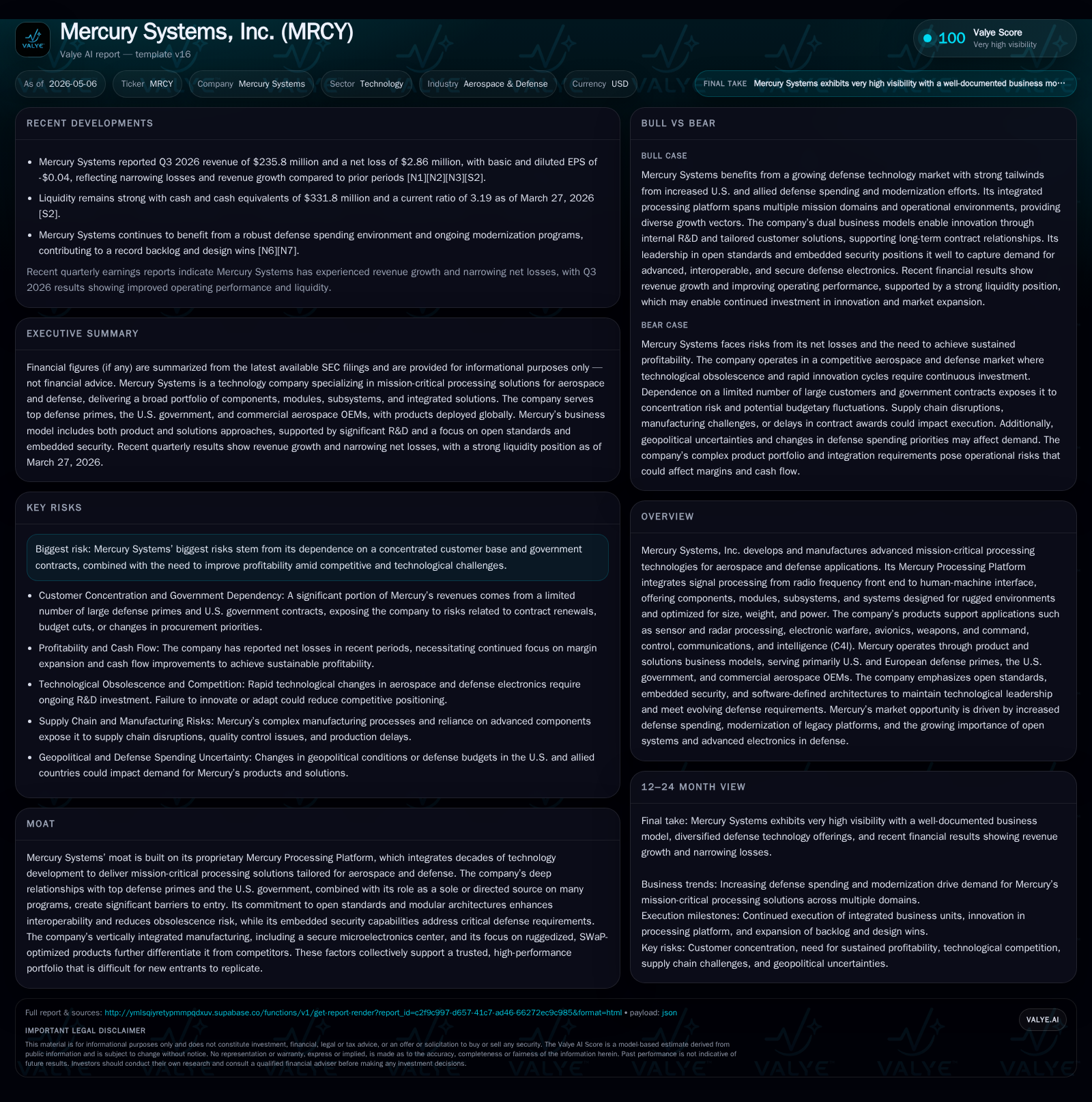
Mercury Systems reported key operating updates in Q3 2026 centered on a $5.6 million restructuring charge linked to workforce reductions and the ongoing use of a $75 million receivables factoring facility that aids cash flow management. Its business model revolves around advanced mission-critical processing solutions for aerospace and defense, leveraging a proprietary platform with embedded security and SWaP optimization. The company faces competitive pressure but benefits from robust integration in prime contractor ecosystems and emerging growth drivers such as AI-enabled sensing. Concentrated customer exposure and margin pressures remain important watchpoints. Financially, Mercury maintains strong liquidity with over $330 million in cash and manageable debt levels supporting ongoing operational resilience.
Third-Quarter Operational Highlights
Mercury Systems' Q3 ended March 27, 2026 (10-Q filed May 5, 2026) discloses continued strategic actions aimed at optimizing operational efficiency amid growth initiatives. The company recorded restructuring charges totaling approximately $5.6 million related to severance costs from a workforce reduction eliminating about 100 positions during the nine months ended March 27, 2026 [S2][S4]. This realignment reflects management's focus on right-sizing the cost base following earlier headcount adjustments in fiscal year 2025.
On the working capital front, Mercury operates under a receivables purchase agreement (RPSA) originally set at $60 million since August 13, 2024, which was amended upwards to $75 million in December 2025 to better support liquidity demands as billing volumes scale [S2][S23]. At quarter-end, factored accounts receivable totaled $75 million with approximately $14 million collected but yet to be remitted to the factor counterparty—a dynamic carefully managed within current liabilities. Factoring fees remain immaterial but are included within SG&A expenses.
Revenue recognition practices continue consistent with ASC 606 standards. About 52% of revenues for the quarter arose from contracts recognized at a point in time—primarily standard products and services delivered upon shipment or completion—and the remainder recognized over time as key performance obligations or milestones are met [S2]. This stable split implies balanced revenue quality despite ongoing contract complexity.
Business Model and Product Portfolio Overview
Mercury Systems thrives on its Mercury Processing Platform — an integrated suite covering every layer of signal processing from radio frequency (RF) front-end hardware to human-machine interfaces built for demanding aerospace and defense applications [S1][S19]. This platform offers modular components ranging from silicon chips to fully integrated subsystems and systems characterized by ruggedized designs optimized for size, weight, and power (SWaP), critical in military deployments.
Two complementary business models underpin Mercury's go-to-market: standalone products that address broad technical needs within sensor processing chains, alongside highly customized subsystem solutions engineered jointly with primes and defense OEMs for specific program requirements. Emphasizing software-defined architectures and embedded cybersecurity capabilities ensures these offerings stay relevant amid evolving defense technology landscapes emphasizing interoperability and mission readiness.
By serving top-tier U.S. and European defense primes such as Lockheed Martin, Raytheon Technologies, Northrop Grumman, alongside select government agencies directly and select commercial aerospace OEMs, Mercury embeds itself deeply into high-value system platforms supporting radar systems, electronic warfare suites, command & control communications (C4I), avionics platforms, and weapons systems integration [S1].
Competitive Landscape and Industry Dynamics
The aerospace & defense supplier ecosystem is traditionally structured with prime contractors controlling major platform contracts sourced predominantly from government budgets; Mercury occupies a multi-tiered supplier role delivering mission-critical components through integrated subsystems enabled by its proprietary processing technology stack [S1].
Mercury's competitive advantage is anchored by its proprietary Mercury Processing Platform that aggregates decades of internal R&D investment into open modular architectures supporting rapid composability across various mission requirements while embedding robust cybersecurity—an indispensable feature given increasing electronic threats within defense domains.
Further differentiation stems from vertical integration aspects including its secure microelectronics manufacturing center enabling internal control over advanced silicon fabrication processes vital to maintaining lead times and secure supply chains [S1]. This integration reduces risk compared with competitors dependent solely on outsourced component fabrication.
The firm's commitment to open standards simultaneously reduces technological obsolescence risk by allowing integration flexibility across evolving commercial silicon advances such as AI-enabled processors—a key factor given rapid innovation cycles imposed by defense priorities today [S1]. Overall barriers include exclusive arrangements where Mercury serves as sole or directed source on multiple programs amplifying switching costs.
Growth Catalysts and Market Opportunities
Several structural factors position Mercury for growth: first is accelerating modernization efforts by military customers driving expedited adoption of enhanced sensor suites featuring advanced electronic warfare capabilities alongside next-generation radar systems demanding higher speed processing at lower SWaP metrics [N1][N2][S1].
Second is rising governmental emphasis on embedding artificial intelligence into sensor data acquisition pipelines—AI algorithms require robust edge computing capabilities which Mercury’s platform is architected to support with modularity designed for continuous upgrades without full system redesigns.
Increasingly favorable budget environments within U.S. defense allocations focused on space domain awareness and C4I modernization inject incremental recurrence into order books. These factors translate into expanding addressable market sizes exploited through existing deep prime contractor relationships enabling easier contract captures beyond greenfield programs.
New program wins leveraging Mercury’s platform scalability particularly for emerging unmanned aerial vehicle (UAV) ISR (intelligence, surveillance reconnaissance) applications serve as tangible metrics of demand momentum. Structural demand appears more durable than cyclical given persistent geopolitical security concerns accentuating procurement urgency.
Risks, Constraints, and Watchpoints
Nonetheless risks anchor around customer concentration—with substantial revenue weighted towards U.S. government agencies (defense contracts) channeled via large primes who cumulatively represent significant portions of top-line revenues rendering Mercury vulnerable to shifts in budget priorities or program delays [S1].
Profitability pressures persist amid competitive pricing responses despite product differentiation largely stemming from costly R&D investments reflective of high-tech intensity inherent to mission-critical electronics design. Although recent restructuring charges may assist EPS recovery trajectories going forward they also signal ongoing margin headwinds hard to entirely offset absent sustained revenue growth.
Supply chain disruptions or tariff impositions could theoretically impact gross margins although no material incidents have been reported recently—warranting attention given global semiconductor supply volatility trends [S1]. Legal proceedings remain non-material yet ongoing litigation typical within complex defense supplier environments necessitates monitoring.
Key Upcoming Milestones and What to Monitor
Investors should scrutinize upcoming quarterly earnings releases for evidence of improved operating leverage stemming from recent workforce realignment efforts particularly monitoring SG&A expense trajectories post-restructuring charge pay-down schedules detailed in Q3 filings [S2][S20].
Contract award announcements focusing on AI-driven sensing or electronic warfare innovations provide leading demand indicators aligning with product relevance trends noted recently in management commentary [N1][N2]. Backlog growth trends will help confirm sustainable revenue streams necessary to offset continued R&D spend intensity.
Additionally watch any updated guidance around R&D spending levels revealing shifts between sustaining versus breakthrough technology investments potentially impacting longer-term product pipeline strength.
Latest Financial Position and Metrics
Latest financial snapshot
| Metric | Value | Period |
|---|---|---|
| Cash & equivalents | $332mm | |
| 2026-03-27 | ||
| Current assets | $1117mm | |
| 2026-03-27 | ||
| Current liabilities | $350mm | |
| 2026-03-27 | ||
| Current ratio | 3.19x | |
| 2026-03-27 |
Source: SEC companyfacts cache [F1].
As of March 27, 2026 balance sheet data shows a robust liquidity profile supporting operational flexibility amid near-term losses—a critical factor given ongoing investment-heavy strategy. Cash & equivalents stood at approximately $331.8 million [F1].
Current assets totaled roughly $1.12 billion offset by current liabilities near $350 million yielding a strong current ratio of 3.19 indicative of ample short-term coverage ability which mitigates liquidity risk factors associated with restructuring paydowns still pending.[F1]
| Metric | Amount (USD millions) |
|---|---|
| Cash & Equivalents | 331.8 |
| Current Assets | 1117 |
| Current Liabilities | 350 |
| Current Ratio | 3.19 |
This report is an analytical summary intended solely for informational purposes based on recently filed SEC disclosures and publicly available data relating to Mercury Systems Inc., without any investment advice or forward-looking guarantees.
Disclaimer: This is research-only, informational analysis and not investment advice. It may include AI-generated interpretation and general industry context. Always verify important details using primary sources.

Comments