
Fifth Third Bancorp's Q1 Shift: Earnings Headwinds and Strategic Growth Levers
Q1 2026 results reveal pressure on earnings from expense growth and margin compression, with strategic opportunities in diversified lending and wealth management segments.
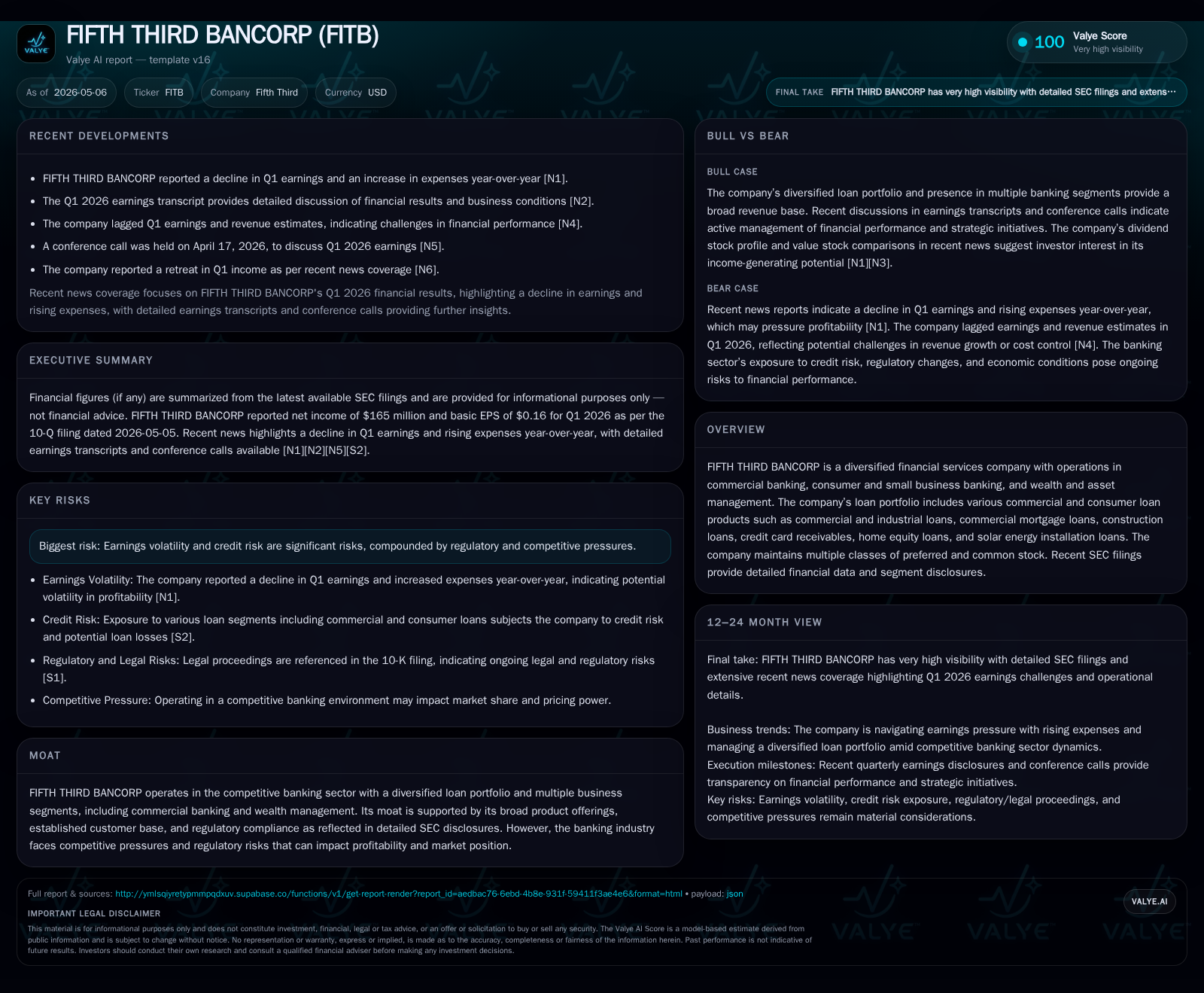
Fifth Third Bancorp reported a Q1 2026 earnings miss attributed primarily to rising operating expenses and net interest margin pressures. The bank’s diversified loan portfolio, including commercial loans and emerging solar energy financing, coupled with a growing wealth management segment, outlines clear growth levers. However, credit risk volatility and regulatory cost inflation pose ongoing challenges amid competitive banking market dynamics. Monitoring credit loss provisions and management’s execution on digital capabilities will be key in upcoming quarters.
Q1 2026 Operating Update: Earnings Miss and Expense Pressures
Fifth Third Bancorp's first quarter of 2026 revealed notable headwinds as the company reported earnings that missed some expectations amidst rising operating expenses. According to the latest 10-Q filing dated May 5, 2026, the bank faced year-over-year increases in noninterest expense which outpaced revenue growth, exerting pressure on profitability [S2]. Market commentary around the report highlighted that this was coupled with net interest margin compression—a challenge stemming from competitive loan pricing environments and prevailing interest rate dynamics that squeezed spreads [N1].
Credit loss provisions showed modest upticks but remained controlled within historical norms, signaling cautious but not alarming credit profile shifts [S2]. Loan growth continued in core commercial segments; however, volume increases were moderated by cautious underwriting amid macroeconomic uncertainties. Overall, this quarter set a tone of cost containment being critical alongside revenue diversification going forward.
Business Model Overview: Diversified Banking with Multi-Product Reach
Fifth Third Bancorp operates as a diversified financial services company mainly through three segments: commercial banking, consumer & small business banking, and wealth & asset management [S1]. Revenue generation is multidimensional—net interest income arises primarily from lending activities such as commercial & industrial loans, various forms of mortgage loans (commercial and residential), construction loans, credit card receivables, home equity loans, along with a growing niche in solar energy installation loans reflecting green financing trends.
Noninterest income complements interest-driven revenues through fee-based wealth management services as well as transactional fees from merchant solutions. The integrated product assortment helps spread risk across sectors and clients while smoothing seasonal or cyclical variances inherent in lending portfolios. Moreover, wealth & asset management revenue streams provide a margin-enhancing buffer during periods when net interest margins narrow.
Competitive Positioning within Commercial Banking and Wealth Segments
In the intensely competitive U.S. banking industry landscape where regional banks jostle for market share against larger national players, Fifth Third Bancorp leverages its broad service offerings across business lines to sustain relevance [S1]. However, pricing power on loans appears constrained by peer competition and macro-driven cautious customer demand. The company faces ongoing challenges related to regulatory compliance costs which elevate its fixed cost base relative to some more digitized peers.
Wealth management continues to play an important role for the firm by diversifying revenue sources beyond traditional lending. Retaining high-net-worth clients depends heavily on the firm’s advisory capabilities and technology integration—areas where Fifth Third has made incremental investments but competes against specialized wealth firms. Geographic footprint advantages in Midwest markets provide certain entrenched client flows but growth opportunities may require expansion or deeper penetration into emerging client segments.
Growth Drivers: Credit Portfolio Mix, Digital Adoption and Fee Income Expansion
The composition of Fifth Third's loan portfolio provides tangible avenues for measured growth backed by structural demand trends rather than purely cyclical factors [S2][S3][S1]. Expansion in commercial sectors including construction lending—as well as new-solar energy installation financing—is notable given the rising emphasis on sustainable energy projects supported by government incentives. This positions the bank favorably for capturing niche growth pockets within broader commercial banking.
Digital adoption is another pillar supporting future revenue streams with enhanced customer retention mechanisms delivering fee income via payment processing and ancillary banking services. The firm has also indicated investment in digital platforms that aim to increase efficiency while bolstering customer experience—the combination theoretically improving both volume metrics and operating leverage over time.
Wealth segment contributions continue to climb gradually, benefiting from market appreciation effects as well as cross-selling success. This fee-based income stream has less direct exposure to interest rate volatility than lending activities.
Risks and Constraints: Credit Volatility, Regulatory Environment, and Margin Compression
Key risks weigh heavily on credit quality given the diverse yet economic cycle-sensitive nature of portfolios such as commercial real estate loans or consumer unsecured products like credit cards [S1][S2]. While early signs of delinquency remain moderate in Q1 2026 disclosures, any sustained economic downturn or abrupt sector-specific stress could elevate charge-offs materially.
Regulatory expense burdens constitute another constraint influencing margins; stringent compliance demands following prior industry shocks necessitate steady investment in control systems that inflate operating expense bases continuously rather than enabling immediate efficiency gains.
Competitive pressures also restrict pricing flexibility on loans and fees, particularly amid technology-enabled entrants disrupting traditional banking origination or advisory services.
Upcoming Milestones: Guidance Expectations and Execution Indicators
Post-Q1 reporting commentary suggests market participants should watch for updates on management’s guidance revisions reflecting those first-quarter performance nuances [S2][N2]. In particular, quarterly evolution of credit loss provisions will be critical for signaling underlying portfolio health beyond headline loan growth figures.
Executions around new product innovations or enhancements in digital engagement platforms will form important progress markers given their strategic roles in driving higher-margin fee income growth alongside core banking revenues. Additionally, developments within wealth management distribution effectiveness may clarify trajectory sustainability amid intensifying competition.
Operating expense control initiatives will bear scrutiny since cost inflation was a principal earnings drag this quarter; successful moderation here would improve operating leverage substantially.
Financial Snapshot: Capital Structure and Profitability in Current Context
At March 31, 2026, Fifth Third Bancorp carried approximately $18.75 billion in total debt consistent with maintaining a capital structure emphasizing liquidity readiness while funding franchise growth initiatives [F1]. Capital adequacy as referenced in regulatory filings remains compliant with supervisory expectations underpinning operational flexibility.
Profitability metrics reflected margins challenged by compressing net interest spreads compounded by higher recurring operating expenses. Nevertheless, diversification into fee-generating areas such as wealth management partially offsets underlying pressure points seen in lending segments.
The balance sheet composition supports continued strategic maneuvering including targeted portfolio expansions especially into higher-growth renewable finance niches without compromising liquidity buffers needed for unforeseen adverse conditions.
This analysis integrates Fifth Third Bancorp’s most recent quarterly filings alongside relevant event updates to present an up-to-date operating perspective balanced against its established business model architecture within competitive U.S. banking industry dynamics. It aims to contextualize evident short-term earnings challenges alongside identifiable medium-term franchise strengths enhancing future growth opportunities while flagging pertinent risk considerations requiring ongoing monitoring.
Disclaimer: This document is an informational industry analysis focused on recent operating developments without any investment recommendation or advice.
Disclaimer: This is research-only, informational analysis and not investment advice. It may include AI-generated interpretation and general industry context. Always verify important details using primary sources.

Comments