
Global Industrial's Multi-Channel Model Navigates Q1 Challenges in MRO Distribution
Global Industrial’s Q1 2026 results highlight the impact of supply chain pressures and inflation on its multi-channel MRO distribution business amid strategic acquisition integrations.
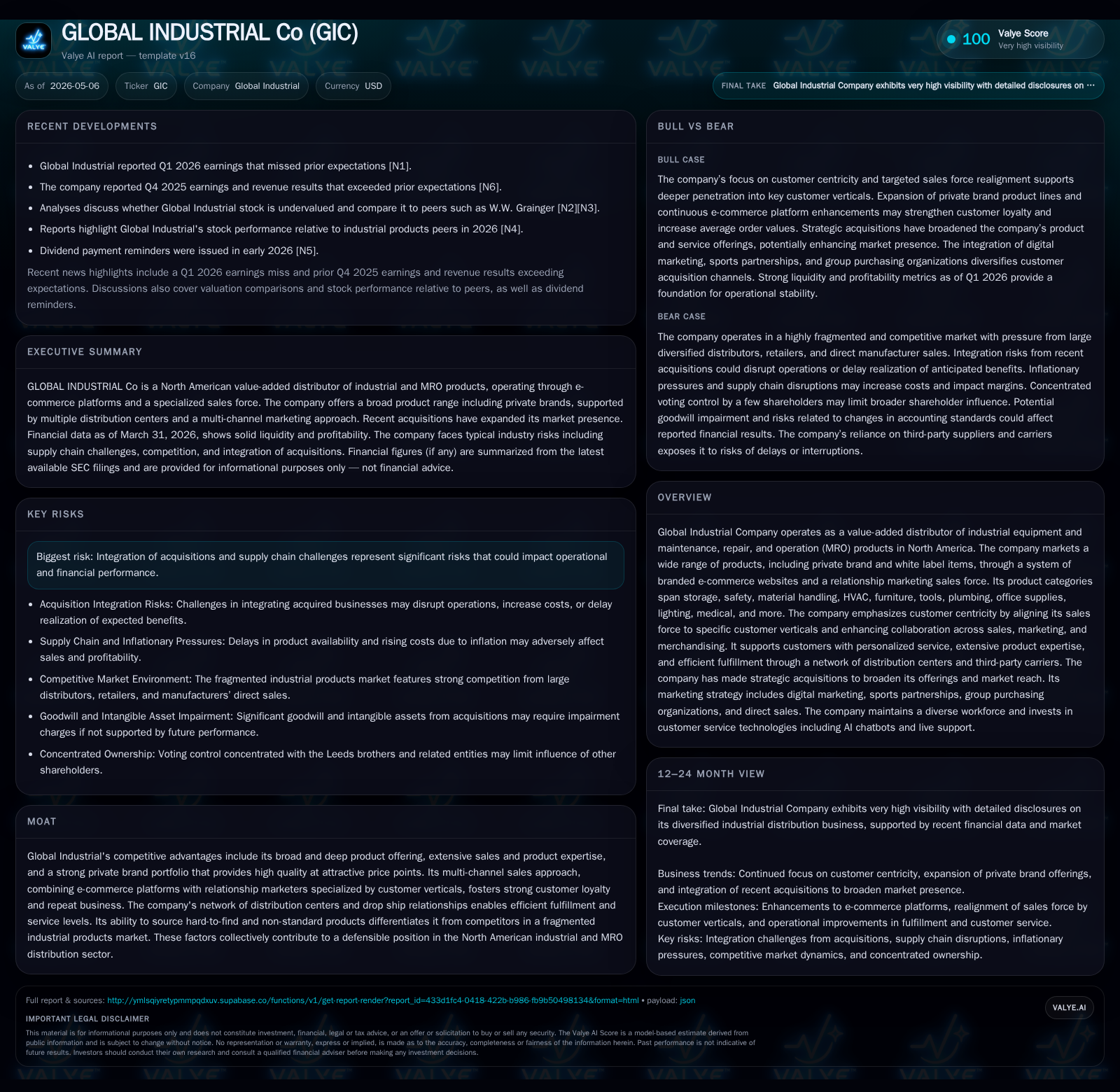
In Q1 2026, Global Industrial Company (GIC) experienced profit pressures due to cost inflation and supply chain disruptions. The company continues to leverage its multi-channel sales model, combining e-commerce platforms with specialized relationship marketers aligned by customer verticals to drive product expansion and customer loyalty. Recent acquisitions, including Indoff LLC and an equipment service provider, bolster its North American presence and value-added offerings but present integration challenges. Key risks include ongoing supply chain fragility, inflation impacts, and execution of acquisition synergies. Monitoring inventory management, pricing initiatives, and vertical demand trends will be critical near-term indicators.
Q1 2026 Operating Update and Near-Term Implications
Global Industrial Company reported first quarter results on May 5, 2026, revealing pressures that weighed on profitability due predominantly to elevated input costs from sustained inflation and ongoing supply chain bottlenecks. The company missed analyst earnings estimates as rising freight costs and product shortages challenged fulfillment timelines in a market still adjusting post-pandemic [S2][N1]. Despite these headwinds, management declared a quarterly dividend of $0.28 per share, signaling confidence in the underlying cash flow profile amidst execution challenges [S3].
The filings indicate that while demand remains intact among core MRO customers, particularly in industrial manufacturing and commercial sectors served by verticalized sales teams, margin compression is evident from difficulty in promptly passing on cost increases to the end customer [S2][N1]. Seasonal variation also played a typical role—first quarter tends to be a softer period for several key product lines such as HVAC and outdoor goods—but the contemporaneous inflation environment materially exacerbated margin pressure compared with prior periods [S1][S8].
Market commentary corroborates cautious optimism about GIC’s positioning despite near-term execution risks linked to supply volatility and elevated logistics expenses. Strategic efforts to realign the salesforce by verticals aim to deepen customer engagement and identify tailored category expansion opportunities that drive repeat orders and elevate average spend per account over time [S1].
Business Model Overview: Multi-Channel Distribution with Customer-Centric Differentiation
Global Industrial operates as a value-added distributor of industrial equipment and maintenance, repair, and operations (MRO) goods throughout North America via a hybrid multi-channel approach. This includes branded e-commerce websites paired with relationship-driven sales personnel specialized by industry verticals—a structure that blends the scale of digital commerce with personalized service enhancing stickiness with customers [S1][S13].
The company’s offering spans a vast array of product categories: storage solutions; safety equipment; material handling; HVAC components; office furniture; tools; plumbing supplies; lighting fixtures; medical accessories; among others. Its portfolio importantly includes private label product lines sold under multiple proprietary brands (Global™, Nexel™, Paramount™, Interion™, Absocold™), producing stable higher-margin revenues relative to commodity items sourced through wholesale channels [S1].
Sales channels are diversified: over 60% of transactions derive from digital orders—from websites or integrated electronic data interchange portals—supported by telephone inbound sales teams and a dedicated field salesforce aligned by customer verticals such as manufacturing, government institutions, or specialty contractors. The collaborative interplay between Sales, Marketing, and Merchandising functions emphasizes responsive assortment curation aligned precisely to customer needs uncovered through close frontline engagement [S13].
Competitive Positioning and Industry Structure in North American MRO
The industrial distribution sector where GIC operates is fragmented with numerous players varying widely in scale from large wholesalers to niche specialists. Competitive dynamics revolve around broad product selection depth, pricing leverage amid commodity volatility, quality brand relationships including private labels, availability timing enabled by logistics proficiency, and technical expertise for complex or hard-to-source items.
GIC differentiates through its expansive private brand catalog combined with relationship marketing enabling deeper account penetration than purely transactional competitors focused solely on price competition. Its distribution infrastructure—five major US centers plus a sizable Canadian facility—is complemented by drop-ship vendor partnerships allowing flexible coverage across thousands of SKUs without holding all inventory internally. This mix improves service levels while managing working capital invested in inventory.
Trade tensions involving China remain relevant given GIC’s substantial dependence on Asia-origin products within its private label range; ongoing geopolitical uncertainties coupled with fluctuating tariffs expose the supply chain to potential disruptions or increased costs [S1][S17]. Moreover, regulatory factors impacting product safety standards enforced by EPA or FDA necessitate rigorous compliance programs embedded within GIC’s quality assurance processes.
Growth Drivers: Strategic Acquisitions and Category Expansion
Recent acquisitions have notably extended GIC’s market footprint and product-service scope. In May 2023, GIC acquired Indoff LLC for $72.6 million in cash—a business-to-business direct marketer specializing in material handling equipment and commercial interiors—significantly expanding its addressable market within the North American MRO landscape [S1][S5].
In April 2025, it added an equipment service provider for approximately $4.3 million further broadening value-added services offerings alongside traditional product sales. These moves are consistent with GIC’s strategy emphasizing vertical alignment to boost cross-selling opportunities through sales teams deeply embedded with end-market customers.
Category expansion efforts focus heavily on consumables, replacement parts, repair components—segments generating recurring demand which underpin higher retention rates due to their essential nature in customers’ operations. Product vetting processes tied to rigorous data analytics allow identification of new SKUs suited for stocking after testing via drop-ship trials minimizes inventory risk while confirming demand velocity before committing warehouse capital [S13].
Integration of acquired entities poses near-term complexity but promises longer-term margin accretion through synergies such as consolidating procurement leverage and cost rationalization across back-office functions if executed effectively [S5][S17].
Risks and Constraints: Supply Chain, Inflation, and Integration Challenges
Persistent macroeconomic challenges represent clear headwinds for Global Industrial. Inflationary pressure affects raw materials like steel copper—and transport fuel costs—that directly increase landed product expenses while squeezing gross margins if price increases lag market cost changes [S1][S5].
Supply chain constraints remain acute particularly due to reliance on offshore factories in China which are vulnerable to shutdowns or shipment delays stemming from political tensions or health crises impacting manufacturing capacity or border logistics. Such disruptions can lead to lost sales or costly expedited freight requirements adversely affecting operational efficiency.
Acquisition integration risks loom large following recent significant deals: assimilating IT systems including remediating known material weaknesses at acquired subsidiaries (notably Indoff campaigned around change management controls), harmonizing operating protocols across geographies spanning the continental U.S., retaining key personnel amid transition turbulence—all impact seamless synergy realization timelines [S21].
Customer spending patterns also pose cyclical risk factors whereby deteriorating economic sentiment or downturns in manufacturing could reduce order volumes thereby limiting top-line growth despite current penetration efforts.
What to Watch Next: Execution Milestones and Demand Signals
Investors should focus on upcoming quarterly disclosures for explicit guidance revisions reflecting inflation pass-through success or failure along with merchandise availability metrics indicating resolution level of supply chain bottlenecks post-Q1 peak disruptions.
Further clarity is expected on integration progress regarding Indoff including resolution timelines for ITGC remediation critical for financial reporting reliability across consolidated operations [S3][S21]. Follow-on acquisition activity or announcements would signal strategic intent either deepening existing vertical plays or entering adjacent categories.
Inventory turns relative to revenue will provide insight into balance between aggressive stocking versus obsolescence risk amid variable demand cycles linked to end-market health conditions.
Finally, shifts in customer vertical demands especially government contracts or healthcare-related product lines will serve as leading indicators given their seasonality sensitivity.
Latest Financial Snapshot
Latest financial snapshot
| Metric | Value | Period |
|---|---|---|
| Cash & equivalents | $62mm | |
| 2026-03-31 | ||
| Current assets | $403mm | |
| 2026-03-31 | ||
| Current liabilities | $177mm | |
| 2026-03-31 | ||
| Current ratio | 2.28x | |
| 2026-03-31 |
Source: SEC companyfacts cache [F1].
The balance sheet remains robust with liquidity supported by over $61 million in cash versus nominal outstanding debt as of Q1 2026 end providing operational flexibility amid inflationary pressures or capital deployment for strategic priorities such as acquisitions or technology investments [F1][S2].
Disclaimer: This is research-only, informational analysis and not investment advice. It may include AI-generated interpretation and general industry context. Always verify important details using primary sources.

Comments