
GLD's Steady Exposure to Gold Amid Active Creation and Redemption Flows
SPDR Gold Trust’s Q1 2026 filing reveals robust share flow dynamics and consistent operational discipline in gold-backed ETF management.
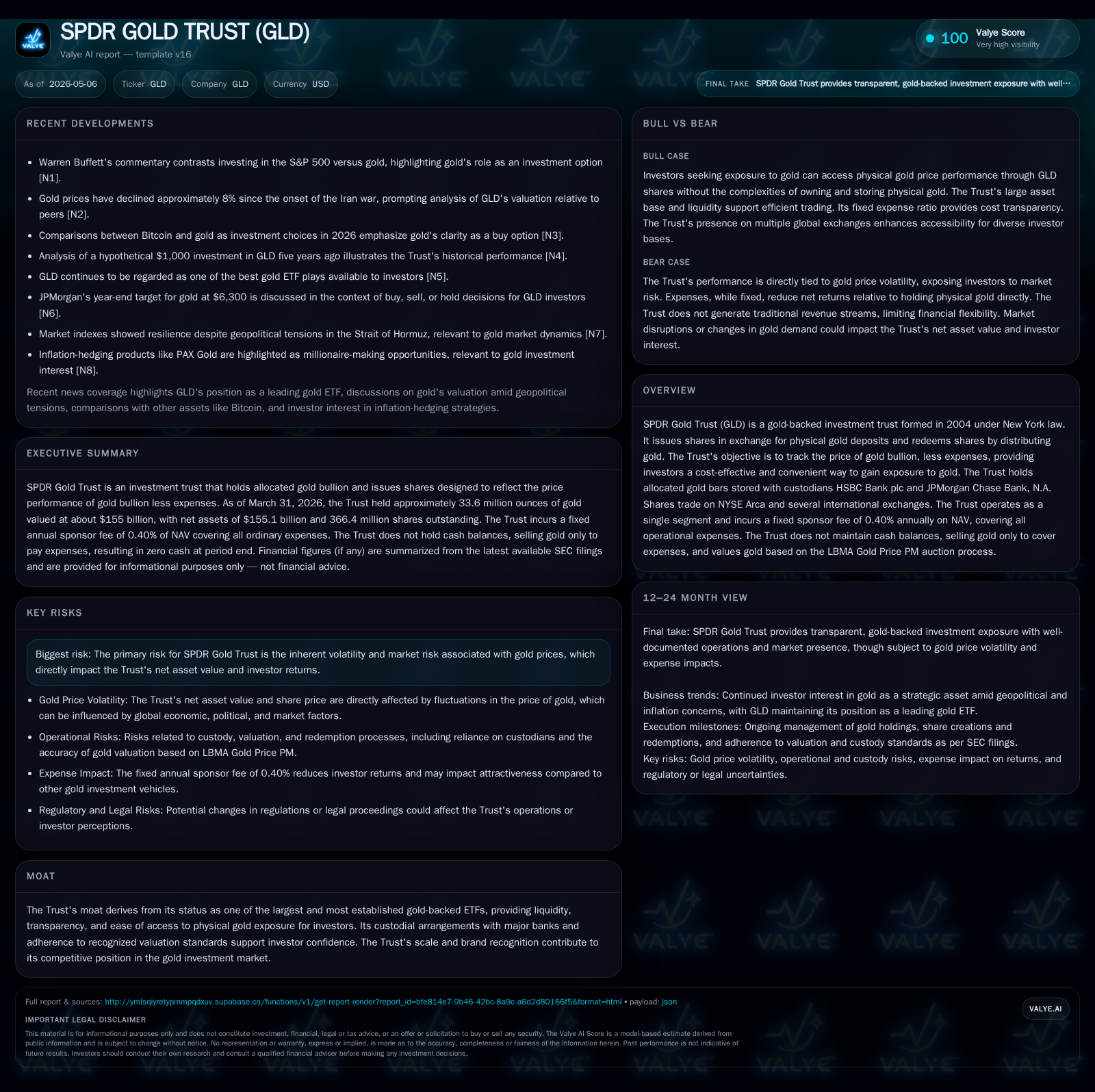
In the latest quarterly report ending March 31, 2026, SPDR Gold Trust (GLD) demonstrated active creation and redemption activity with a net reduction in shares outstanding but an overall increase in gold holdings. The Trust maintains a zero cash balance policy by selling gold only to cover expenses, reinforcing its pure physical backing model. GLD’s fixed sponsor fee structure and custodial arrangements support its market-leading position as a liquid, cost-effective gold exposure vehicle. Growth drivers remain centered on safe-haven demand and inflation hedging amid macroeconomic uncertainties, while risks principally stem from gold price volatility and the absence of hedging strategies.
Latest Operating Update: Q1 2026 Filing Highlights
SPDR Gold Trust’s latest Form 10-Q for the quarter ended March 31, 2026, offers a clear snapshot of recent shareholder activity and operational metrics pivotal to understanding its business model at work [S2][S3]. During this period, the Trust executed redemptions of approximately 46.8 million shares (468 baskets), resulting in a physical distribution of about 4.3 million ounces of allocated gold to redeeming participants. This outpaced creations which totaled roughly 39 million shares (390 baskets) backed by deposits of approximately 3.58 million ounces. Consequently, net share count declined to around 366.4 million by quarter-end from earlier levels.
Notably, despite the net redemption flow, the total gold held increased from roughly 32.5 million ounces at September 30, 2025, to about 33.6 million ounces at March 31, 2026—valued at nearly $155 billion based on the LBMA Gold Price PM benchmark pricing [S6]. This apparent inventory growth aligns with rising gold prices over the interim period rather than additional net inflows into the Trust.
Reflecting its policy of tightly matching expenses to asset liquidity, GLD does not hold cash balances at period-end. Instead, it sells exact amounts of gold exclusively to cover operating costs including sponsor fees and custodial charges [S2]. This practice ensures minimal non-gold holdings and positions GLD as a near-pure physical bullion exposure vehicle.
From an accounting perspective, realized gains stemmed primarily from strategic disposal of gold required for operational expense payments and share redemptions—realized gains totaled approximately $9 million in Q1 on these transactions—while unrealized gains related to mark-to-market revaluation on remaining bullion holdings added over $11 million [S2].
Business Model Fundamentals and Product Quality
SPDR Gold Trust was established in November 2004 as a New York law investment trust designed explicitly to provide investors securities reflecting the price movements of physical gold bullion less operating expenses [S1]. The Trust issues large blocks called baskets (each consisting of 100,000 shares) to Authorized Participants—primarily institutional intermediaries—in exchange for deliveries of allocated London Good Delivery bars held under custody agreements with HSBC Bank plc and JPMorgan Chase Bank [S1][S27].
Retail investors gain access through public trading on NYSE Arca and several international exchanges but do not buy directly from the Trust [S27].
Operational expenses are covered by a fixed annual sponsor fee set at 0.40% of daily net asset value [S13]. This fee encompasses all ordinary costs including trustee services, custodial safekeeping fees for the high-quality bullion inventory, legal/audit expenses, marketing costs via State Street Global Advisors Funds Distributors LLC as the marketing agent, NYSE listing fees, and all administrative overhead [S13]. The fixed fee model drives predictable cost management while supporting transparency around expense drag on returns.
GLD’s physical gold holdings constitute allocated bars conforming strictly to London Good Delivery standards—a globally recognized specification for purity and weight—that enhances investor confidence regarding quality and security [S1][S6]. The trust also undergoes biannual audits including full annual bar counts performed by reputable third parties such as Bureau Veritas Commodities UK Ltd., further underscoring product integrity [S19][S21].
Industry Structure and Competitive Positioning
Within the category of exchange-traded funds providing investment exposure to gold bullion prices without direct physical ownership complexities lies intense competition among product providers. GLD holds a prominent role owing to its substantial scale—the Trust commands tens of billions in assets—and long track record dating back nearly two decades.
Its primary competitors include other physically backed ETFs like iShares Gold Trust (IAU), various commodity index funds integrating futures contracts rather than physical storage, and direct purchases by retail or institutional investors seeking coins or bars outside financial markets [N6][N13]. GLD enjoys structural advantages stemming from deep liquidity pools that facilitate tight bid-ask spreads on NYSE Arca listings and straightforward redemption/creation mechanisms handled exclusively through multiple institutional Authorized Participants authorized by the Trustee [S27].
The presence of globally recognized custodians minimizes counterparty risk on storage while consistent adherence to recognized LBMA PM spot pricing standards ensures transparent valuation that resonates well with investors worldwide [S19][N6]. These factors combined create meaningful switching costs given investor comfort with GLD’s operational transparency versus cost structures seen elsewhere.
Institutional investors employing basket-unit creations/redemptions serve as measurable KPIs reflecting incremental demand dynamics in assets under management even amid short-term price swings; Q1’s redemption volume partially offsetting creations underscores active portfolio rebalancing behavior rather than permanent outflows alone [S6]. This reaffirms GLD’s role as a flexible tool deployed tactically within broader asset allocations.
Risks and Constraints: Market Volatility and Structural Factors
GLD is unambiguously tied one-to-one with prevailing market prices of physical gold bullion; it does not engage in derivative overlays or forward hedging techniques common among some commodity funds designed to mitigate price volatility risk [S4]. Therefore:
- Investors face full exposure to declines in the spot price without offsetting hedges;
- Negative market moves materially reduce NAV directly impacting shareholder returns;
- No internal trading strategies exist within the trust operations; it functions strictly as a passive custodian linked mechanistically via baskets.
Additionally, while custody arrangements with major global banks minimize operational risk substantially, inherent risks associated with secure storage cannot be entirely eliminated though there have been no recent material events reported related to such vulnerabilities [S15].
Cash management practices emphasizing zero cash balances preserve fidelity to backing by physical assets but introduce limited flexibility for expenses since requisite sales must be transacted promptly following expense accruals—though this process is routine without apparent liquidity strain given scale [S2].
Other general risks documented include potential fluctuations due to currency exchange rates (as gold trades globally in USD), interest rate shifts affecting opportunity cost comparisons vs fixed income products, and political-economic developments influencing supply-demand indirectly through mining outputs or central bank policies (purchases/sales) [S14][N14]. However, these remain macro factors externalized beyond GLD’s control.
Key Metrics and What to Watch Next
Monitoring share flow activity remains critical: the Q1 pattern where redemptions exceeded creations by roughly seven million shares reflects nuanced investor repositioning but may signal cautious sentiment near current gold price levels [S6][S21]. Total ounces owned continuing upward despite share flow volatility suggests strong underlying price appreciation offsetting balance sheet impacts.
Close tracking of LBMA PM auction prices provides timely indicators aligning with NAV calculations since GLD employs these benchmarks exclusively unless geographically exceptional valuation circumstances emerge warranting trustee-sponsor consultation on alternatives [S19][S28]. Equally important will be sponsor fee stability; any changes would materially affect expense ratios impacting return calculations for shareholders given flat annualized structure currently at 0.40%.
Looking ahead over coming quarters:
- Inflation data releases,
- Geopolitical developments involving key economies,
- Monetary policy announcements influencing real rates,
- Institutional positioning shifts evident through large basket unit trades, can serve as barometers guiding price dynamics ultimately reflected in GLD performance metrics.
Concise Financial Overview
GLD’s financials underscore its function as an investment pass-through trust anchored solely upon its underlying bullion holdings less known operating costs. For Q1 2026:
- Net realized gains relating predominantly to sale of gold stocks made up for expenses amounted to just over $70K;
- Gains realized from gold distributed upon redemptions contributed approximately $9 million;
- Net unrealized gains on ongoing holdings added more than $11 million reflecting appreciation during the quarter;
- Sponsor fees accrued reached roughly $166K covering comprehensive operational costs;
- No cash balance was maintained throughout confirming policy adherence restricting any meaningful cash build-up within trust operations [S2][S17][S20].
It does not constitute investment advice or recommendations.
Disclaimer: This is research-only, informational analysis and not investment advice. It may include AI-generated interpretation and general industry context. Always verify important details using primary sources.

Comments