
Chemours Navigates Regulatory Pressures While Pursuing Growth in Specialty Chemicals
Chemours' latest quarter reveals ongoing regulatory challenges alongside strategic advances in its specialty chemicals portfolio and financial management.
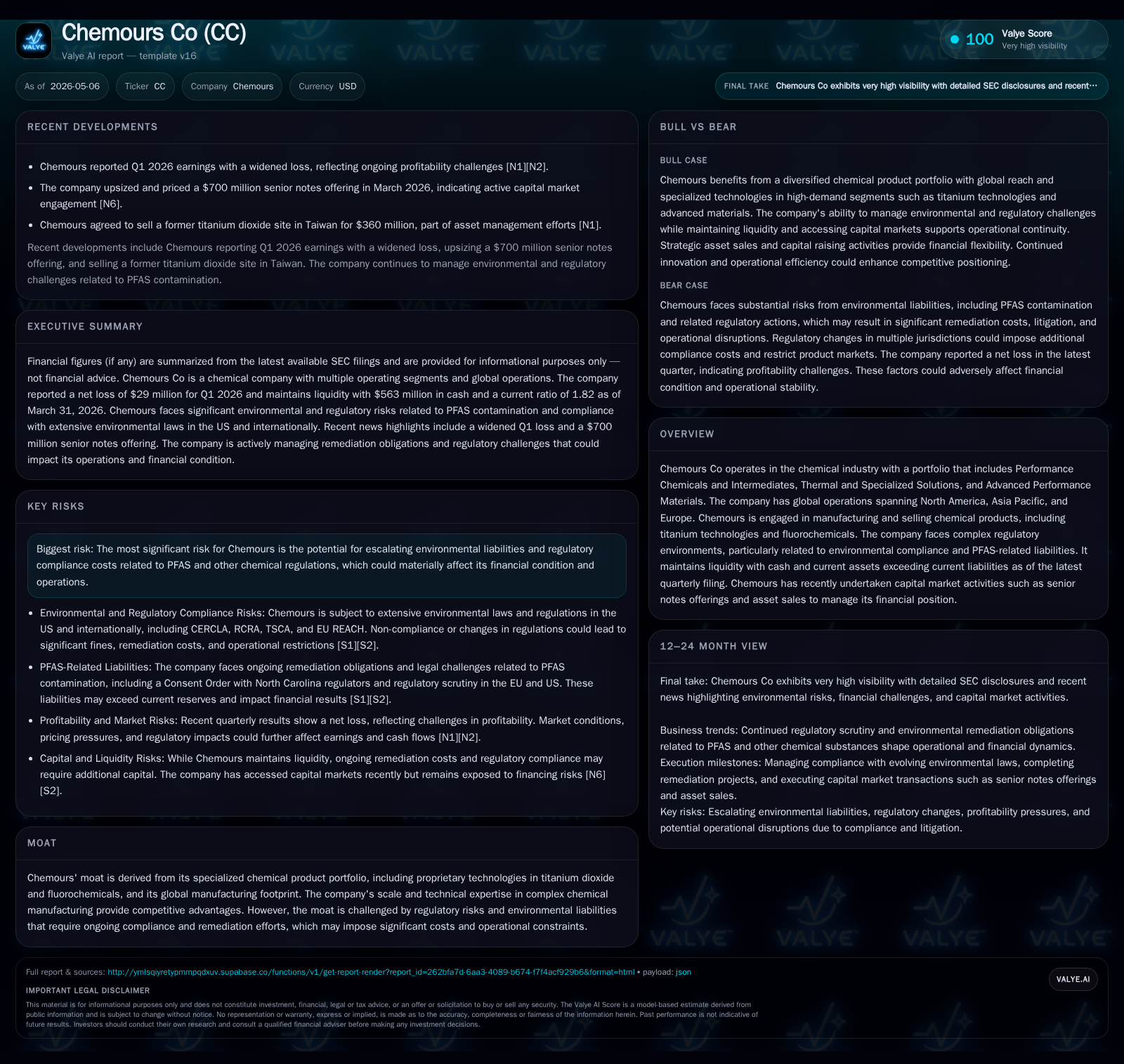
In the first quarter of 2026, Chemours reported continued operational and financial headwinds primarily driven by increased compliance costs related to environmental regulations, including PFAS-related liabilities. Despite these challenges, the company maintains a robust current ratio and liquidity position, supported by cash reserves and current assets exceeding liabilities. Chemours leverages its proprietary titanium dioxide and fluorochemical technologies within global manufacturing operations to sustain competitive advantages. Growth drivers include demand recovery in specialty applications and advancements in advanced performance materials, although regulatory risks remain the primary external constraint. Monitoring upcoming regulatory decisions and execution on asset sales will be crucial for assessing the company's path forward.
Latest Quarterly Highlights and Regulatory Update
Chemours’ first quarter 2026 results reflect ongoing pressures from intensified environmental regulations. The company disclosed increased compliance costs tied especially to PFAS-related liabilities that continue to weigh on profitability metrics while also elevating operational complexity [S2]. Although revenues are not detailed in the latest filing excerpts, reported liquidity remains comfortable with current assets at approximately $2.93 billion exceeding current liabilities of $1.61 billion for a current ratio of 1.82 [F1]. Cash and equivalents stood at about $563 million at quarter-end, supporting operational flexibility amidst regulatory uncertainty [F1].
Additionally, a contemporaneous 8-K report accompanied the earnings release highlighting capital markets maneuvers including asset sales designed to strengthen the balance sheet amid ongoing remediation expenses [S3]. These moves underscore management’s pragmatic focus on both internal restructuring and external financing to navigate volatile regulatory landscapes.
Core Business Model and Product Excellence
Chemours operates through distinct product lines anchored largely by its Titanium Technologies and Fluorochemicals segments. These units represent specialized niches where proprietary manufacturing processes enable the production of titanium dioxide pigment—the industry standard for coatings and plastics—and advanced fluorochemicals utilized extensively in refrigeration, air conditioning, electronics cleaning agents, and other industrial applications [S1][S29]. The company's advanced performance materials complement this portfolio by supplying thermal management solutions and other high-value-added products serving automotive and electronics sectors.
Revenue generation hinges on B2B contracts where industrial customers pay for volume-based product deliveries with price adjustments reflecting raw material costs as well as technological differentiation. The company’s proprietary process innovations and extensive global footprint afford a competitive edge insofar as they enable premium product quality and reliable supply across North America, Asia Pacific, and Europe—a critical advantage given localized market dynamics and diverse regulatory regimes [S1]. Specialized process engineering provides some insulation against commoditization though fluctuating input costs remain relevant.
Competitive Position within Chemical Industry Structure
Within the chemical industry's value chain, Chemours occupies a mid- to upper-tier position characterized by complex manufacturing requirements for specialty intermediates rather than bulk commodities. Its moat is grounded in titanium dioxide technology leadership supported by decades of process optimization plus a broad fluorochemical portfolio necessitating substantial R&D investments due to stringent safety standards.
Pricing power is materially influenced by escalating regulatory compliance expenses linked to environmental laws; these costs elevate baseline operating expenses but also create barriers for smaller competitors less capable of managing complex permitting regimes or remediation liabilities [S2][F1]. The firm’s scale allows absorption of such fixed compliance investments more readily than some peers. However, near-term volume growth is limited by plant utilization constraints and permit renewals which may temporarily cap expansion throughput until investment cycles conclude.
Growth Catalysts Driving Specialty Chemical Demand
Demand drivers are predominantly structural rather than cyclical: Chemours’ offerings are integral to end-markets undergoing transformation—such as automotive lightweighting requiring superior coatings enabled by titanium dioxide pigments or global refrigeration shifts favoring lower-GWP fluorochemicals aligned with climate policies [S2][N1].
The firm has noted contractual expansions within advanced performance materials that target sustainability-focused industrial applications where premium pricing can offset commodity volatility. Geographic expansion into Asia Pacific markets aims at capturing growing industrial production while leveraging local manufacturing capabilities to optimize cost competitiveness.
Operational efficiencies derived from process enhancements introduced via ongoing technology programs could translate into margin improvements despite external pressures, bolstering medium-term profit sustainability.
Key Risks: Environmental Regulations and Liability Exposure
Foremost among risks are environmental regulation complexities heightening financial liabilities—particularly those related to per- and polyfluoroalkyl substances (PFAS) under both U.S. Superfund (CERCLA) frameworks and evolving international chemical governance like EU REACH [S2][S1]. Non-compliance or adverse legal outcomes could impose severe remediation charges or fines impacting liquidity.
Increased scrutiny on emissions (Clean Air Act) or water protections (Clean Water Act) further compound operational cost uncertainty; maintaining operational permits requires continuous investment in emission control technologies or procedural adjustments that may strain capital allocation priorities.
Additionally, reputational risks stemming from litigation developments could indirectly affect market access or customer perceptions affecting demand patterns. The dynamic nature of these regulations necessitates adaptable compliance systems which entail both ongoing expense commitment and potential need for strategic asset reallocation.
Upcoming Milestones and Market Indicators to Watch
Key near-term events include subsequent quarterly results releases where progress indicators such as segment profitability shifts or order backlog changes could elucidate the degree of recovery or further strain related to environmental compliance costs [S3].
Regulatory decisions—both legal settlements concerning PFAS cases and permit renewal outcomes—will represent critical information inflection points illuminating prospective cost trajectories.
Capital market activities such as senior notes issuances or strategic divestiture completions should be monitored for signals about balance sheet optimization efforts aimed at mitigating leverage effects while funding compliance expenditures [N9][N11]. Insider transaction trends may provide ancillary clues on sentiment toward fundamental prospects.
Condensed Financial Snapshot and Balance Sheet Health
Latest financial snapshot
| Metric | Value | Period |
|---|---|---|
| Cash & equivalents | $563mm | |
| 2026-03-31 | ||
| Current assets | $2.9bn | |
| 2026-03-31 | ||
| Current liabilities | $1609mm | |
| 2026-03-31 | ||
| Current ratio | 1.82x | |
| 2026-03-31 |
Source: SEC companyfacts cache [F1].
Total debt date best-effort from latest available data.
As of Q1 ending March 31, 2026, Chemours demonstrated ample liquidity evidenced by a solid current ratio of 1.82 supported by nearly $563 million in cash equivalents against $1.61 billion in current liabilities [F1]. Ongoing asset sale initiatives disclosed aim to prudently manage the company’s financial position [S3].
Disclaimer: This analysis is based solely on publicly available information as of the cited dates without any reliance on non-public material data. It does not constitute investment advice or recommendations.
Disclaimer: This is research-only, informational analysis and not investment advice. It may include AI-generated interpretation and general industry context. Always verify important details using primary sources.

Comments