
Alphatec Holdings Advances Spine Surgery Focus with Strategic Financing and Sales Expansion
Q1 2026 filings reveal Alphatec’s refined revenue recognition, new credit facility, and targeted salesforce growth that together advance its spine surgery technology leadership.
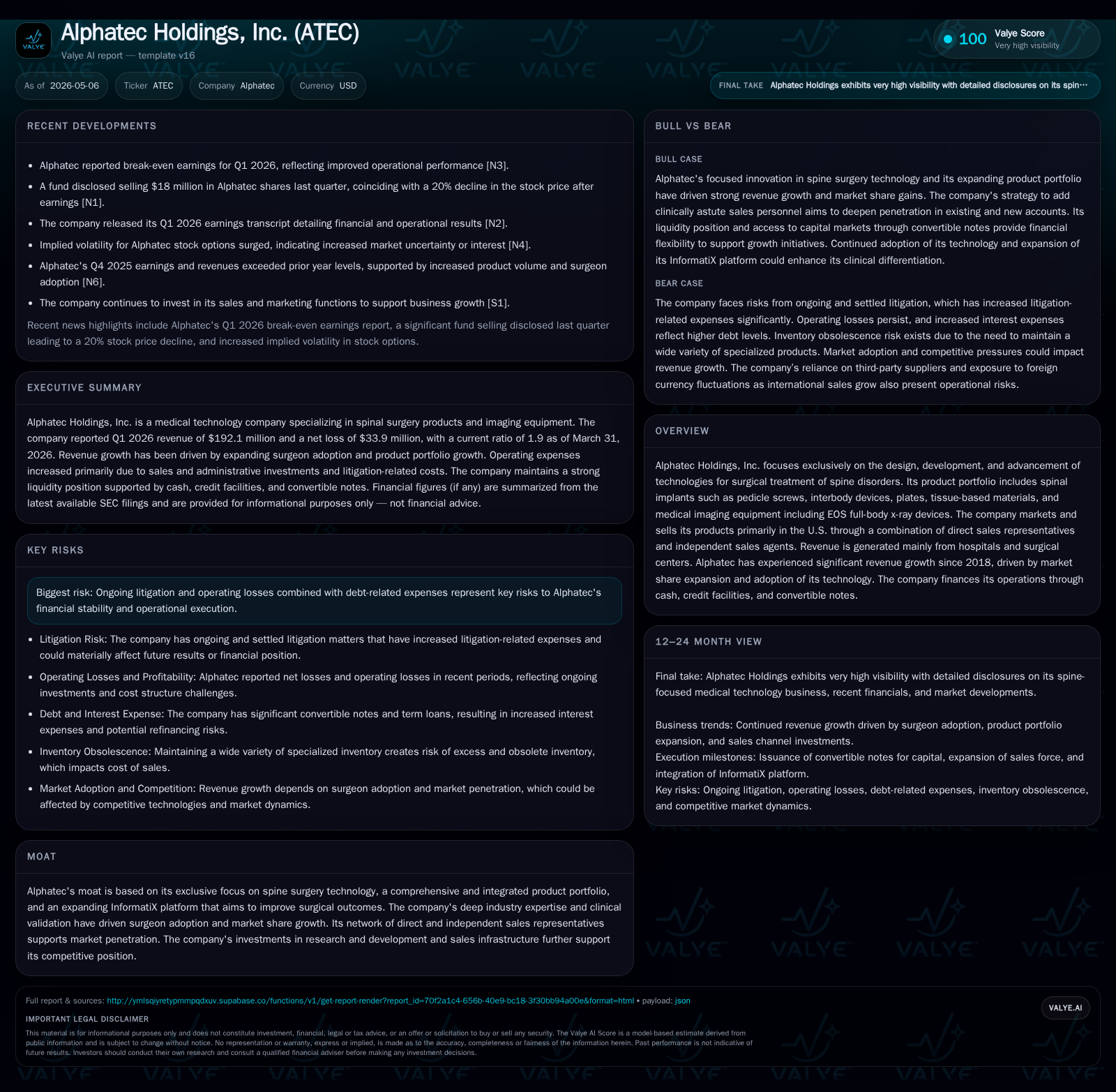
In early 2026, Alphatec Holdings tightened its revenue recognition practices concerning contract assets and liabilities reflecting staged performance obligations, signaling improved top-line clarity. The company also secured a senior secured credit agreement with JPMorgan Chase to enhance liquidity and flexibility. These financial moves underpin ongoing investments in an exclusive, clinically savvy salesforce aimed at broadening market penetration. Alphatec’s concentrated spine device portfolio integrated with its InformatiX platform positions it well within a competitive yet specialized spine surgery segment poised for structural growth.
Q1 2026 Operating Update Highlights
Alphatec Holdings’ May 5, 2026, quarterly report [S2] outlined key operational refinements crucial to interpreting near-term revenue flows. The company recognizes revenue based on the completion of distinct performance obligations, recording contract assets when payment depends on future conditions and contract liabilities when prepayments exceed fulfilled obligations. This accounts for deferred revenues tied to multi-stage product deliveries or services, enhancing transparency around timing differences between shipments and recognized revenue.
Further bolstering liquidity, Alphatec entered a senior secured credit agreement with JPMorgan Chase Bank on May 1, 2026 [S3], adding a structured lending facility alongside its existing convertible notes. This facility aims to provide additional financial flexibility for corporate purposes amid ongoing investments in product development and sales expansion.
The quarterly earnings call contemporaneous with the filings revealed break-even operating earnings for Q1 2026 [N3], reflecting progress toward improving profitability by managing operational costs amid growth initiatives. Additionally, references in the earnings transcript highlighted ongoing efforts to enhance salesforce productivity metrics [N2].
Alphatec's Spine-Centric Business Model and Product Portfolio
Alphatec concentrates exclusively on technologies for surgical treatment of spine disorders, encompassing spinal implants (pedicle screws, interbody devices, plates), tissue-based materials, and advanced medical imaging equipment like EOS full-body x-ray systems [S1]. The company employs a dual-channel sales strategy combining direct sales representatives with independent agents primarily targeting hospitals and surgical centers across the U.S., where procedural volumes are substantial.
Revenue generation hinges on product shipments invoiced to healthcare providers, with payment terms considered customary but variably monitored for collectability risks, occasionally leading to deferred revenue recognition per ASC standards [S2]. Capitalizing on integrated offerings is the InformatiX platform—an evolving surgical intelligence system designed to improve predictability and outcomes in spine surgery by coupling implants with data-driven insights [S1].
This integrative approach is a cornerstone differentiator supporting surgeon adoption by delivering proven clinical value backed by continuous innovation. The company’s focused R&D investment demonstrates commitment to developing comprehensive procedural solutions within its niche market segment.
Industry Competitive Dynamics and Alphatec’s Differentiators
Within the highly regulated medical device industry focusing on spine surgery technologies, barriers to entry are significant due to stringent FDA approvals, clinical validation requirements, and surgeon adoption cycles [S1]. Alphatec’s narrow specialization contrasts with diversified device companies juggling multiple therapeutic areas.
Its competitive moats stem from offering an ecosystem of interconnected products—surgical implants coupled with imaging technologies—that collectively enable better surgical planning and execution. This contrasts favorably against competitors offering piecemeal implant systems without integrated intelligence platforms.
Further differentiation arises from the dedicated sales infrastructure blending exclusive clinical expertise with independent agents. This extended reach facilitates deeper penetration into less saturated hospital systems while reinforcing presence in established accounts. Pricing power appears sustainable given proprietary technology bundles and entrenched clinical endorsements.
Supply chain dynamics remain stable but require precise coordination given the complexity of manufacturing biologics components alongside metal implants; any disruption could impact delivery timelines critical for elective surgeries.
Growth Catalysts: InformatiX Platform and Sales Network Expansion
Alphatec’s reported approximately 35% compound annual revenue growth since its strategic pivot in 2018 attests to successful market share gains seeded by its spine-exclusive model [S1]. The InformatiX platform is central to this trajectory—aimed at equipping surgeons with actionable data before and during operations to reduce complications and standardize results.
Investment continues aggressively in expanding a clinically astute exclusive salesforce targeting untapped surgeons, hospitals, and national accounts [S1][N2]. These representatives bring deep procedural knowledge enabling consultative selling rather than transactional engagement. This approach is expected to accelerate account conversion rates and increase wallet share per client.
Product innovation complements these efforts as Alphatec regularly introduces next-generation implants leveraging improved materials or ergonomic designs responding directly to surgeon feedback, thus sustaining demand momentum.
Risks and Constraints: Litigation, Debt Burden, and Market Pressures
Alphatec confronts significant headwinds including ongoing litigation that imposes legal costs integered into operating expenses [S1]. Operating losses continue albeit narrowing as recent results approached break-even territory—nonetheless cautionary given the high fixed cost structure associated with R&D and sales personnel.
Leverage remains elevated following issuance of $405 million senior unsecured senior convertible notes due 2030 bearing very low stated interest of 0.75%, but accruing immediate interest payments semiannually [S2]. Net debt stands at approximately $552.5 million as of March-end 2026 after accounting for $139.9 million in cash holdings [F1]. To mitigate dilution risk from note conversion into equity shares priced initially at about $15.54 each (~64 shares per $1000 principal), capped call transactions were executed reducing potential common stock dilution [S1][S2].
Market sentiment reflects some volatility demonstrated by insider stock selling activities valued over $2 million recently [N4][N6] alongside large institutional liquidation reported last quarter amounting to $18 million worth of shares sold which coincided with a notable stock price decline [N1]. Meanwhile implied volatility in options markets surged sharply earlier this year suggesting heightened uncertainty among investors on near-term stock swings [N5].
Near-Term Watchpoints: Guidance, Contract Metrics, and Financing Developments
Key indicators warranting scrutiny encompass quarterly revenue trends closely linked to movement in contract liabilities/deferred revenues as unfulfilled performance obligations convert into recognized sales per GAAP requirements detailed in Q1 disclosures [S2]. Monitoring stability or improvements here will clarify demand sustainability.
Salesforce productivity enhancements remain focal points for management measurable through new accounts converted annually alongside average deal size uplifts noted during earnings discussions [N2]. Progress reports on deployment phases or improvements related to the InformatiX platform rollout can materially influence customer retention rates.
Debt service metrics tied to utilization levels of the newly established senior secured credit facility [S3], combined with interest expense trends attributable to the convertible notes issued last year are also salient for assessing financial resilience going forward.
Any resolution or updates relating to litigation exposures will be material triggers affecting cost structures or contingent liabilities disclosed in future filings.
Latest Financial Snapshot
Latest financial snapshot
| Metric | Value | Period |
|---|---|---|
| Cash & equivalents | $140mm | |
| 2026-03-31 | ||
| Total debt | $692mm | |
| 2026-03-31 | ||
| Net debt | $553mm | |
| 2026-03-31 | ||
| Current assets | $456mm | |
| 2026-03-31 | ||
| Current liabilities | $240mm | |
| 2026-03-31 | ||
| Current ratio | 1.9x | |
| 2026-03-31 |
Source: SEC companyfacts cache [F1].
The balance sheet position at quarter-end reveals a cash buffer providing some cushion against short-term obligations amid substantial debt primarily sourced from convertible notes maturing in 2030 [F1][S2].
Disclaimer: This analysis is based solely on publicly available SEC filings, company disclosures dated as specified above, and related contemporaneous news sources without any confidential information or forward-looking projections beyond sourced content. It does not constitute investment advice or recommendations regarding Alphatec Holdings, Inc.'s securities.
Disclaimer: This is research-only, informational analysis and not investment advice. It may include AI-generated interpretation and general industry context. Always verify important details using primary sources.

Comments