
DaVita Inc. Reports Q1 2026 Earnings Beat: Execution and Volume Trends in Focus
DaVita’s Q1 results highlight robust volume growth and operational execution underpinning its leading kidney care services.
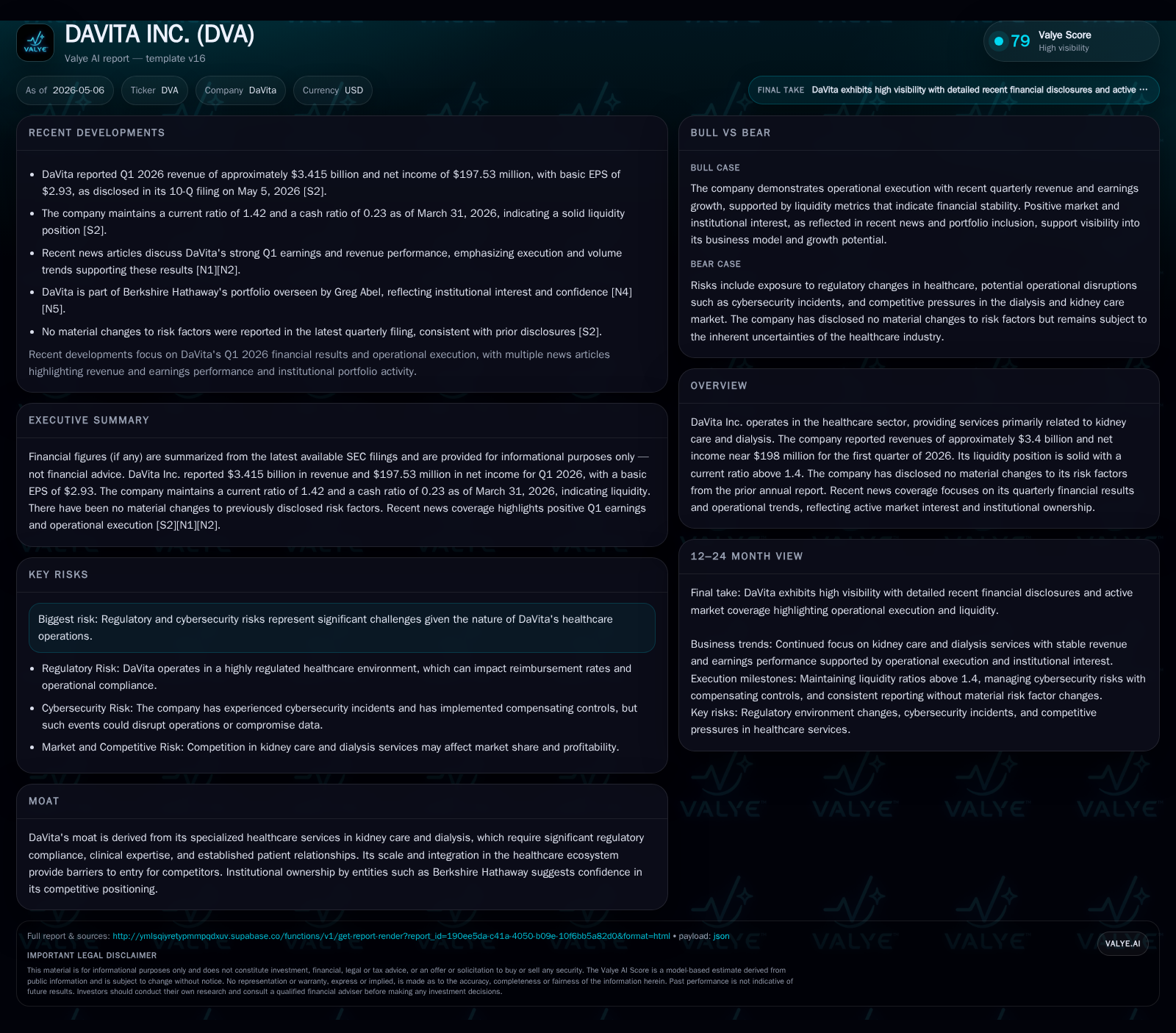
In Q1 2026, DaVita Inc. delivered revenue of approximately $3.4 billion, exceeding consensus estimates, along with a net income near $198 million, driven by favorable dialysis patient volume trends and solid execution. The company’s business model leverages integrated kidney care services with a differentiated clinical approach sustained by regulatory compliance and scale economies. While regulatory and cybersecurity risks remain notable, the growing adoption of home dialysis therapies and expanding patient volumes represent primary growth vectors. DaVita’s liquidity and leverage position remain stable amid ongoing investments and market dynamics.
Q1 2026 Operating Update: Performance Highlights and Implications
DaVita Inc. reported a strong first quarter for fiscal 2026 with revenues reaching approximately $3.4 billion, outperforming consensus estimates according to its May 5, 2026 Form 10-Q filing [S2]. The company recorded net income near $198 million during this period [N1], reflecting stable operating leverage despite macroeconomic pressures. Volume trends played a key role—dialysis patient counts saw an increase which boosted overall treatment sessions, both in traditional in-center settings as well as expanding home dialysis modalities [N2].
Market response emphasized confidence in DaVita's continuing ability to execute amidst competitive pressures and complex healthcare regulations [N4]. Institutional interest remains elevated, reinforced by ownership stakes from large investment entities such as Berkshire Hathaway that underline faith in DaVita’s specialist kidney care franchise [N10]. This quarter stands out given poise in operational execution combined with favorable demand signals suggesting structural expansion rather than transient cyclical effects.
Business Model Overview: Kidney Care Services and Revenue Drivers
DaVita’s core business revolves around providing dialysis treatments to patients suffering from end-stage renal disease (ESRD), alongside comprehensive kidney care solutions designed to improve quality of life and clinical outcomes [S1]. Revenues are primarily derived from fee-for-service payments under public programs such as Medicare and Medicaid alongside private payor contracts.
The offering includes high-quality in-center hemodialysis services alongside growing home dialysis options—peritoneal dialysis and home hemodialysis—which reflect industry trends towards patient empowerment and cost-effective care delivery [N5]. Additionally, DaVita integrates ancillary services like pharmacy support, nutrition management, and disease monitoring leveraging data analytics across its network of clinics.
This business model depends heavily on clinical expertise compliant with stringent federal regulations governing equipment standards, hygiene protocols, drug administration, and outcome reporting [S1]. Long-term customer (patient) relationships are vital for retention given the chronic nature of renal disease requiring frequent treatments multiple times weekly. Contractual mix coupled with treatment volume drives top-line growth; pricing power is moderated due to regulatory constraints but somewhat offset by value-added service differentiation.
Industry Structure and Competitive Dynamics in Dialysis Care
The U.S. dialysis market is highly concentrated with DaVita and Fresenius Medical Care dominating over 70% of market share nationally [S1]. Significant barriers protect incumbents: extensive clinical certification requirements limit new entrants while capital intensity for clinic infrastructure establishes economic moats through scale economies.
Reimbursement environment remains a key sector force impacting profitability; government payors set baseline rates which companies must operate within or negotiate for supplemental payments via private insurance arrangements. Periodic regulatory scrutiny introduces challenges such as changes to Medicare bundled payment codes or quality metrics-based adjustments.
Switching costs for patients are material given clinical trust-based relationships and logistical complexities associated with treatment site changes. Thus, DaVita’s integrated ecosystem—from direct care provision to complementary service lines—provides defensive insulation against competition [S1]. Supplier concentration risk exists regarding medical equipment vendors but has not materially constrained growth.
Growth Catalysts: Volume Trends, Execution Strength, and Market Penetration
Volume expansion remains the primary growth engine evidenced in the recent quarter where increased patient enrollments in both outpatient clinics and home modalities contributed positively [S2]. Home dialysis adoption accelerates as education improves clinician-patient alignment towards flexible therapy options that offer enhanced autonomy plus potential cost savings for payors.
Strategic partnerships with large health systems aiming at holistic kidney care pathways further enable market penetration beyond traditional models [N5]. Operational efficiencies also amplify margin resilience; careful cost control initiatives retrofit labor deployment without compromising service quality. Innovations in telehealth-assisted monitoring for home patients provide scalability while enhancing adherence.
These factors combine to support structurally increasing treatment volumes which underpin sustainable revenue growth rather than transient utilization spikes [N2]. Ongoing investments into facility upgrades maintain capacity adequacy mitigating supply constraints from clinic saturation.
Risks and Challenges: Regulatory Landscape and Cybersecurity Exposure
DaVita continues to explicitly disclose regulatory risks as a persistent challenge given dependence on government reimbursement policies which can adjust payment models or impose stricter compliance mandates unpredictably [S2][S1]. Such changes could pressure revenues or require additional expenditure to meet quality thresholds.
Cybersecurity represents another critical vulnerability area since handling protected health information necessitates robust IT defenses; prior incidents have led to incremental control testing though no new material events have been flagged recently [S9][S10]. Continuous vigilance is essential considering evolving cyber threat landscapes targeting healthcare data.
While no material changes were disclosed in risk factors this quarter compared to the previous annual filing [S2], the company underscores ongoing monitoring given external uncertainties around policy or technological disruptions intrinsic to healthcare operations.
What to Monitor Next: Milestones, Guidance, and Demand Signals
The May 5 event filing emphasized the absence of updated formal guidance but highlighted forward-looking commentary to be gleaned from subsequent earnings announcements tied to volume management effectiveness [S3][N4]. Close attention should focus on:
- Patient count growth metrics across treatment modalities.
- Home dialysis uptake rates reflecting patient preference shifts.
- Margin progression signaling operational leverage gains or cost inflation impact.
- Any changes or clarifications relating to reimbursement framework adaptations announced by CMS or legislative bodies.
- Institutional investor activity that may hint at shifts in confidence levels around growth execution.
Tracking these KPIs on release cycles will shed light on whether current momentum can persist sustainably throughout the year.
Current Financial Profile: Liquidity and Leverage Snapshot
Latest financial snapshot
| Metric | Value | Period |
|---|---|---|
| Cash & equivalents | $644mm | |
| 2026-03-31 | ||
| Total debt | $10.7bn | |
| 2026-03-31 | ||
| Net debt | $10.1bn | |
| 2026-03-31 | ||
| Current assets | $4.1bn | |
| 2026-03-31 | ||
| Current liabilities | $2.9bn | |
| 2026-03-31 | ||
| Current ratio | 1.42x | |
| 2026-03-31 |
Source: SEC companyfacts cache [F1].
As of March 31, 2026, DaVita held cash & equivalents totaling roughly $644 million alongside current assets valued near $4.06 billion versus current liabilities at about $2.87 billion—a current ratio of approximately 1.42 indicating comfortable short-term liquidity coverage [F1].
Total debt stands at an estimated $10.7 billion at quarter-end with net debt approximating $10.05 billion after subtracting cash reserves [F1].
| Metric | Value |
|---|---|
| Cash & Equivalents | $644.2 million |
| Total Debt | $10.7 billion |
| Net Debt | $10.05 billion |
| Current Assets | $4.06 billion |
| Current Liabilities | $2.87 billion |
| Current Ratio | 1.42 |
This analysis reflects information available as of May 6, 2026. It aims solely to illuminate DaVita's operational context within the kidney care sector using recent disclosures without making investment recommendations or price forecasts.
Disclaimer: This is research-only, informational analysis and not investment advice. It may include AI-generated interpretation and general industry context. Always verify important details using primary sources.

Comments