
Viemed Healthcare's Q1 2026: Revenue Growth Amid Operational Challenges
Viemed Healthcare reported strong equipment sales growth in Q1 2026 driven by women’s health and sleep supplies, offset by slight declines in healthcare staffing revenue and moderated net income margins.
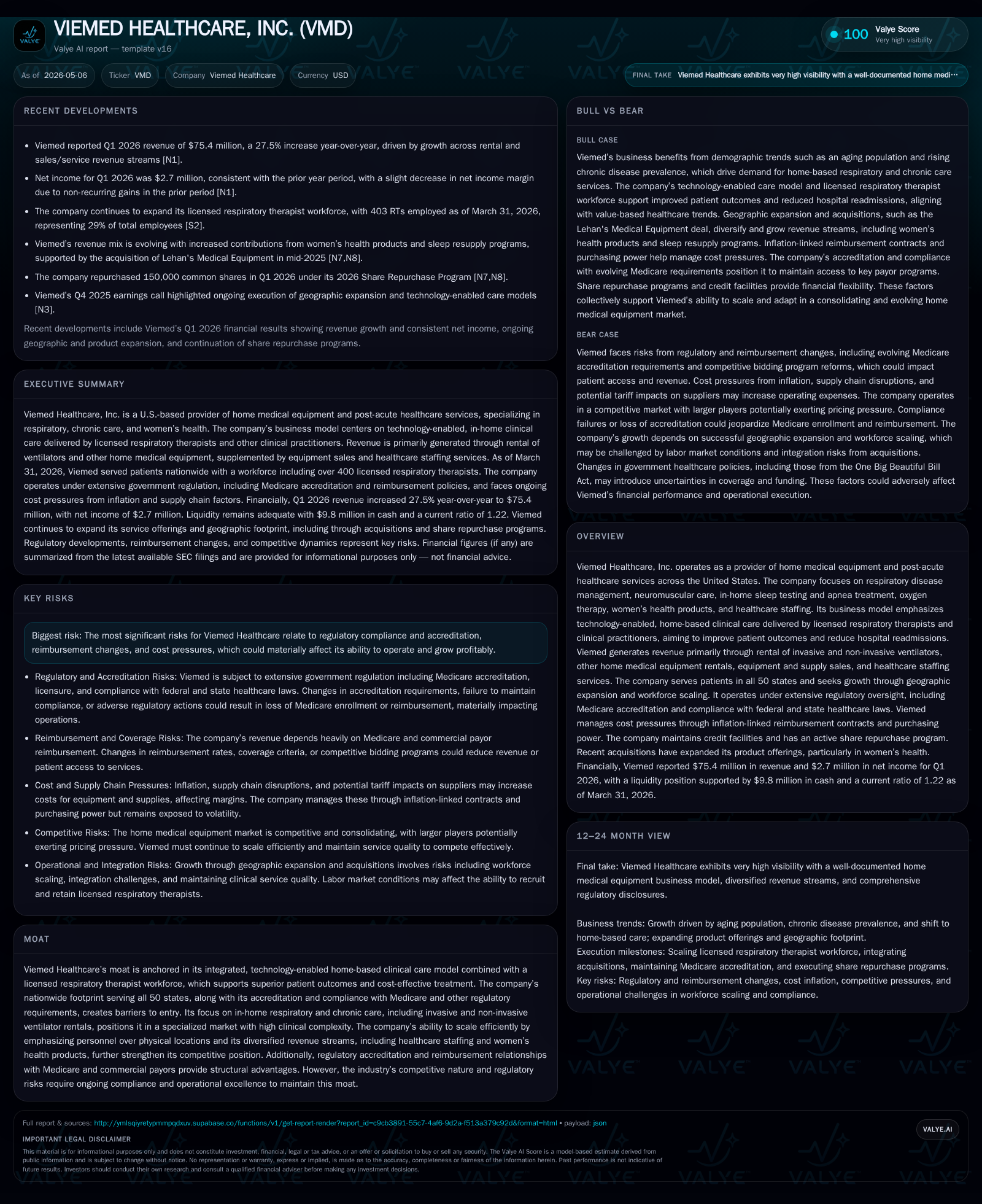
In Q1 2026, Viemed Healthcare expanded its equipment and supply sales dramatically, primarily fueled by the Lehan acquisition and scaling PAP resupply programs, while healthcare staffing services saw a modest decline. The company's integrated home respiratory care model continues to drive patient outcomes across all 50 states, supported by a sizable licensed respiratory therapist workforce. Strategic growth hinges on further geographic expansion, women’s health product line growth, and clinical staffing increases, but regulatory oversight and reimbursement uncertainties remain material risks. Liquidity remains adequate with $9.8 million cash and manageable debt of $9.2 million as of March 31, 2026.
Latest Quarterly Operating Update: Revenue Growth and Segment Performance
Viemed Healthcare’s Q1 2026 results highlight robust equipment and supply sales growth alongside operational headwinds within its healthcare staffing segment. Sales from equipment and supplies surged by $10.0 million or an extraordinary 132.6%, reaching $17.5 million for the quarter ended March 31, 2026 [S2]. This spike stems mainly from the integration of its July 2025 Lehan acquisition which bolstered women’s health product offerings such as breast pumps and accessories. Additionally, scaling of Viemed's sleep resupply program significantly contributed to increased volumes of positive airway pressure (PAP) supplies and related equipment.
However, service revenues—primarily healthcare staffing—experienced a modest contraction of $0.1 million or 1.9% down to $6.4 million during the same period, suggesting some cooling or competitive pressure within this segment [S2].
Liquidity showed tightening with cash and equivalents dropping from $13.5 million at December 31, 2025 to $9.8 million as of March 31, 2026 [S2][F1]. Despite this decline, the firm maintains a conservative leverage profile with total debt approximating $9.2 million and effectively negative net debt (-$0.56 million) on a net basis given cash reserves [F1], ensuring flexibility during growth investments such as equipment purchases evidenced by an $8.5 million net cash outflow for investing activities largely related to rental asset acquisitions.
The company’s ability to service its financial obligations remains intact with scheduled principal repayments totaling $3.2 million during Q1 on the term loan facility [S2].
Business Model and Service Quality: Technology-Enabled Home Respiratory Care
Viemed operates predominantly within the home medical equipment (HME) space specializing in post-acute respiratory care across the United States. Its business model leverages proprietary technology paired with licensed respiratory therapists (RTs) delivering in-home clinical interventions designed to mitigate hospital readmissions while managing complex chronic conditions cost-effectively [S1].
Central revenue drivers include rental streams from invasive and non-invasive ventilators which comprised over half of their total revenue base in recent years (50.6% for fiscal year ended December 31, 2025) supplemented by ancillary revenue lines—equipment/supply sales, oxygen therapy products, sleep testing/treatment solutions, women’s health offerings, along with healthcare staffing services provided both internally and externally [S1][S2].
This integrated care approach combining asset rentals with professional clinical oversight aims at superior outcomes relative to traditional institution-based models while containing costs—a critical value proposition given today's rising healthcare expenditure climate focused on chronic disease management.
By prioritizing patient-facing personnel over fixed-location overheads Viemed achieves operational scalability enabling entry into underserved regions across all fifty states without prohibitive capital expenditure burdens typically associated with physical footprint expansions [S1].
Competitive Position and Industry Structure: Barriers from Compliance and Accredited Care
Viemed’s competitive moat lies chiefly in its national scale combined with stringent regulatory accreditations required for Medicare participation—a crucial consideration given that government payors represent substantial payment sources within the HME industry [S1][S15]. Their licensed respiratory therapist workforce—which accounted for roughly 29% of total employees as of end-2025—provides differentiated clinical competencies supporting superior patient adherence and monitoring capabilities uncommon among smaller competitors lacking scale or integrated care models [S1].
The industry's structural barriers also arise from the highly regulated environment involving complex billing compliance under federal statutes including the False Claims Act and Civil Monetary Penalties Law—as well as state anti-kickback statutes—that impose rigorous documentation standards on medical necessity for claim validity to avoid penalties or exclusions from federal reimbursement programs [S15][S19].
Further buttressing its position is Viemed’s strategic focus on specialized respiratory disease management amidst a broader pivot toward value-based home care delivery increasingly favored by government insurers adjusting competitive bidding frameworks—for example removing certain ventilator categories from prior bidding rounds—these shifts alleviate downward pricing pressures historically faced within contested HME product lines while demanding robust compliance governance as managed by Viemed’s established internal controls [S1][S19].
Growth Drivers: Geographic Expansion, Women’s Health Product Line, and Workforce Scaling
Growth catalysts for Viemed sprout from multiple vectors:
- Geographic Expansion: Deploying cost-effective launch frameworks concentrating overhead on skilled personnel rather than facility-based expense enables rapid market penetration into previously underserved or inefficiently served locales nationwide driving patient volume gains without commensurate fixed-cost burdens [S1][N3].
- Women’s Health Products: Post-Lehan acquisition integration notably accelerated women's health offering scale including breastfeeding support devices which yielded meaningful incremental sales during Q1; this diversification smoothens revenue volatility inherent in ventilator rental cycles while accessing growing demand segments tied to maternal health trends [S2][N3].
- Clinical Workforce Growth: Maintaining high standards of care depends critically on sourcing licensed RTs; expanding hiring pipelines bolsters capacity for patient intake growth sustaining quality metrics essential for favorable insurer contracting and reimbursement continuity [S1][N3].
- Sleep Therapy Resupply Expansion: Scaling PAP therapy-related consumables supports recurring volume uplifts linked to patient adherence programs further anchoring subscription-like revenue streams complementing capital-intensive equipment rentals [S2][N3].
Together these initiatives align tightly with secular healthcare trends favoring home-based chronic therapy modalities over inpatient care —a structural tailwind underpinning sustainable scalable growth prospects.
Risks and Constraints: Regulatory Oversight, Reimbursement Uncertainties, and Staffing Challenges
Regulatory risk remains paramount given Viemed's exposure to evolving CMS reimbursement policies such as frequent adjustments in competitive bidding program scopes which can materially influence pricing frameworks particularly for key product categories like ventilators or oxygen equipment removed or reintroduced intermittently affecting revenue predictability [S15][N1].
Compliance demands around documentation integrity amplify operational complexity; failure by prescribing clinicians to maintain robust medical records threatens claim validity exposing Viemed to overpayment recovery actions or penalties under False Claims Act provisions posing existential risk factors if systemic issues arise [S15].
Labor market dynamics also present challenges amidst nationwide shortages of licensed respiratory therapists—a critical input variable needed to maintain care standards—with attrition or hiring freezes potentially constraining capacity expansion impeding growth execution plans or elevating wage costs squeezing margins further given inflationary pressures pervasive across medical labor pools [N1][S15].
These operational themes collectively will dictate balance between growth acceleration versus margin resilience shaping overall financial performance trajectory post-operating earnings miss noted in early May reporting disclosures [N1][S2][S3].
Financial Snapshot: Q1 2026 Liquidity, Debt, and Profitability
Latest financial snapshot
| Metric | Value | Period |
|---|---|---|
| Cash & equivalents | $9.8mm | |
| 2026-03-31 | ||
| Total debt | $9.2mm | |
| 2026-03-31 | ||
| Net debt | $-0.56mm | |
| 2026-03-31 | ||
| Current assets | $50mm | |
| 2026-03-31 | ||
| Current liabilities | $41mm | |
| 2026-03-31 | ||
| Current ratio | 1.22x | |
| 2026-03-31 |
Source: SEC companyfacts cache [F1].
The above snapshot underscores Viemed's solid liquidity position despite a sequential cash decrease during Q1 reflecting strategic investment deployment offset by stable debt levels yielding negative net leverage providing moderate financial flexibility heading into the balance of fiscal year operations.[F1][S2]
This analysis is based solely on publicly available filings as cited without any investment advice or recommendations.
Disclaimer: This is research-only, informational analysis and not investment advice. It may include AI-generated interpretation and general industry context. Always verify important details using primary sources.

Comments