
Amerant Bancorp Advances Florida Expansion While Managing Rising Mortgage Exposure
Amerant Bancorp is expanding its Florida branch network while increasing residential mortgage exposure, balancing growth opportunities with emerging asset sensitivity risks.
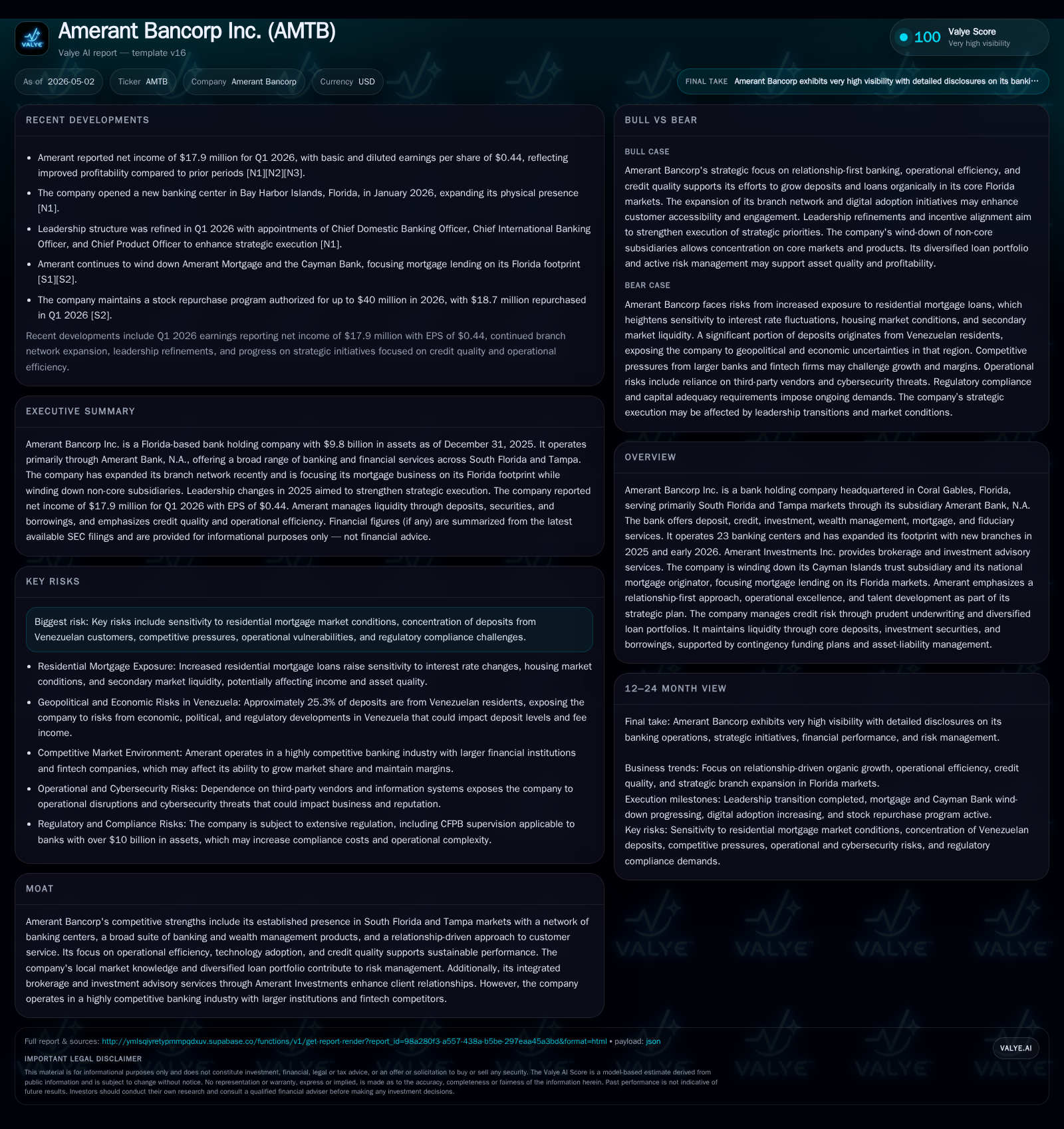
In Q1 2026, Amerant Bancorp accelerated its Florida footprint expansion with new branches in Bay Harbor Islands and plans for St. Petersburg, complementing an ongoing shift toward residential mortgage lending concentrated in its core markets. This strategic pivot accompanies a wind-down of noncore subsidiaries, like the Cayman trust and national mortgage originator, highlighting a focus on operational efficiency and local market penetration. However, the increased jumbo and nonconforming mortgage holdings amplify interest rate and liquidity sensitivities, while deposit concentration from Venezuelan clients remains a notable risk factor amid geopolitical uncertainties. The bank’s relationship-driven model and diversified offerings support competitive positioning in Florida’s crowded regional banking landscape.
Latest Operating Developments: Branch Expansion and Loan Portfolio Shifts
Amerant Bancorp’s Q1 2026 report underscores concrete expansion moves within its primary Florida markets alongside identifiable changes within its loan portfolio structure. The company added new physical presence with the January 2026 opening of a banking center in Bay Harbor Islands, following regulatory approval granted in July 2025 for a St. Petersburg branch slated for launch within the year [S1][S2]. These expansions augment the existing footprint of 23 banking centers concentrated mainly in South Florida regions such as Miami-Dade, Broward, Palm Beach counties as well as Tampa.
Simultaneously, Amerant is actively winding down noncore subsidiaries including Elant Bank & Trust Ltd., its Cayman Islands trust entity — which ceased fiduciary relationships ahead of anticipated regulatory dissolution this year — alongside the transition of Amerant Mortgage from broad national origination towards a geographically focused model servicing Florida clients primarily [S1][S2][S16]. This refocus aligns with strategy prioritizing market familiarity over dispersal.
On the loan portfolio front, first-quarter disclosures reveal residential mortgage loans have grown through acquisitions, elevating their share of earning assets. The commercial real estate (CRE) loan mix exhibits retrenchment across retail ($562M vs $618M end-2025), multifamily ($261M vs $322M), and hospitality ($187M vs $239M), counterbalanced by increases notably in industrial and warehouse sectors ($109M up from $82M) supporting diversification aims [S2].
Deposit funding trends reflect growing reliance on brokered time deposits which rose to $548 million at March-end from $436 million at December-end 2025. Meanwhile, large fund providers – institutional or third-party accounts over $20 million – saw modest reduction from $962 million to $885 million in total balances during the same period [S2].
A material concentration risk resides in deposits from Venezuelan residents totaling roughly 25.3% or about $2 billion at quarter-end — drawing attention owing to political and regulatory volatility connected to U.S.–Venezuelan relations and corresponding OFAC licenses [S2][S8].
Amerant Bancorp Business Model: Diverse Product Suite Anchored in Relationship Banking
Amerant operates principally through its Coral Gables–headquartered bank subsidiary offering retail banking products including varied deposit products (checking, savings, money markets, CDs), diverse credit services spanning commercial loans and mortgages focused locally post-renewal strategy, wealth management advisory delivered via Amerant Investments Inc., and fiduciary services transitioning away from offshore structures towards domestic focus [S1][S16].
Revenue generation hinges on net interest income derived from lending-funded deposits complemented by fee-based revenue streams originating from brokerage commissions, mortgage servicing fees (though shrinking as origination model winds down), fiduciary fees, and wealth management advisory fees. The company emphasizes a ‘relationship-first’ approach designed to foster client loyalty by integrating banking with investment services under one brand umbrella tailored to Hispanic-American affluent segments predominant in South Florida.
Credit risk management underpins sustained profitability through conservative underwriting policies calibrated via a robust credit committee oversight that monitors portfolio performance weekly for larger credits exceeding $5 million or exposures over $20 million aggregated by borrower relationships [S21]. Importantly, loan officers’ incentives are partially contingent upon asset quality metrics ensuring alignment between originations growth and credit discipline.
Operational efficiency comes into sharper focus with recent leadership additions: specialists overseeing domestic banking operations, international banking relationships focusing on global clientele within Florida’s immigrant-heavy base, plus a Chief Product Officer tasked with harmonizing product offerings across channels — signaling intent to streamline delivery while boosting sales execution against competitors both local banks and fintech entrants disrupting customer acquisition models [S16].
Competitive Dynamics and Industry Positioning in Florida’s Regional Banking Market
Operating primarily within South Florida’s dense regional banking ecology — characterized by major banks such as Wells Fargo, Bank of America alongside niche regional players — Amerant differentiates itself via entrenched local knowledge especially within the Hispanic communities paired with comprehensive service bundles incorporating brokerage services uncommon among typical community banks [S1][S8].
Despite these advantages, competitive pressures are acute given scale disparities favoring larger financial institutions with broader digital capabilities as well as fintech competitors providing low-cost digital-first deposit products challenging traditional customer acquisition costs.
Regulatory scrutiny also imposes operational overheads necessitating rigorous compliance frameworks; nonetheless Amerant’s investment in cyber security governance led by an experienced Chief Information Security Officer reflects proactive risk mitigation aligned with industry best practices detailed annually before the Board’s Risk Committee [S1]. This positions it well against vulnerabilities threatening mid-sized banks amidst escalating cyber threats.
Growth Catalysts: Geographic Expansion and Mortgage Loan Portfolio Augmentation
Branch network expansion into Bay Harbor Islands manifestly addresses affluent catchment zones while planned St. Petersburg branch taps Tampa Bay area growth potential reflecting demographic migration trends favoring Sunbelt urban hubs [S1][S2]. Such physical expansion complements digital outreach initiatives aimed at client retention.
The purchase-driven augmentation of residential mortgages buttresses earnings diversification but introduces renewed sensitivity to housing market fluctuations. The portfolio’s jumbo/nonconforming composition implies exposure to less liquid secondary markets which can complicate sales or securitization strategies under stress scenarios; hence Amerant’s cautious stance incrementally scaling these holdings alongside rigorous credit monitoring underscores a measured approach towards capitalizing on housing demand stability within Florida’s core markets even amid national economic deceleration [S2][N1].[S8]
Integration of wealth management offerings via Amerant Investments enhances cross-sell opportunities deepening wallet share within existing customers while potentially attracting affluent prospects seeking consolidated financial solutions underpinned by trusted relationship bankers.
Risks and Constraints: Mortgage Market Sensitivity and Deposit Concentration Challenges
Elevated exposure to jumbo residential mortgages heightens exposure to prepayment risk should interest rates decline below weighted coupons—a dynamic that could accelerate runoff reducing interest income absent comparable reinvestment avenues. Conversely rising rates or economic uncertainty threaten borrower affordability impacting credit performance materially given nonconforming loan predilection toward less liquid secondary markets causing potential valuation swings or trading freezes that would constrain balance sheet flexibility [S8].
On deposits side geopolitical risk stems from significant Venezuelan depositor concentration; about one-quarter of total deposits originate from this cohort whose inflows depend heavily on improved bilateral relations between U.S. and Venezuela coupled with OFAC licensing regimes permitting certain dollar transactions. Any reversal or tightening would pressure deposit stability requiring swift funding substitution maneuvers potentially at unfavorable cost structures [S2][S8].
Operational risks include ongoing adjustments related to leadership transitions initiated late 2025 designed to accelerate strategic execution but exposing short-term organizational alignment challenges until onboarding completes fully with expected permanent CEO appointment pending; meanwhile technology adoption pace remains critical to managing cost-to-income ratios effectively against fintech rivals.
Key Near-Term Milestones and Performance Indicators to Monitor
Stakeholders should track the expected opening date adherence for the St. Petersburg branch as a tangible milestone signaling geographic expansion execution momentum post regulatory clearance.[N1] Monitoring loan portfolio quality indicators—particularly delinquency trends within acquired residential mortgages—will shed light on credit risk evolution amid macroeconomic cycles.[N2] Deposit composition shifts notably Venezuelan inflows warrant continued observation given their implications for liquidity resilience under geopolitical flux.[N2]
Operational efficiency metrics including cost-to-income ratios will reveal progress against stated strategic priorities surrounding talent development and technology investments crucial for competitive agility.[N1] Regulatory approvals finalizing dissolution plans for Cayman trust entity and national mortgage origination will mark strategic clarity towards domestic market concentration.[S16]
Financial Overview: Interest Expense Trends and Funding Profile Stability
Amerant reported reduced interest expense totaling $52.7 million for Q1 ended March 31, 2026—a decline of nearly 12.8% compared with prior-year period—primarily owing to a 42 basis point drop in average interest rates coupled with approximately $41 million decline in average interest-bearing liabilities despite growing balances in interest-bearing demand, savings, and money market deposits indicative of evolving funding mix dynamics [S2].
Brokered time deposits climbed significantly from $436 million end-2025 to $548 million first quarter suggesting reliance on third-party deposit sources somewhat elevated relative to core relationship-driven accounts whereas large fund provider balances decreased moderately evidencing nuanced debt optimization strategy maintenance aimed at preserving liquidity buffers consistent with planned asset growth trajectories.[ } Cash equivalents declined sharply relative to year-end largely due to reallocation into securities purchases totaling more than $540 million accompanied by loan originations growth indicative of active balance sheet deployment supporting earning asset expansion goals though tempered by net loan sales providing some liquidity offsetting.[S14] Overall liquidity posture supports planned branch buildouts and operational investments while maintaining prudent capital adequacy ratios comfortably above regulatory minima underpinning ongoing dividend payments recently executed despite macroeconomic uncertainties around GDP slowdown evidenced by Federal Reserve forecasts amidst persistent inflationary pressures.[S2]
This analysis presents an integrated view grounded solely on disclosed filings without forward-looking investment guidance but highlights how Amerant Bancorp balances strategic growth ambitions particularly through geographic expansion combined with increasingly sensitive mortgage exposure against identifiable funding risks notably deposit concentration amid complex external factors shaping Florida's competitive banking landscape.
Disclaimer: This report is for informational purposes only based on publicly available SEC filings and news sources as of May 2026. It does not constitute investment advice or recommendations.
Disclaimer: This is research-only, informational analysis and not investment advice. It may include AI-generated interpretation and general industry context. Always verify important details using primary sources.

Comments