
Royal Caribbean’s Q1 Surge: Leveraging Fleet Expansion and Market Segmentation
Royal Caribbean Cruises Ltd. demonstrates strong Q1 2026 operating momentum driven by diversified brands, fleet innovation, and expanding private destination offerings.
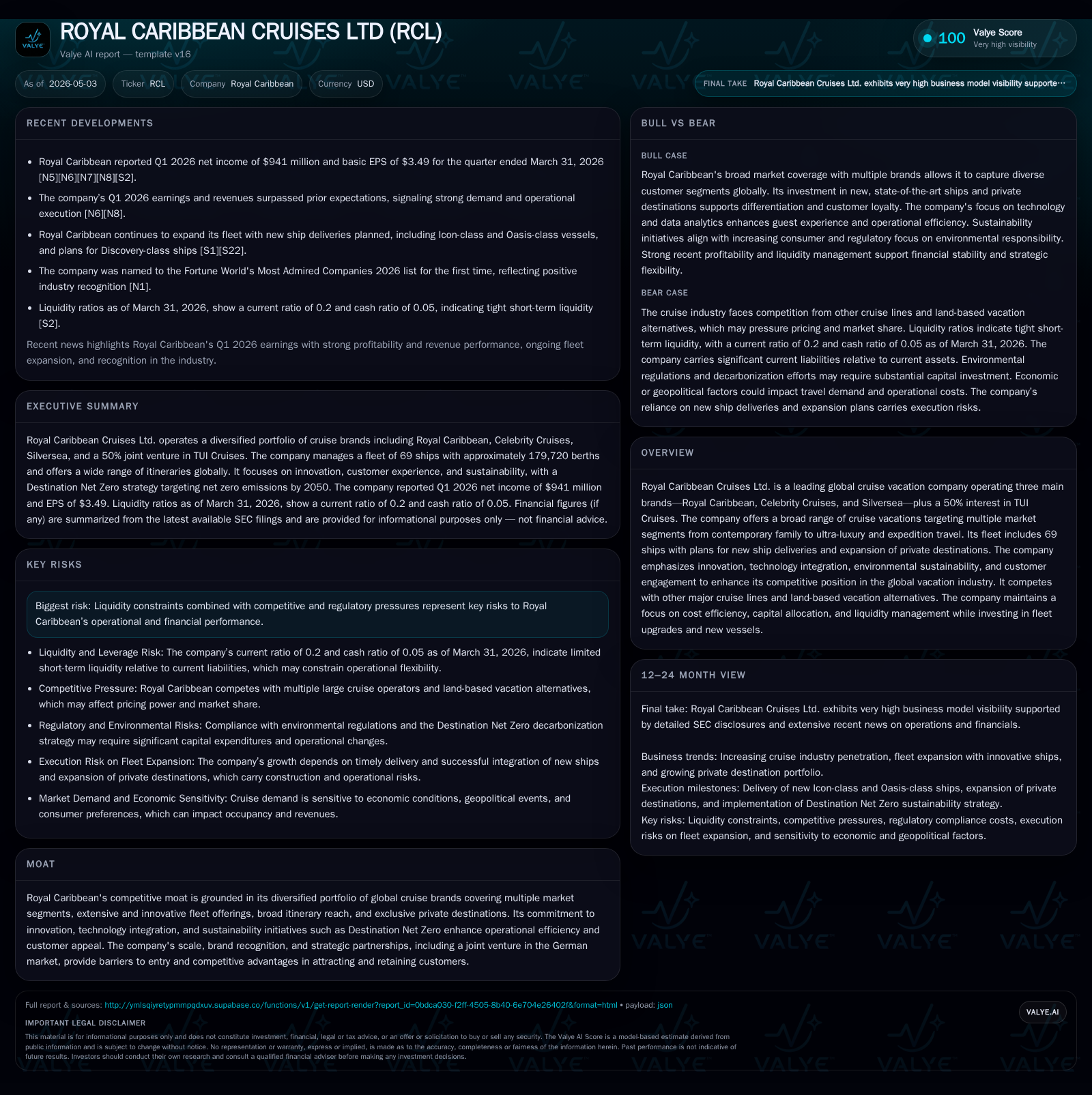
In its latest quarterly filing, Royal Caribbean Cruises Ltd. reports sustained revenue performance and operational enhancements rooted in a broad brand portfolio and fleet growth. The company’s Q1 2026 results reflect solid demand across market segments supported by innovative ship designs and expanding private destination experiences. Structural advantages from global itinerary reach and strategic partnerships underpin its competitive moat despite liquidity pressures from substantial debt levels. Near-term growth is fueled by new ship deliveries and portfolio expansion, though challenges remain from regulatory requirements and competitive dynamics.
Q1 2026 Operating Update: Performance Highlights and What Changed
Royal Caribbean Cruises Ltd.'s April 30, 2026 10-Q filing ([S2]) reveals a continuation of positive operational momentum in the first quarter, with robust bookings supporting steady revenue streams despite ongoing macroeconomic uncertainties. Earnings calls around this release ([N5]) confirm that itinerary adjustments have been strategically implemented to optimize vessel deployment across lucrative routes worldwide. While no material changes occurred in risk factors this quarter ([S2]), the company reaffirms focus on liquidity management amid expanding investment needs.
Business Model Overview: Diverse Cruise Brands and Value Drivers
Royal Caribbean operates three main Global Brands—Royal Caribbean itself, Celebrity Cruises, and Silversea—alongside a 50% joint venture stake in Germany’s TUI Cruises ([S1], [F1]). This multi-brand architecture enables strategic segmentation across a wide vacation spectrum: from family-focused contemporary cruises with Royal Caribbean to ultra-luxury expedition-style journeys with Silversea. Each brand maintains tailored marketing campaigns leveraging travel advisors, digital platforms, and loyalty programs, fostering high repeat customer engagement ([S28]). The combined fleet capacity stood at nearly 180,000 berths across 69 ships as of year-end 2025 ([F1]).
Fleet Quality and Product Differentiation: Innovation’s Role in Customer Value
Fleet assets represent the company’s dominant capital investment category ([S1]). Depreciation policies reflect a weighted average useful life of ships between 30 to 35 years with periodic drydocking for maintenance under deferral accounting. Recent introductions such as Royal Caribbean’s Icon of the Seas emphasize large-scale innovation with family neighborhoods like “Surfside,” extensive waterparks, and environmentally conscious designs aligned with the Destination Net Zero initiative ([S1]). Silversea’s Silver Nova further exemplifies cutting-edge sustainability measures coupled with luxury offerings.
Exclusive private destinations—including Perfect Day at CocoCay and Royal Beach Club—enhance differentiated experiences beyond onboard activities ([S18], [S27]). These locations provide unique attractions (e.g., zip lines, helium balloon rides) that bolster customer retention through immersive shore excursions unavailable through competitors.
Industry Structure: Competitive Dynamics, Supply Factors, and Regulatory Environment
Royal Caribbean operates within a complex landscape featuring major cruise conglomerates such as Carnival Corporation & plc and Norwegian Cruise Line Holdings alongside emerging private island resort options and assorted land-based leisure alternatives ([S20]). Key barriers to entry are capital intensity of new ship construction, scale efficiencies achievable through fleet size (69 ships), extensive port rights secured via strategic investments, and brand loyalty effects.
Regulatory mandates—primarily environmental standards—drive capital expenditures focused on emissions reductions via innovative hull design, fuel alternatives compatibility, and waste management systems ([S1], [S29]). Though increasing compliance costs pose near-term pressures, they also present differentiation opportunities for early adopters like Royal Caribbean.
Growth Catalysts: Fleet Expansion, Market Penetration, and Private Destinations
Looking forward, Royal Caribbean plans moderate fleet expansion benchmarked by new ship deliveries including an Edge-class vessel expected in 2028 adding approximately 3,250 berths ([S1]). Ongoing enhancements to itineraries allow market penetration both in established regions like North America —and growing areas such as Asia-Pacific where supply constraints previously limited growth ([S21], [N11]).
The allure of private destinations continues to support higher yield per guest metrics through exclusive shore experiences. Investment in digital platforms enriches customer booking journeys while loyalty program integration drives repeat visitation ([S28], [N12]). Management emphasizes targeted marketing strategies aligning product mix with evolving consumer demographics.
Risks and Constraints: Liquidity, Competitive Pressures, and Regulatory Exposure
Liquidity remains a key concern given the substantial net debt load approximating $19.15 billion against cash balances around $512 million as of March 31, 2026 ([F1]). The company's current ratio near 0.20 signals concentrated reliance on long-term financing rather than liquid assets for near-term obligations ([F1]). Competitive intensity from other cruise lines’ expanding fleets plus alternative experiential vacations requires sustained innovation investment. Environmental regulations will continue demanding capex for compliance upgrades impacting operating margins over time ([S2], [S29]). External shocks in fuel pricing or global health-related travel restrictions also remain latent operational hazards.
Key Milestones Ahead: Guidance, Demand Signals, and Strategic Execution
Upcoming milestones include the delivery of Celebrity Xcite onboard Celebrity Cruises by 2028 adding berth capacity aligned with higher yield premium clientele ([S1]). Seasonally significant booking data released in coming quarters will be critical indicators of consumer discretionary recovery trends linked to macroeconomic conditions impacting leisure spending ([N11], [N12]).
Management’s commentary affirms no immediate risk factor revisions but underscores ongoing emphasis on balanced capital allocation—prioritizing fleet innovation while conserving financial robustness amid macro uncertainties ([S2]). Further expansion of private destinations remains a priority for enhancing differentiated value propositions.
Financial Position Snapshot: Capital Structure and Liquidity Metrics
Latest financial snapshot
| Metric | Value | Period |
|---|---|---|
| Cash & equivalents | $512mm | |
| 2026-03-31 | ||
| Total debt | $19.7bn | |
| 2026-03-31 | ||
| Net debt | $19.2bn | |
| 2026-03-31 | ||
| Current assets | $2.2bn | |
| 2026-03-31 | ||
| Current liabilities | $11.1bn | |
| 2026-03-31 | ||
| Current ratio | 0.2x | |
| 2026-03-31 |
Source: SEC companyfacts cache [F1].
This snapshot reveals a capital-intensive business model operating with considerable leverage balanced against moderate cash reserves ([F1]). Liquidity constraints are evident given the low current ratio, indicating reliance on long-term financing rather than liquid assets for near-term obligations ([F1]).
Disclaimer: This analysis is for informational purposes only to provide detailed insight into Royal Caribbean Cruises Ltd.'s recent operations and industry context based on available SEC filings and news reports as of May 3rd, 2026. It does not constitute investment advice or recommendations.
Disclaimer: This is research-only, informational analysis and not investment advice. It may include AI-generated interpretation and general industry context. Always verify important details using primary sources.

Comments