
Summit Therapeutics Poised for Regulatory Milestone on Ivonescimab Amid Solid Trial Progress
Summit's latest quarterly filing highlights the upcoming FDA decision on ivonescimab and underscores the company’s clinical advancement amidst financial constraints.
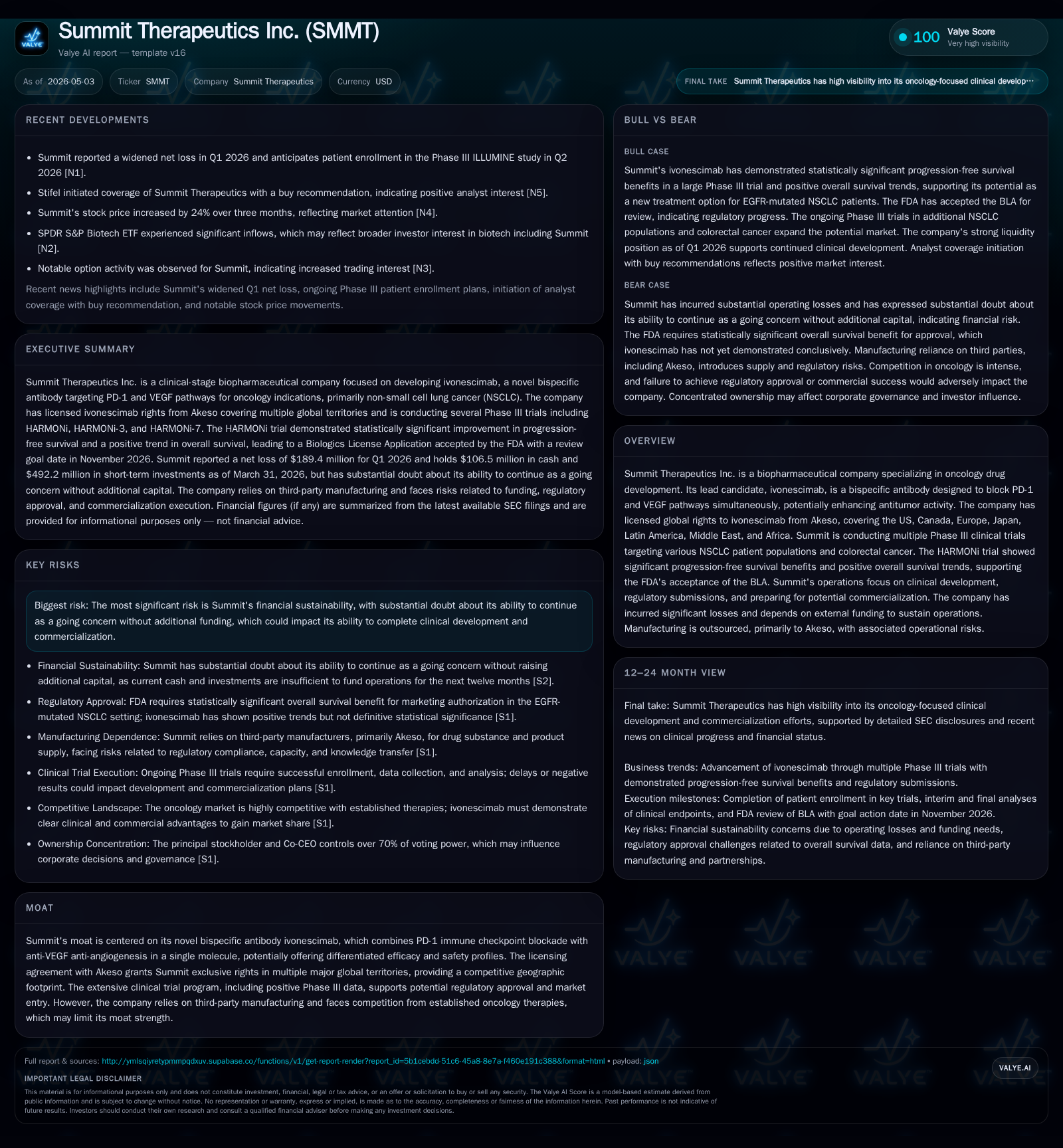
In its Q1 2026 10-Q filing, Summit Therapeutics announced a pivotal FDA PDUFA date of November 14, 2026 for ivonescimab’s Biologics License Application, following strong Phase III trial results. Ivonescimab's innovative bispecific antibody mechanism targets NSCLC and colorectal cancer by dual inhibition of PD-1 and VEGF pathways, positioning it distinctively in oncology therapeutics. Despite promising clinical momentum and extensive global licensing from Akeso, Summit faces significant financial challenges with limited working capital and substantial going-concern risks. Upcoming clinical milestones and regulatory decisions will be crucial to validate the growth potential amid capital dependency.
Latest Quarterly Filing Reflects Critical FDA Approval Timeline
Summit Therapeutics’ most recent quarterly report (Form 10-Q dated April 30, 2026) anchors the company's near-term outlook around the FDA's planned action on ivonescimab’s Biologics License Application (BLA), accepted earlier that year with a target PDUFA date set for November 14, 2026 [S2][S3]. This milestone concretizes expectations following the positive topline results from the Phase III HARMONi trial announced in May 2025. However, the filing starkly reveals Summit’s precarious financial footing: cash and equivalents totaled $106.5 million as of March 31, 2026 but with an explicit disclosure of substantial doubt about continuing as a going concern without further capital raises [S2]. The company lacks sufficient working capital to sustain operations through the next twelve months unaided.
The acceptance of the BLA signals regulatory validation of ivonescimab’s clinical data package and initiates a compressive review window potentially culminating in commercial approval. Yet this regulatory path also imposes demands for robust pharmacovigilance and post-marketing commitments that Summit must fund while navigating capital scarcity [S1]. Thus, the quarter’s disclosures both elevate optimism regarding product approval timing and underscore material operational risks tied directly to financing needs.
Ivonescimab’s Dual-Action Therapeutic Approach Shapes Summit’s Value Proposition
At the heart of Summit’s business model is ivonescimab—a novel bispecific antibody designed to simultaneously target the programmed death-1 (PD-1) immune checkpoint and vascular endothelial growth factor (VEGF) pathways [S1]. This molecular design merges immunotherapy's capacity to unleash anti-tumor T-cell responses with anti-angiogenic effects limiting tumor blood vessel formation. Unlike sequential or combination therapies utilizing separate agents against PD-1 and VEGF respectively, ivonescimab integrates these mechanisms into one compound with potential improvements in efficacy, safety profile simplification, and patient convenience.
Clinical rationale for this approach reflects unmet needs in non-small cell lung cancer (NSCLC) settings—particularly among patients harboring epidermal growth factor receptor mutations resistant to tyrosine kinase inhibitors—and extends to metastatic colorectal cancer [S1]. The bispecific format could mitigate toxicities associated with overlapping side effects from multi-agent regimens while exploiting synergistic mechanisms to delay disease progression more effectively than existing monotherapies or combinations.
Competitive Dynamics in Oncology Bispecific Antibodies and Strategic Licensing
Summit's competitive edge depends substantially on its licensing arrangement with Akeso, which grants comprehensive global rights—covering key markets including North America, Europe, Japan, Latin America, Middle East, and Africa—to develop and commercialize ivonescimab [S1]. This territorial exclusivity positions Summit strongly within an increasingly crowded immuno-oncology landscape characterized by multiple approved PD-1 inhibitors and anti-VEGF agents but fewer bispecific antibodies in late-stage clinical development.
However, Summit’s business model entails reliance on third-party contract manufacturers for drug substance production given its status as a development-stage biopharma company [S1]. This dependency introduces potential supply chain complexities and manufacturing scalability challenges that could affect launch readiness post-approval. Additionally, competitive pricing pressures loom large: established PD-1 monoclonal antibodies command premium pricing often supported by extensive reimbursement networks. Ivonescimab must demonstrate not only therapeutic differentiation but also cost-effectiveness under evolving payor scrutiny.
Advancing Growth Through Clinical Trials and Geographic Expansion
The HARMONi Phase III study demonstrated statistically significant progression-free survival improvement in EGFR-mutated locally advanced or metastatic NSCLC patients who progressed after tyrosine kinase inhibitor therapy, underpinning the January 2026 FDA BLA submission [S1]. Additional ongoing pivotal trials include:
- HARMONi-3: First-line metastatic NSCLC across histologies with chemotherapy combination.
- HARMONi-7: Monotherapy in first-line metastatic NSCLC patients exhibiting high PD-L1 expression.
- HARMONi-GI3: Combination therapy evaluation in unresectable metastatic colorectal cancer initiated in late 2025 [S1][N2].
This diversified pipeline addresses several patient subsets across major tumor types where significant unmet medical needs exist. Patient enrollment dynamics remain critical; notably enrollment initiation for the ILLUMINE study (a GSK collaboration involving risvutatug rezetecan) is targeted for Q2 2026 [N2]. These milestones represent measurable KPIs reflective of demand adoption curves needed to propel eventual commercial launch readiness.
Risks Highlighted by Cash Constraints and Execution Dependencies
Execution risks extend into operational domains where delivering large-scale global Phase III trials requires complex coordination among contract research organizations, investigators, regulators, and manufacturing partners. Any delays or disruptions risk eroding shareholder value via postponement of commercialization timelines or need for costly supplemental studies required by regulators [S1]. Moreover, failure to secure reimbursement coverage upon launch remains an ongoing risk amid rapidly evolving healthcare policies globally.
Upcoming Catalysts and Operational Milestones to Monitor
The November 14, 2026 PDUFA action date stands as the paramount near-term event shaping Summit’s valuation trajectory [S2][S3]. Positive regulatory determination would unlock commercial opportunities across multiple international markets covered under licensing agreements.
Other significant developments include tracking enrollment progress and data readouts from ongoing Phase III programs—particularly HARMONi-3 and HARMONi-GI3—as well as advancement of collaborations like the GSK partnership targeting novel combinatory regimens launching mid-2026 [N2][S1]. Additionally, announcements relating to financing rounds or strategic partnerships could materially affect operational continuity given capital intensity constraints.
Monitoring payor engagement strategies post-approval will also be essential to assess pricing power durability amid competitive oncology therapeutics pricing pressures.
Financial Health Snapshot Supports Near-Term Operational Plans
Latest financial snapshot
| Metric | Value | Period |
|---|---|---|
| Cash & equivalents | $107mm | |
| 2026-03-31 | ||
| Current assets | $617mm | |
| 2026-03-31 | ||
| Current liabilities | $83mm | |
| 2026-03-31 | ||
| Current ratio | 7.41x | |
| 2026-03-31 |
Source: SEC companyfacts cache [F1].
| Metric | Value | Period Ended |
|---|---|---|
| Cash & Equivalents | $106.5M | |
| 2026-03-31 | ||
| Current Ratio | 7.41 | |
| 2026-03-31 | ||
| Total Debt | $24.5M | |
| 2024-09-30 | ||
| Net Debt (Est.) | -$82.0M | |
| 2024-09-30 |
Summit maintains a relatively healthy liquidity cushion evidenced by over $100 million in cash reserves at quarter-end coupled with a robust current ratio of approximately 7.4 indicating manageable short-term liabilities relative to assets [F1][S2]. Total debt stands modest at $24.5 million (dated Sept'24) resulting in an estimated net cash position exceeding $80 million [F1]. While this financial profile supports operational continuity near-term, it does not obviate management’s acknowledgment that additional capital injection is imperative beyond one year horizon to fund clinical progress through anticipated approval events [S2].
Capital allocation remains focused on R&D expenditures associated with clinical development programs targeting registration endpoints—reflecting typical investment priorities for development-stage oncology biopharma firms preparing for initial product launches [S1].
This analysis synthesizes public filings as of April 30, 2026 alongside supporting news releases through early May highlighting Summit Therapeutics’ critical regulatory timeline combined with their innovative therapeutic platform strategy centered on ivonescimab. While phase III evidence builds differentiated clinical promise across challenging oncology indications leveraging exclusive global license rights from Akeso, serious financial constraints impose execution risk demanding close monitoring of capital raising efforts concurrent with approaching milestones. The regulatory decision in November will be pivotal in determining whether Summit can bridge from predominantly R&D-stage operations toward commercial execution amid sector competition marked by incumbents in immune checkpoint inhibition and antiangiogenesis therapies.
Disclaimer: This report is an informational industry analysis based solely on publicly available data without investment recommendations or price forecasts.
Disclaimer: This is research-only, informational analysis and not investment advice. It may include AI-generated interpretation and general industry context. Always verify important details using primary sources.

Comments