
Asbury Automotive Group Faces F&I Revenue Pressure but Expands Scale with Strategic Acquisitions
Q1 2026 results spotlight segment revenue shifts and capital deployment amid evolving industry dynamics.
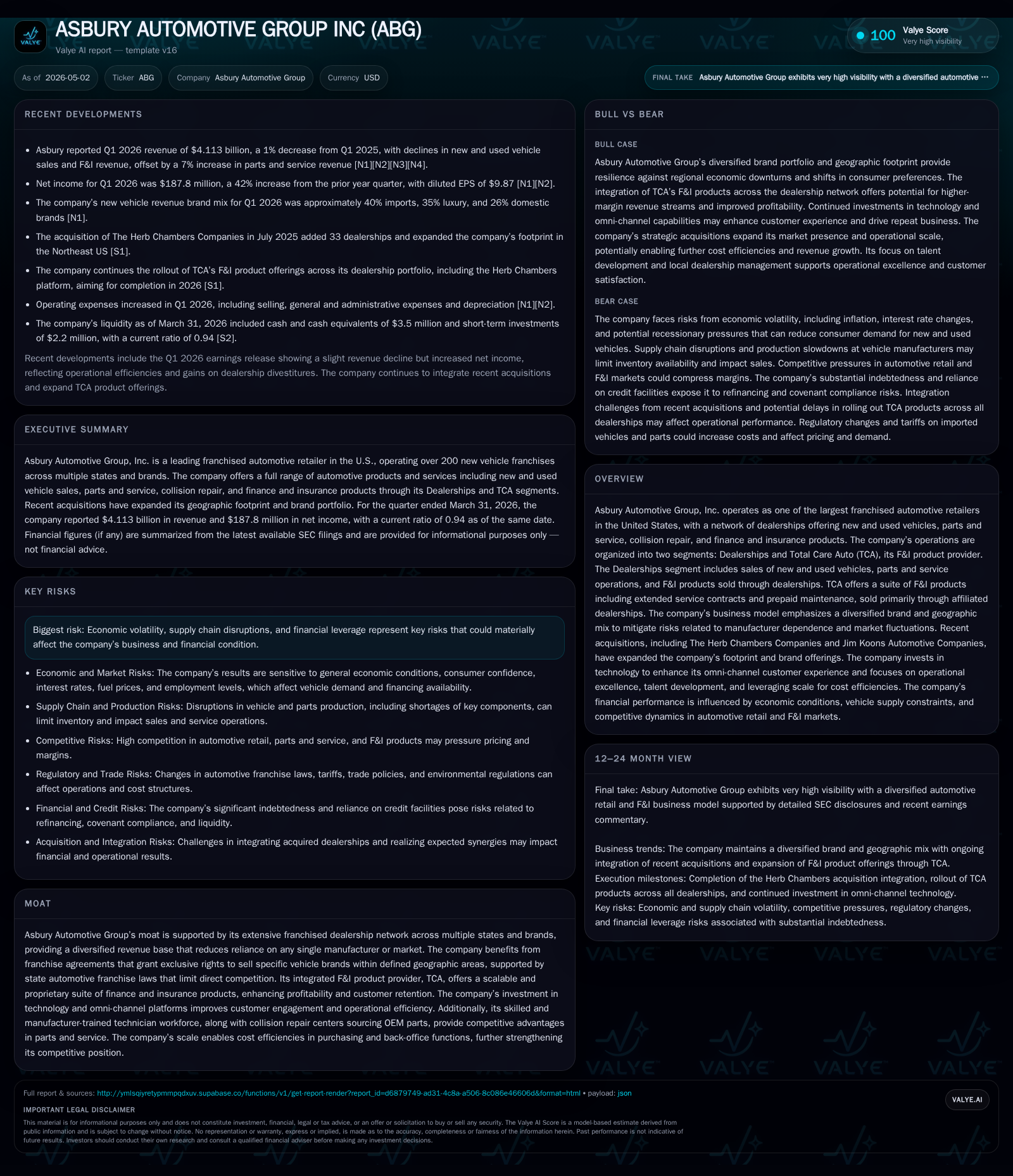
Asbury Automotive Group’s latest quarter reveals a contraction in finance and insurance (F&I) revenues alongside steady profitability from its core Dealerships segment. The company continues to integrate large-scale acquisitions such as Herb Chambers, underscoring its commitment to geographic and brand diversification. While operational execution benefits from scale and omni-channel advances, margin pressure persists in the F&I business, compounded by broader economic uncertainties and supply chain challenges. Focus remains on managing leverage prudently while pursuing selective growth opportunities in parts, service, and used vehicles.
Recent Operating Update
Asbury Automotive Group's first quarter of 2026 showed a meaningful decline in finance and insurance (F&I) revenues, with net revenue slipping 4% to $179 million compared to the prior year period. On a same-store basis — excluding acquired or divested dealerships — the decline was steeper at 11%. The net gross profit from F&I also decreased by about 4% year-over-year despite a slight increase in F&I profit per vehicle sold ($2,302 vs. $2,261), underscoring pressures on volume or product uptake. This softness in the high-margin F&I segment reflects continuing challenges in consumer demand for aftermarket financing products amidst tight economic conditions [S2].
In contrast, Asbury's Dealerships segment continues to drive revenues primarily through new vehicle sales, used retail/wholesale sales, parts & service operations (including collision repair), and third-party financing arrangements. The firm highlights that increased sales contribution from used vehicles and parts/services typically lift overall gross margins given their superior profitability relative to new vehicles. However, the recent easing of pandemic-induced supply issues has led new vehicle margins to retract from unusually high levels seen in the past few years [S2][S1].
Furthermore, during the trailing twelve months ending December 31, 2025, Asbury completed the transformative acquisition of The Herb Chambers Companies for approximately $1.76 billion. This added some 33 dealer franchises across multiple brands and geographic areas to Asbury's footprint — expanding scale and diversification. This deal was primarily financed through borrowings under the existing senior credit structure [S1].
Business Model
Asbury operates through two reportable segments:
- Dealerships: Involving franchised retail sale of new vehicles spanning luxury, import, and domestic brands; used vehicle retail and wholesale sales; automotive parts & services (repair & maintenance plus collision); plus finance & insurance products offered at dealerships.
- Total Care Auto (TCA): Its proprietary finance & insurance product engine providing extended service contracts, prepaid maintenance contracts, GAP coverage, and other protection products sold primarily through affiliated dealerships.
Revenue drivers depend on unit volumes sold—new cars tend to generate lower gross profits than used vehicles or parts/services cycles but represent larger top-line dollars. Usage intensity of parts/services sets a recurring revenue floor stemming from vehicle ownership lifecycles. F&I products offer profitable aftermarket suite opportunities enhancing yields per transaction. Importantly, TCA's revenues come from premiums earned on contracts as well as investment income tied to its portfolio performance; hence interest rate swings impact margins here [S1].
The integrated model affords controllable commissions expense due to TCA’s relationship with dealerships. The company also leverages technology-enabled omni-channel platforms enhancing customer engagement throughout shopping or service life stages—digital retailing tools reduce friction creating stickier guest experiences.
Industry Structure and Competitive Position
Franchised automotive retailers like Asbury operate in a highly fragmented U.S. market dominated by regional players owning specific brand lines under strict franchise agreements sanctioned by state laws. These agreements provide a structural moat by preventing direct manufacturer bypass efforts — dealers retain exclusive rights within defined geographies ensuring limited direct dealership competition.
Asbury’s strength lies in its diversified portfolio: it covers 171 dealership locations spanning 36 automobile brands across 15 states including substantial luxury/import brand exposure (~40% import brands + ~32% luxury brands). This diversity cushions against headwinds specific to manufacturers or local markets.
Complementing physical assets are collision centers supported by OEM-spec parts backed by manufacturer-trained technician workforce—a significant differentiator enabling differentiated repair quality and warranty adherence.
Moreover, proprietary F&I products via TCA create recurring backend profit streams that complement transactional car sales margins—enhancing customer retention due to product lock-in effects.
Growth Drivers
- Used Vehicle Sales: Given higher margins relative to new cars especially when managed via auctions or trade-ins; growth here bolsters gross profit.
- Parts & Service Expansion: Expected organic growth driven by increasing vehicle parc size nationwide combined with rising vehicle complexity requiring maintenance.
- Aftermarket Finance & Insurance Products: Upselling proprietary warranties and prepaid maintenance via TCA enhances customer lifetime value.
- Strategic Acquisitions: Large-scale deals like Herb Chambers expand market reach quickly while capturing synergies in procurement/consolidation.
- Digital Transformation: Omni-channel engagement platforms streamline customer interaction from discovery through purchase/service driving conversion rates higher.
- Geographical & Brand Diversification: Reduces volatility exposure related to manufacturer supply constraints or regional downturns—provides stable overall revenue flow.
Risks / Watchpoints / Growth Constraints
- Macroeconomic uncertainty affecting consumer confidence limits demand elasticity for discretionary automotive purchases impacting volumes particularly new vehicles.
- Supply chain bottlenecks remain intermittent but continue influencing inventory availability leading to margin variability especially on new cars.
- The company’s leverage position reflects borrowings primarily for acquisitions and inventory financing; maintaining operational discipline will be important to manage financial flexibility [S2][F1].
- Increasing interest rates could depress TCA investment returns which form part of segment profitability thus affecting resultant margins.
- Integration risks related to large recent acquisitions may strain operational efficiencies if cultural or systems consolidation lags expectations.
- Competitive pressures from online-only auto retailers growing share may gradually erode traditional dealership dominance though currently still limited by franchise laws.
What to Watch Next
Key indicators will include same-store sales trajectories across all segments post-Herb Chambers integration—the company typically excludes contribution from divested franchises when reporting like-for-like results. Close monitoring of F&I product mix adjustments—both volume per vehicle sold and margin trends—will reveal if pressure observed in Q1 is cyclical or structural. Capital allocation execution including pace of further acquisitions or potential changes in share repurchase activity given available restricted payment capacity set by debt covenants are material touches for future expansion or shareholder returns. Implementation efficacy of omni-channel initiatives impacting customer visit frequency or service retention rates should emerge over forthcoming quarters as digital investments mature. Lastly, tracking compliance with credit facility covenants amid ongoing borrowing for working capital floor plan needs will be vital given sizeable short-term cash flows dedicated there [S2].
Financial Profile Summary (Latest Quarter Context)
Latest financial snapshot
| Metric | Value | Period |
|---|---|---|
| Current assets | $3.04bn | |
| 2026-03-31 | ||
| Current liabilities | $3.22bn | |
| 2026-03-31 | ||
| Current ratio | 0.94x | |
| 2026-03-31 |
Source: SEC companyfacts cache [F1].
- Current assets of approximately $3.04 billion versus current liabilities near $3.22 billion yield a current ratio below unity at about 0.94 indicating tight near-term liquidity balance though consistent with industry norms given nature of floor planning liabilities [F1].
- Net cash used in financing activities rose materially compared with prior quarter primarily due to elevated repayments against floor plan notes payable offsetting reasonably stable borrowings levels [S2].
- SG&A expenses include significant variable components such as commissions which provide cost-flexibility amidst fluctuating sales volumes balancing operational efficiency tradeoffs [S1].
This analysis is based on public filings through May 2026. It aims solely to provide an informed perspective on Asbury Automotive Group’s strategic position and operating dynamics without investment advice or valuation judgments.
Disclaimer: This is research-only, informational analysis and not investment advice. It may include AI-generated interpretation and general industry context. Always verify important details using primary sources.

Comments