
Federated Hermes Strengthens Private Market Foothold While Managing Regulatory and Distribution Complexities
Q1 2026 results highlight strong asset growth and a strategic acquisition amid evolving regulatory landscape.
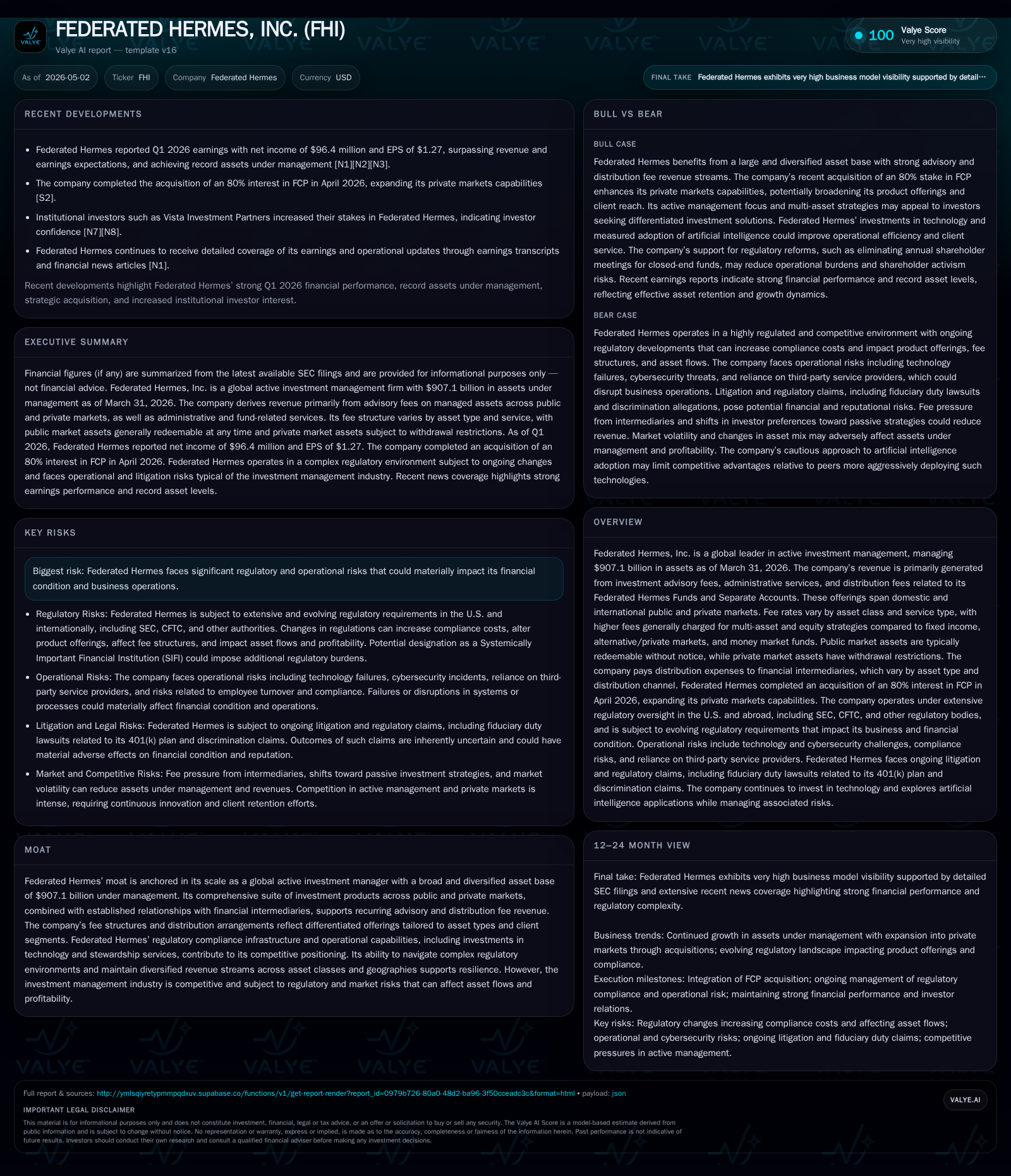
Federated Hermes, Inc. reported robust asset under management (AUM) growth to $907.1 billion as of March 31, 2026, driven by strong net inflows and favorable market conditions. The company completed a strategic acquisition of an 80% stake in FCP, expanding its private markets capabilities. Despite modest net income decline, earnings per share benefited from share repurchases. The active investment management firm faces ongoing regulatory complexities especially around money market reforms and disclosures but leverages its diversified platform balanced across public and private markets to navigate cyclical pressures and competition.
Recent Operating Update
Federated Hermes’ latest quarterly filing dated May 1, 2026 [S2] anchors our current view—with assets under management reaching $907.1 billion as of March 31, 2026. This high watermark reflects positive net inflows combined with market appreciation. Revenue increases have been driven largely by AUM growth, notably in higher-fee equity and multi-asset categories. However, net income saw a slight decrease compared to the prior year period due to increased operating expenses and non-operating items impacting profitability. Diluted earnings per share nevertheless rose thanks to ongoing share repurchases reducing the share count.
Crucially, Federated Hermes completed its acquisition of an 80% interest in FCP [S3], a move signaling a strategic pivot toward expanding private market capabilities within its broader investment platform. The acquisition enhances Federated Hermes' product diversification beyond public markets into alternatives and specialized private assets—a sector exhibiting structural growth trends.
Concurrently, the firm continues to navigate an evolving regulatory environment domestically and internationally [S2]. For example, SEC staff guidance around Rule 2a-7 institutional prime and institutional municipal money market funds contemplates new liquidity fee requirements triggered by redemption thresholds—potentially altering fund attractiveness among investors. Additionally, European Union (EU) and United Kingdom (U.K.) sustainability reporting requirements are shaping product disclosures and client communications.
Business Model
Federated Hermes operates predominantly as an active investment management company generating revenue through advisory fees on managed assets coupled with administrative service fees tied to its fund operations. These streams span diverse asset classes: from public equities, fixed income, multi-asset strategies to alternative/private investments including real estate development and renewable energy project initiatives [S2].
Fee structures are tiered by asset type: multi-asset and equity offerings command higher fee percentages relative to fixed income and alternatives; money market funds carry the lowest fees owing to their liquidity characteristics [S2]. In addition to advisory revenues, the firm earns distribution and shareholder servicing fees primarily from its mutual fund complexes distributed via financial intermediaries.
Importantly, distribution expenses represent a substantial outlay as Federated Hermes pays intermediaries commissions calculated as a percentage of net assets attributable per channel. The payout structures vary with asset classes—money market funds typically warrant higher commission payouts percentage-wise versus equity or alternative products—affecting margin dynamics [S2].
Operating costs are concentrated in compensation (inclusive of performance-linked incentives) and distribution expenses which fluctuate with AUM levels and sales activity. Technology investments towards compliance infrastructure modernization also contribute meaningfully to ongoing expense trends [S1][S2].
Industry Structure & Competitive Position
The global active asset management industry is characterized by intense competition against passive strategies while facing investor pressure for performance differentiation amidst fee compression trends. Federated Hermes distinguishes itself through scale ($907 billion AUM), breadth across public-to-private asset classes, comprehensive intermediary relationships, and growing stewardship services emphasizing ESG integration.
Ownership consolidation in alternatives/private markets is accelerating industrywide; Federated Hermes’ acquisition of a majority stake in FCP positions it advantageously to access bespoke private assets generating persistent fee streams beyond volatile public markets [S3][N11]. This complements its established traditional asset management offerings distributed globally.
Regulation imposes complexity: U.S. SEC reforms focusing on money market liquidity fees and disclosure modernization pressure product design choices while adding compliance costs [S2][S12]. Abroad, FCA (U.K.) and ESMA (EU) regulatory focus on sustainability disclosures requires enhanced reporting capabilities [S2]. Federated Hermes’ established global infrastructure facilitates adaptability but necessitates continuous investment.
Growth Drivers
Private Markets Expansion: The strategic acquisition of FCP broadens Federated Hermes’ presence in private equity-style funds and real assets where longer lock-ups yield steadier fees less vulnerable to redemptions.
Fee Rate Mix Enhancement: Shifting portfolio compositions toward higher-fee equity/multi-asset strategies support revenue growth per unit AUM versus lower-margin money market segments.
ESG Integration & Stewardship Offerings: Heightened regulatory mandates globally amplify demand for responsible investing solutions—a core competency for Federated Hermes that can strengthen client retention.
Intermediary Distribution Strength: Robust relationships with financial intermediaries maintain consistent flows into flagship mutual fund products despite industry churn.
Technology-Led Efficiency: Planned multi-year investments (~$283 million over three years) in technology drive compliance automation & data governance improvements enhancing scalability [S6].
Risks / Watchpoints / Growth Constraints
- Regulatory Uncertainty: Ongoing SEC proposals around liquidity fees on prime institutional money market funds could alter investor preference dynamics adversely impacting AUM mix & revenues [S2][S12].
- Fee Pressure & Product Attractiveness: Competitive intensity in active management demands continuous product innovation; susceptibility exists if alternative passive or private providers gain traction among target clients.
- Distribution Cost Increase: High intermediary payouts required for scalable retail fund distribution may constrain margin expansion if not offset by volume gains or fee hikes.
- Operational Complexity & Expense Creep: Investments associated with regulatory compliance systems upgrades risk elevating fixed costs beyond anticipated levels potentially compressing operating leverage.
- Market Volatility Impact on Flows/AUM: Public market turbulence can induce redemptions affecting revenue stability; withdrawal restrictions on private assets mitigate but do not eliminate this risk.
What To Watch Next
Key forthcoming developments include the ramp-up integration progress for FCP assets contributing incremental AUM and revenue streams; close monitoring of regulatory timelines such as November 2027 compliance deadlines for Form N-PORT amendments impacting large fund groups; quarterly flow reports signaling retention success amid competitive backdrop; updates from SEC relating to Rule 2a-7 liquidity fee implementation; progress on technology initiatives supporting operational resilience; and margin trajectory linked to distribution expense management against evolving product mix.
Financial Profile Snapshot (as of Q1 2026)
Latest financial snapshot
| Metric | Value | Period |
|---|---|---|
| Cash & equivalents | $514mm | |
| 2026-03-31 | ||
| Total debt | $348mm | |
| 2026-03-31 | ||
| Net debt | $-165mm | |
| 2026-03-31 | ||
| Current assets | $789mm | |
| 2026-03-31 | ||
| Current liabilities | $241mm | |
| 2026-03-31 | ||
| Current ratio | 3.28x | |
| 2026-03-31 |
Source: SEC companyfacts cache [F1].
| Metric | Value | Period Ended |
|---|---|---|
| Cash & Equivalents | $513.9 million | |
| 2026-03-31 | ||
| Total Debt | $348.4 million | |
| 2026-03-31 | ||
| Net Debt | -$165.5 million* | |
| 2026-03-31 | ||
| Current Assets | $788.6 million | |
| 2026-03-31 | ||
| Current Liabilities | $240.7 million | |
| 2026-03-31 | ||
| Current Ratio | 3.28 | |
| 2026-03-31 | ||
| *Net Debt calculated as total debt minus cash & equivalents indicates a net cash position supporting liquidity flexibility.[F1] |
Federated Hermes maintains a strong capital structure evidenced by substantial cash resources exceeding debt obligations which supports planned investments including acquisitions like FCP alongside shareholder return initiatives such as share repurchases [S7][S2]. Compliance with all credit covenants is affirmed for the quarter ended March 31, 2026 [S6]. Operating cash flow improved year-over-year demonstrating healthy cash conversion metrics augmented by portfolio trading activities [S2].
This analysis synthesizes the latest publicly available SEC filings through May 1, 2026 alongside related disclosures without offering investment advice or recommendations.
Disclaimer: This is research-only, informational analysis and not investment advice. It may include AI-generated interpretation and general industry context. Always verify important details using primary sources.

Comments