
TXNM ENERGY INC Advances $10.2B Infrastructure Investment Amid Regulatory and Usage Challenges
TXNM’s latest quarter underscores capital expenditure expansion alongside regulatory recovery risks and shifting electricity demand dynamics.
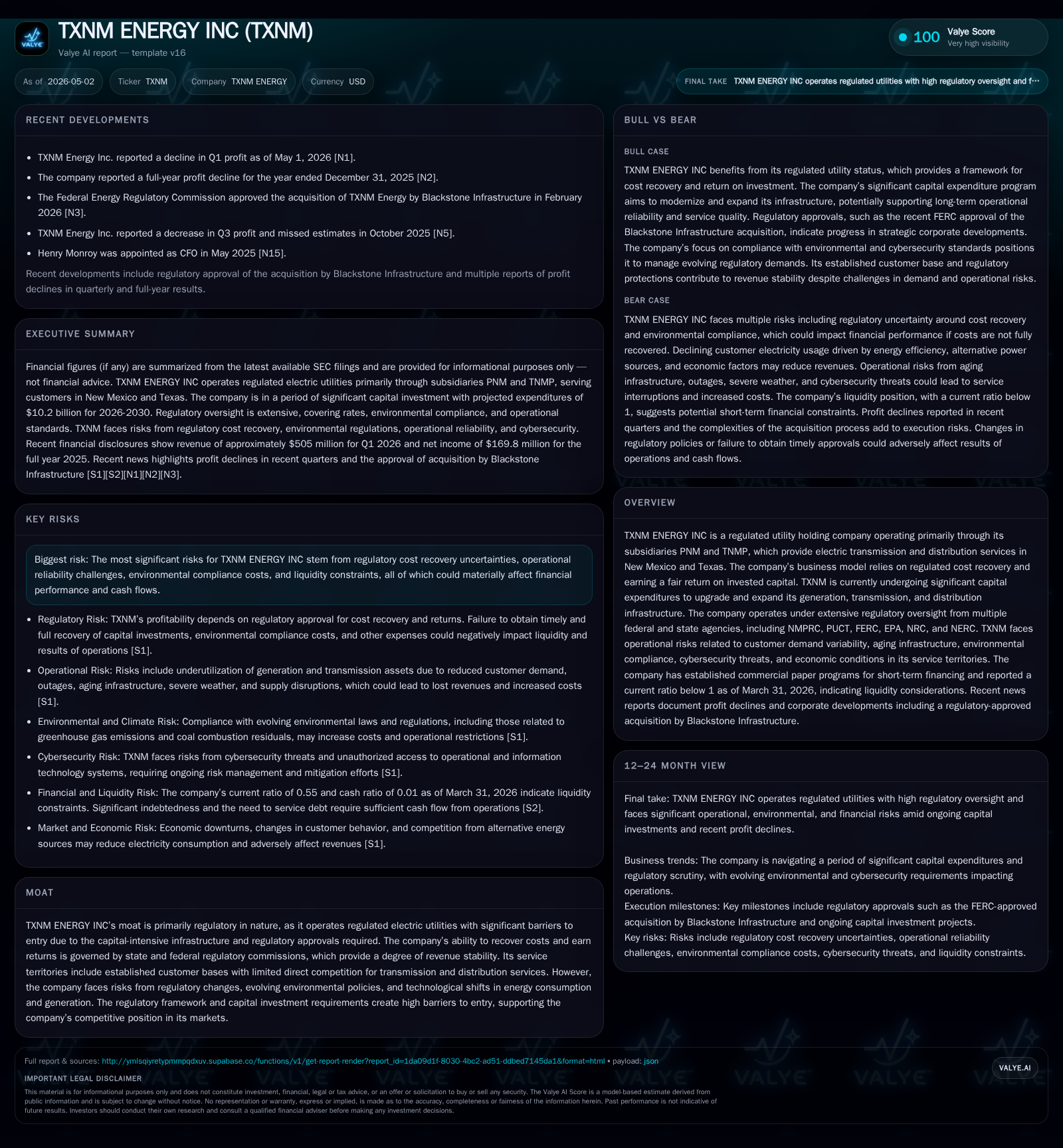
In its first quarter 2026 filing, TXNM ENERGY INC reaffirmed significant ongoing investments in transmission and generation capacity, targeting $10.2 billion of construction through 2030. The regulated utility business continues to navigate upward pressure on costs driven by capital projects and environmental compliance, while simultaneously contending with structural reductions in electricity usage due to customer energy efficiency and alternative power sources. The company’s regulatory-based moat offers revenue stability but is challenged by potential delays or denials in rate recovery and increasing operational costs. TXNM’s new commercial paper programs enhance short-term liquidity flexibility amid its capital-intensive growth path. Key risks remain regulatory approval uncertainties and operational reliability in an evolving energy landscape.
Recent Operating Update
TXNM ENERGY INC’s Q1 2026 Form 10-Q filing dated May 1 confirms no material change in previously disclosed risk factors but highlights the establishment of a new commercial paper program granting up to $300 million of short-term unsecured notes issuance capacity. This financial flexibility initiative complements TXNM’s revolving credit agreements and demonstrates proactive liquidity management during ongoing substantial capital expenditures [S2].
Further detail from accompanying recent 8-K filings reiterates the firm’s results announcements for Q1 without major surprises but reflects continued cost pressures impacting earnings narratives due to increased capital investments and environmental compliance spending [S3][N1].
Business Model Overview
TXNM ENERGY INC operates as a holding entity for regulated utility subsidiaries primarily including Public Service Company of New Mexico (PNM) and Texas-New Mexico Power Company (TNMP). These subsidiaries deliver electric transmission and distribution within New Mexico and Texas respectively, generating revenues under rate-regulated frameworks overseen by state commissions such as NMPRC and PUCT, with federal regulatory elements governed by FERC.
The company’s business model depends heavily on regulatory approval to recover incurred costs plus earn a fair return on invested capital — centering on generation assets, grid infrastructure, environmental compliance costs, and depreciation. Revenues are therefore a function of authorized rate structures linked closely to the value of rate base investments rather than open-market competitive pricing.
This regulatory model grants TXNM a degree of revenue stability stemming from monopoly-like service territories with significant barriers due to the capital-intensive nature of utility infrastructure and comprehensive multi-jurisdictional oversight [S1]. However, this model is sensitive to timing delays or refusals in cost recovery by regulators which can compress liquidity and earnings.
Usage volume dynamics also influence revenue over time: downward pressure arises from increasingly energy-conscious consumer behaviors, alternative power generation adoption (e.g., distributed solar), energy efficiency programs mandated or incentivized by regulators, plus macroeconomic factors influencing consumption patterns. These act counter to inflationary pressures on unit rates needed to support rising investment levels [S1].
Industry Structure and Competitive Position
TXNM’s utilities operate in largely captive franchises within regulated U.S. electric markets for its service areas. PNM serves New Mexico utility customers through vertically integrated assets whereas TNMP provides transmission/distribution infrastructure facilitating retail electric providers' access in parts of Texas.
Competition is indirect rather than head-to-head; alternative suppliers or DERs (distributed energy resources) influence demand profiles but do not substitute regulated wires services directly — thus preserving TXNM’s core transmission/distribution natural monopoly status.
Key competitors lie principally outside the immediate service territories or within overlapping regional ISOs’ broader market supply layers but do not affect the geographically bound monopoly utilities’ core networks operated by PNM/TNMP.
The industry is characterized by:
- Substantially regulated pricing governed through rate cases.
- Significant long-term capital intensity requiring financing access.
- High operational standards tied to safety, reliability, environmental adherence.
- Growing incorporation of emerging technologies such as grid modernization and battery storage projects (noted in ongoing regulatory filings).
Growth Drivers
The primary growth engine for TXNM centers on massive planned infrastructure investments: from 2026 through 2030, the company projects roughly $10.2 billion in construction expenditures focusing on expanding generation capacity, modernizing transmission lines, upgrading distribution systems, integrating renewables-related assets, enhancing cybersecurity measures, environmental remediation efforts (coal plant retirements/clean-ups), and deploying technology upgrades like battery energy storage systems.[S1]
Rate base expansions from these projects underpin future revenue increases subject to successful regulatory rate recovery approvals.
Furthermore, mandated environmental compliance rules compel additional capital outlays—while potentially constraining coal-fired resource operations—forcing shifts towards cleaner resources that require new investments.
Incremental improvements in operational efficiency stemming from grid modernization initiatives may also enable optimized asset utilization over time.
Additionally, modest population growth trends within both New Mexico and Texas translate into gradual increases in connection points or service demand that contribute incremental volume upside over the medium term.
Risks & Watchpoints
TXNM continues to confront important risks which include:
- Regulatory Recovery Uncertainty: Rate case outcomes remain a critical variable affecting timely cost recoupment; denials or delays could impair liquidity given substantial upfront capex commitments.[S1]
- Demand Erosion: Structural declines in per-customer electricity consumption due to energy efficiency gains and alternative power adoption create headwinds for volumetric revenue components.[S1]
- Capital Intensity & Leverage: With total debt around $5.44 billion as of December 31, 2025 and a current ratio below one (~0.55), working capital constraints exist requiring efficient funding management,[F1] particularly as additional borrowing proceeds via the newly established commercial paper programs.[S2]
- Environmental & Compliance Costs: Expanding regulatory requirements impose higher costs that must be passed through regulated rates or absorbed internally.[S21]
- Operational Reliability Risks: Aging infrastructure necessitates continuous maintenance investment; failure risks could result in fines or reputational damage.[S19]
- Merger & Integration Uncertainty: Pending Blackstone Infrastructure merger creates strategic uncertainty with potential disruptions around management focus, employee morale, and external stakeholder relations.[S20]
- Litigation Exposure: Shareholder litigation challenging disclosure related to the merger remains unresolved.[S16]
- Cybersecurity Threats: Increasing complexity of grid assets elevates vulnerability requiring ongoing defense investment.[S1]
What To Watch Next
Going forward, key milestones include:
- Regulators’ rulings on pending rate cases for PNM and TNMP which will clarify allowed cost recovery parameters and impact near-term earnings trajectory.[S23]
- Execution progress against multi-billion-dollar capex plans especially regarding timelines, budget adherence, and technological deployment effectiveness[S1].
- Utilization metrics reflecting customer electricity demand trends post-energy efficiency incentives implementation.[N1]
- Commercial paper program utilization patterns signaling liquidity needs vs balance sheet strength[S2].
- Developments in merger approval processes including regulatory consents as well as any changes in shareholder sentiment or litigation outcomes[S20][S22].
- Environmental regulation shifts potentially affecting compliance cost forecasts or asset retirement schedules[S21].
Tracking these indicators will be essential for assessing whether TXNM can sustain its regulated returns profile amid evolving regulatory frameworks and changing customer consumption patterns.
Financial Profile Summary
Latest financial snapshot
| Metric | Value | Period |
|---|---|---|
| Cash & equivalents | $6mm | |
| 2026-03-31 | ||
| Total debt | $5.4bn | |
| 2025-12-31 | ||
| Net debt | $5.4bn | |
| 2025-12-31 | ||
| Current assets | $562mm | |
| 2026-03-31 | ||
| Current liabilities | $1023mm | |
| 2026-03-31 | ||
| Current ratio | 0.55x | |
| 2026-03-31 |
Source: SEC companyfacts cache [F1].
TXNM maintains substantial indebtedness approximating $5.44 billion as of December 31, 2025 with net debt closely aligned after considering limited cash reserves (~$5.62 million) reported at March 31, 2026[F1]. The current ratio at approximately 0.55 signals tight near-term liquidity relative to current liabilities around $1.02 billion[F1].
The launch of new commercial paper programs totaling up to $300 million enhances short-term liquidity options, supporting working capital needs during high capital spending periods[S2].
Operating income figures reported stand at around $441 million for year-end December 31, 2025 based on the latest available data[F1], reflecting the earnings capacity before interest expense impacts related to heavy debt servicing obligations inherent in utility capex-heavy models.
Ongoing earnings per share guidance metrics utilize adjusted non-GAAP measures excluding volatility from unrealized mark-to-market gains/losses associated with hedging activities[S14], indicating management focus on operational fundamentals over accounting noise.
Disclaimer: This analysis is provided for informational purposes only based on publicly available SEC filings and does not constitute investment advice.
Disclaimer: This is research-only, informational analysis and not investment advice. It may include AI-generated interpretation and general industry context. Always verify important details using primary sources.

Comments