
Cadence Embraces AI Advancements to Strengthen Semiconductor Design Leadership
Q1 2026 results underscore accelerating AI integration and cloud capabilities driving Cadence’s expanding semiconductor design ecosystem.
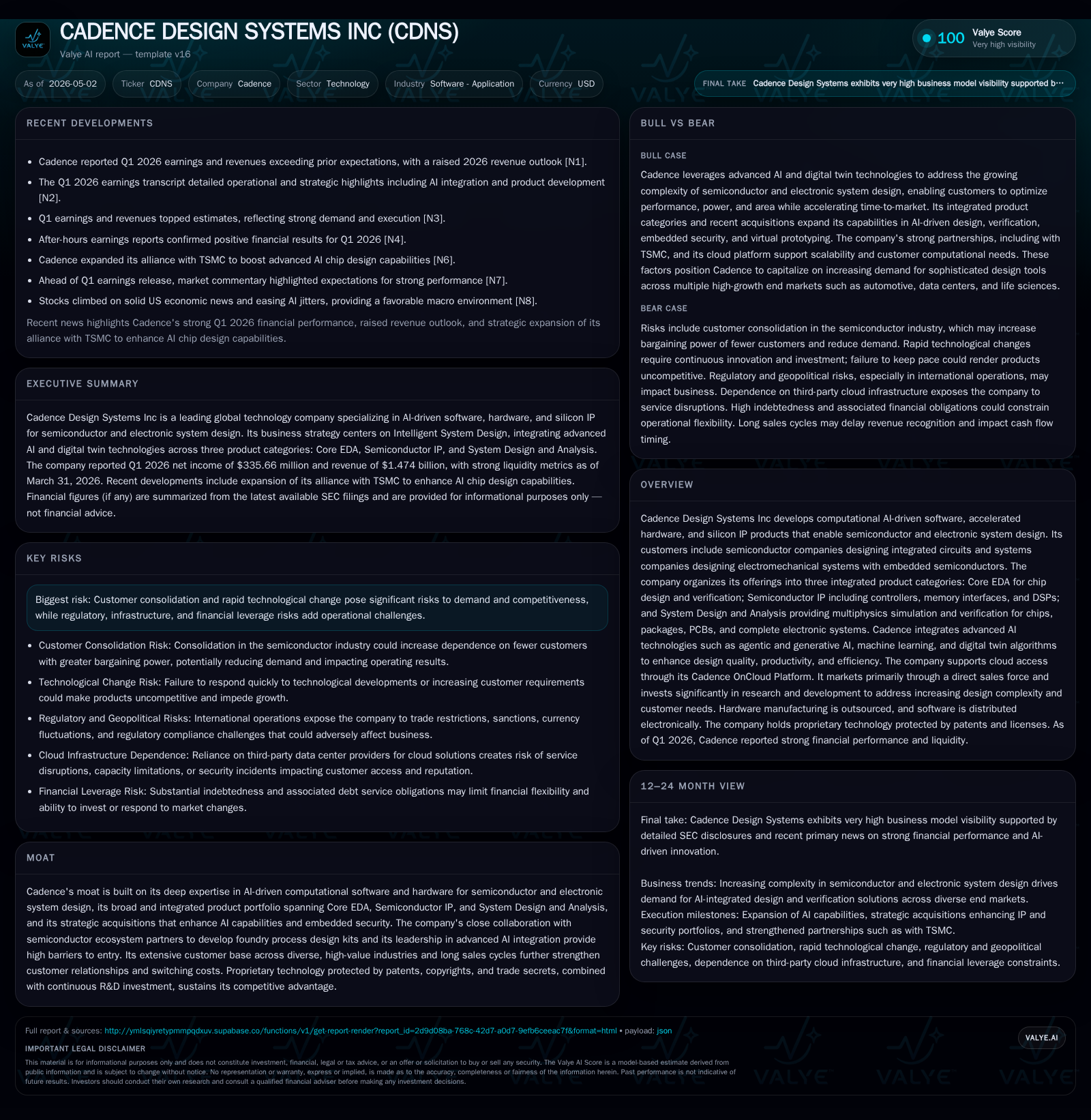
Cadence Design Systems’ latest quarterly filing reveals robust momentum from AI-powered enhancements across its EDA software, semiconductor IP, and system-level simulation offerings. The company’s deepening cloud strategy complements these advances by broadening customer access and improving workflow efficiency. Cadence’s integrated product portfolio, fortified by strategic foundry partnerships and advanced AI tools, sustains its competitive moat amid evolving semiconductor industry demands. Risks remain from customer concentration, rapid technological change, and regulatory oversight, but ongoing investments in AI and platform expansion position Cadence for sustained growth.
Q1 2026 Operating Review: Accelerated AI-Driven Growth and Cloud Expansion
Cadence's first quarter of fiscal 2026 evidenced tangible acceleration in demand for its AI-integrated electronic design automation (EDA) tools and semiconductor intellectual property (IP) offerings, according to the May 1, 2026 quarterly report [S2]. The company highlighted that enhanced agentic and generative AI features have permeated its core EDA workflows and system-level simulation platforms, leading to measurable productivity gains among customers. Additionally, subscription cloud services via Cadence Cloud significantly increased usage as semiconductor firms seek flexible hybrid computing environments more aligned with modern tapeout cycles [N7]. Revenue momentum reflected not only organic volume gains but also mix benefits from higher SaaS/cloud penetration.
Crucially, Cadence expanded strategic alliances with key foundry partners including TSMC in this timeframe [N7], aiming to shorten time-to-market for advanced nodes through process design kits (PDKs) tightly integrated with Cadence’s software suites. Management pointed to an elevated revenue outlook for calendar year 2026 based on this robust demand environment and pipeline strength [N1]. This near-term update contrasts prior years by underscoring a structural shift toward AI-driven computational software enhanced by cloud deployment options.
Integrated Product Portfolio Enabling Diverse Semiconductor Design Needs
Per the latest annual disclosures [S1], Cadence organizes operations into three tightly interwoven product categories that meet broad semiconductor design requirements:
- Core EDA: Comprehensive tool suites for IC design entry, verification, synthesis, place-and-route, manufacturing signoff — foundational software employed by chip developers.
- Semiconductor IP: Embedded silicon intellectual property blocks such as controllers, memory interfaces, DSPs designed to be integrated into SoCs or chiplets across mobile, automotive, hyperscale computing devices.
- System Design & Analysis: Multiphysics simulation including thermal-electrical-mechanical effects via the Cadence Reality Digital Twin platform to validate chips through packages up to full electronic systems.
Customers span fabless and IDMs (integrated device manufacturers), as well as system companies embedding semiconductors into electromechanical products [S1]. The business model focuses largely on multi-year license arrangements supplemented by recurring technical support and continuous updates—a combination enhancing revenue visibility and client stickiness. This structural setup positions Cadence to derive stable recurring revenue while extending product lifecycle relevance through continuous innovation.
Competitive Positioning within Semiconductor EDA and IP Markets
The semiconductor EDA industry is oligopolistic with high barriers to entry driven by product complexity, ecosystem integration needs, and proprietary technology portfolios. Cadence’s moat combines its broad integrated offering spanning software tools plus silicon IP assets protected by extensive patents, alongside embedded security technologies that are increasingly demanded by customers.
Long sales cycles—often aligning with multiyear chip development projects—and deep collaborations with foundries creating validated PDKs create elevated switching costs for customers [S1]. These factors discourage shifts to competing providers like Synopsys or Mentor Graphics. Furthermore, Cadence’s early adoption of AI technologies such as digital twins for system-level validation differentiates it technologically in a maturing competitive landscape.
Growth Drivers: AI Integration, Cloud Adoption, and Strategic Alliances
Growth engines discernible from filings include:
- Embedded AI Enhancements: Generative AI aids verification complexity reduction; agentic AI drives autonomous exploration in floorplanning or layout optimization tasks [S1]. These incremental productivity gains expand tool usage intensity among developers.
- Cloud Access Expansion: The shift toward hybrid workflows leveraging Cadence Cloud facilitates scalable compute capacity on demand while aiding global collaborative design efforts amid semiconductor supply chain pressures [N7].
- Foundry Partnerships: Closer alignment with major foundries streamlines PDK validations enabling quicker tapeout cycles—a critical factor in accelerating go-to-market timelines for advanced process nodes [N7].
- Product Innovation Pipeline: Regular releases integrating physics-aware digital twin simulations enhance cross-domain validation capabilities embracing chip-package-board co-design trends [S1].
These drivers collectively underpin a durable growth thesis tied less to cyclical ups-and-downs than structural shifts in semiconductor architecture complexity requiring holistic computational methodologies augmented by AI.
Emerging Risks: Customer Consolidation, Technological Change, and Regulatory Pressures
Cadence faces risk from concentrated customer profiles dominated by fewer large semiconductor OEMs controlling substantial order flow—the potential impact of which includes revenue volatility if one or more reduce licensing spend abruptly [S10]. The company must also maintain pace with rapid advances in AI tech. Failure to integrate next-gen capabilities effectively risks obsolescence given competitive pressure [S10].
Geopolitical tensions impose regulatory compliance burdens—export controls particularly impact access to China—and sanctions may constrain market participation or necessitate costly legal safeguards [S10]. Cybersecurity threats loom as attackers target critical supply chain participants potentially jeopardizing proprietary IP or client trust [S10]. Legal proceedings related to export violations have burdened the company recently with fines that affect reputation [S10]. Continuous investment into governance frameworks managing ethical use of AI internally is required but may entail reputational risk if inadequately executed.
Upcoming Catalysts: Guidance Updates and Industry Demand Signals
Investors should watch forthcoming quarterly disclosures for updated guidance reflecting Ai-powered product adoption rates plus subscription service growth trajectories discussed at recent earnings calls [N2]. Key operational KPIs include backlog expansions, cadence of foundry alliance announcements illustrating deepened integrations enabling faster nodes rollout [N7], cloud user expansion metrics reflecting hybrid model acceptance rates worldwide [N3], and the timing/introduction of novel digital twin capabilities.[N1]
At the macro level, monitoring wafer fab capacity utilization trends alongside fab investment plans will shed light on future design activity levels influencing Cadence’s addressable market size given its role upstream in the semiconductor value chain.
Financial Snapshot: Solid Liquidity and Capital Structure Support Investment
Latest financial snapshot
| Metric | Value | Period |
|---|---|---|
| Cash & equivalents | $1407mm | |
| 2026-03-31 | ||
| Current assets | $3.2bn | |
| 2026-03-31 | ||
| Current liabilities | $2.2bn | |
| 2026-03-31 | ||
| Current ratio | 1.47x | |
| 2026-03-31 |
Source: SEC companyfacts cache [F1].
Cadence enters Q2 2026 with approximately $1.4 billion in cash and equivalents balanced against about $425 million drawn under its $1.25 billion revolving credit facility plus long-term notes composing roughly $2.5 billion total debt at par—though amortized carrying values are slightly lower per recent filings [S2][F1]. Notably net debt is negative given high cash balances exceeding reported borrowings indicating strong liquidity reserves supported by a current ratio around 1.47 [F1].
The Credit Facility extends through August 2029 with borrowings up to $1.25 billion and an option to increase capacity by $500 million subject to lender commitments, providing financial flexibility [S2]. Strong operating cash flow generation supports ongoing investments into R&D aligned with strategic priorities around AI-enhanced toolchains plus cloud infrastructure deployment.[S2]
| Metric | Amount ($ Millions) |
|---|---|
| Cash & Equivalents | 1407 |
| Total Debt | ~300 |
| Current Ratio | 1.47 |
| Net Debt | ~ -1104 |
This financial posture provides a flexible platform for bolt-on acquisitions or capital expenditures aimed at consolidating Cadence’s technology lead without immediate liquidity constraints.
Disclaimer: This analysis is based solely on publicly available SEC filings dated through May 1, 2026 ([S2] being the primary source), supplemented by selected news articles reflecting company disclosures. No forward-looking investment advice or price forecasts are offered herein. Readers should consider all risks disclosed in official filings before making any financial decisions regarding CADENCE DESIGN SYSTEMS INC.
Disclaimer: This is research-only, informational analysis and not investment advice. It may include AI-generated interpretation and general industry context. Always verify important details using primary sources.

Comments