
Extra Space Storage Roots Growth Strategy in Scale and Technology-Driven Pricing
The latest quarterly filing underscores Extra Space Storage's steady operational momentum driven by its expansive footprint, advanced pricing technology, and diversified revenue streams.
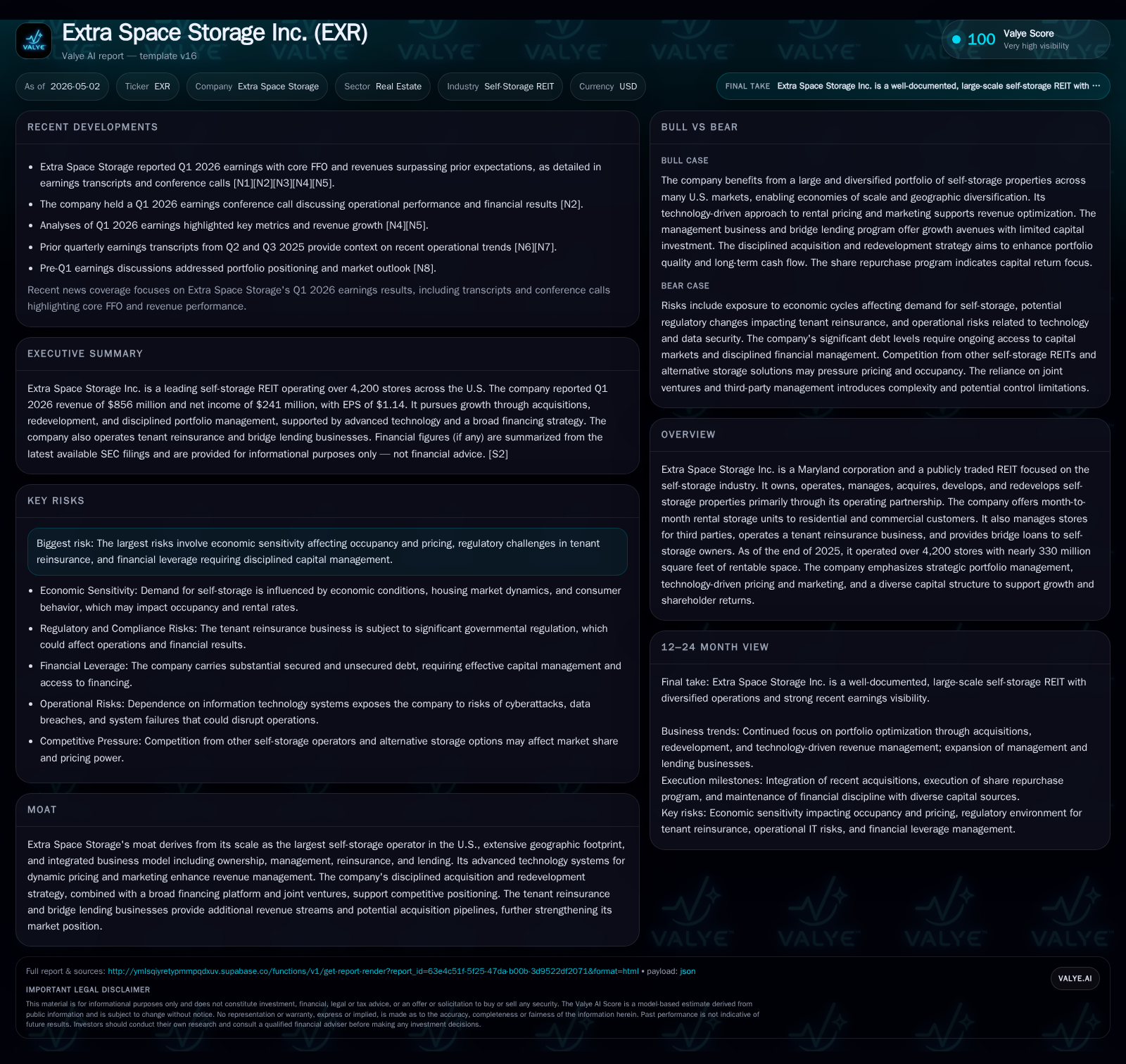
Extra Space Storage Inc. (EXR) reported sustained operational performance in its Q1 2026 filing, maintaining high occupancy through strategic pricing and portfolio management. Its business model integrates direct property ownership with management services, tenant reinsurance, and bridge lending, creating multiple revenue streams underpinned by scale and technology. The company’s competitive edge stems from its extensive U.S. store network, dynamic pricing algorithms, and flexible capital structure. Growth is propelled by disciplined acquisitions, redevelopment projects, and ancillary businesses. Risks include economic sensitivity impacting demand, regulatory challenges around reinsurance, and leverage management. Investors should monitor occupancy trends, rental rate changes, acquisition pipeline activity, and use of share repurchase authorizations.
Latest Quarterly Update Reflects Steady Operational Momentum
Extra Space Storage’s first quarter 2026 Form 10-Q filing [S2] highlights continued positive operational performance amid a stable demand backdrop for self-storage. The company reported that it repurchased 11,109 shares in January at an average price of $129.80 per share under its authorized three-year buyback program totaling $500 million; after these purchases the remaining share repurchase capacity stands at approximately $349 million [S2]. Notably, the Q1 earnings release filed via 8-K on April 28 confirmed revenues and core FFO exceeding consensus estimates [S3][N8][N9]. Occupancy levels held firm despite modest macroeconomic jitters, underscoring the company’s ability to maintain steady utilization across its vast portfolio [N1].
No defaults or material contract changes were reported during the quarter [S2]. Management’s discretion in pacing buybacks reflects confidence in the stock's valuation while preserving financial flexibility. This disciplined approach aligns with strategic priorities including technology-driven dynamic pricing programs aimed at maximizing rental rates in real time based on local market conditions [S1][S23]. These operational updates validate EXR’s growth trajectory as it balances organic yield enhancement with opportunistic capital deployment.
Comprehensive Business Model Integrating Ownership, Management, and Financial Services
EXR operates as a publicly traded REIT owning more than 4,200 storage facilities totaling nearly 330 million rentable square feet across the United States as of year-end 2025. Its core revenue driver is month-to-month rentals from a diverse customer base spanning residential consumers to commercial clients seeking flexible space solutions [S1]. However, the company uniquely extends its business beyond property ownership:
- Property Management: EXR manages stores owned by third parties leveraging its operational expertise to generate fee income without incremental capital investment.
- Tenant Reinsurance: Underwriting tenant insurance policies provides an additional recurring revenue stream while offering customers convenience and protection.
- Bridge Lending: The company lends short-term capital to other self-storage owners facilitating acquisitions or development projects that can feed the acquisition pipeline.
This integrated approach not only diversifies income but also increases ecosystem stickiness through cross-selling opportunities and capital recycling efficiencies. Proprietary pricing algorithms and advanced online marketing tools enhance occupancy rates and rental yield optimization across owned and managed properties alike [S1][S23]. Such synergies deter competitors who typically operate with narrower business models focused solely on property ownership or management.
Competitive Position Anchored by Scale, Technology, and Diversified Offerings
EXR’s competitive moat stands on a triad of scale, technological advantage, and financial versatility. With over 4,200 stores nationally—far surpassing other public self-storage operators—the scale offers tangible benefits across customer reach, supplier negotiations, marketing breadth, and risk mitigation through geographic diversification [S1]. Additionally:
- Technology Platform: Their sophisticated dynamic pricing system continuously adjusts unit rates based on supply-demand signals at a granular level. This real-time data integration maximizes net operating income while sustaining high occupancy levels.
- Capital Structure: Utilizing a broad palette of secured/unsecured debt instruments alongside equity channels enables flexibility in funding acquisitions or developments without excessive dilution.
- Joint Ventures & Partnerships: Partnership structures account for hundreds of stores allowing EXR to leverage third-party equity capital while controlling operations—enabling scalable expansion with controlled capital intensity [S5][S8].
These factors create substantial entry barriers for smaller operators who struggle to replicate such integrated platforms or compete on price-performance metrics sustainably. Moreover, tenant switching costs are elevated by convenience factors—such as easy digital rentals—and physical location availability which favors incumbents with well distributed networks.
Growth Drivers Fueled by Strategic Acquisitions and Technology-Enabled Operations
EXR’s growth engine comprises several interlinked levers:
- Acquisition Pipeline: The company consistently pursues both fully stabilized multi-store portfolios and Certificate of Occupancy stores (newly built but not fully leased). While certificate-of-occupancy assets result in near-term earnings dilution due to lease-up times (typically 2–4 years), they tend to offer higher long-term returns due to lower purchase multiples [S8].
- Redevelopment Projects: Existing properties undergo unit mix optimizations or expansions tailored to market demand shifts enhancing returns per square foot.
- Ancillary Revenue Expansion: Tenant reinsurance has grown steadily while bridge loan origination catalyzes deal flow—both providing complementary revenue streams beyond traditional rental income.
- Technology Utilization: Advanced online marketing attracts customers efficiently resulting in higher conversion rates; simultaneous price optimization minimizes vacancy duration thereby boosting revenues [S23][N2].
Measurable KPIs supporting this thesis include incremental store count growth (maintained above 4200), rental rate increases driven by pricing sophistication amid localized competition dynamics, rising managed-store counts generating fee income streams, and an expanding bridge loan portfolio contributing to non-rental revenues [N1][N3]. This balanced growth model combines asset light fee income with traditional REIT cash flow stability.
Risks and Constraints: Economic Sensitivity and Regulatory Environment
The primary risks facing EXR derive from external shocks influencing demand elasticity for physical storage space—such as economic downturns reducing discretionary consumer mobility or business activity—and regulatory pressures surrounding financial service lines:
The company acknowledges these considerations openly in filings underscoring risk factor primacy without material changes noted in the most recent quarterly report [S2].
Investor Focus: Key Milestones and Performance Indicators to Monitor
Market participants should hone in on several upcoming markers that will signal trajectory continuity or emerging challenges:
- Occupancy & Rental Rates: Stability or growth here are critical lead indicators for demand resilience amid prevailing economic headwinds.
- Capital Deployment Efficiency: Tracking how EXR uses remaining share repurchase authorization ($349 million as of March end) will provide clues about confidence levels versus reinvestment priorities into acquisitions or redevelopment projects.
- Acquisition & Development Pipeline Visibility: Updates on signed deals or joint venture expansions will clarify future growth runway strength.
- Tenant Reinsurance & Bridge Loan Revenues: Traction trends here reflect success scaling ancillary businesses that diversify earnings.
Additionally, management commentary during earnings calls often elucidates tactical shifts around pricing strategy responsiveness or cost management initiatives offering further insight into execution quality [N2][N10]. These operational benchmarks collectively shape medium-term valuation perspectives.
Concise Financial Overview Underpinning Operational Narrative
While detailed current-period debt disclosures remain limited beyond year-end historical figures (total debt ~$3.76 billion) [F1], the company reported solid cash reserves of $138.99 million as of March 31, 2026 providing liquidity flexibility [F1][S2]. Ongoing share repurchases reflect a shareholder-friendly capital return policy balanced against growth reinvestment needs underpinned by robust operating income generation ($1.41 billion annually ending 2025) [F1].
The interplay between operational execution—in particular occupancy maintenance through tech-enabled pricing—and savvy capital management forms the backbone of EXR’s value proposition heading into subsequent quarters.
This analysis is based solely on information available through May 2026 filings and credible market releases without incorporating projections or speculative views.
Disclaimer: This is research-only, informational analysis and not investment advice. It may include AI-generated interpretation and general industry context. Always verify important details using primary sources.

Comments