
LendingTree Elevates Consumer Choice Across Financial Products Amid Challenging Macro
Q1 2026 results showcase LendingTree’s agile marketing strategies and diversified platform amid economic headwinds.
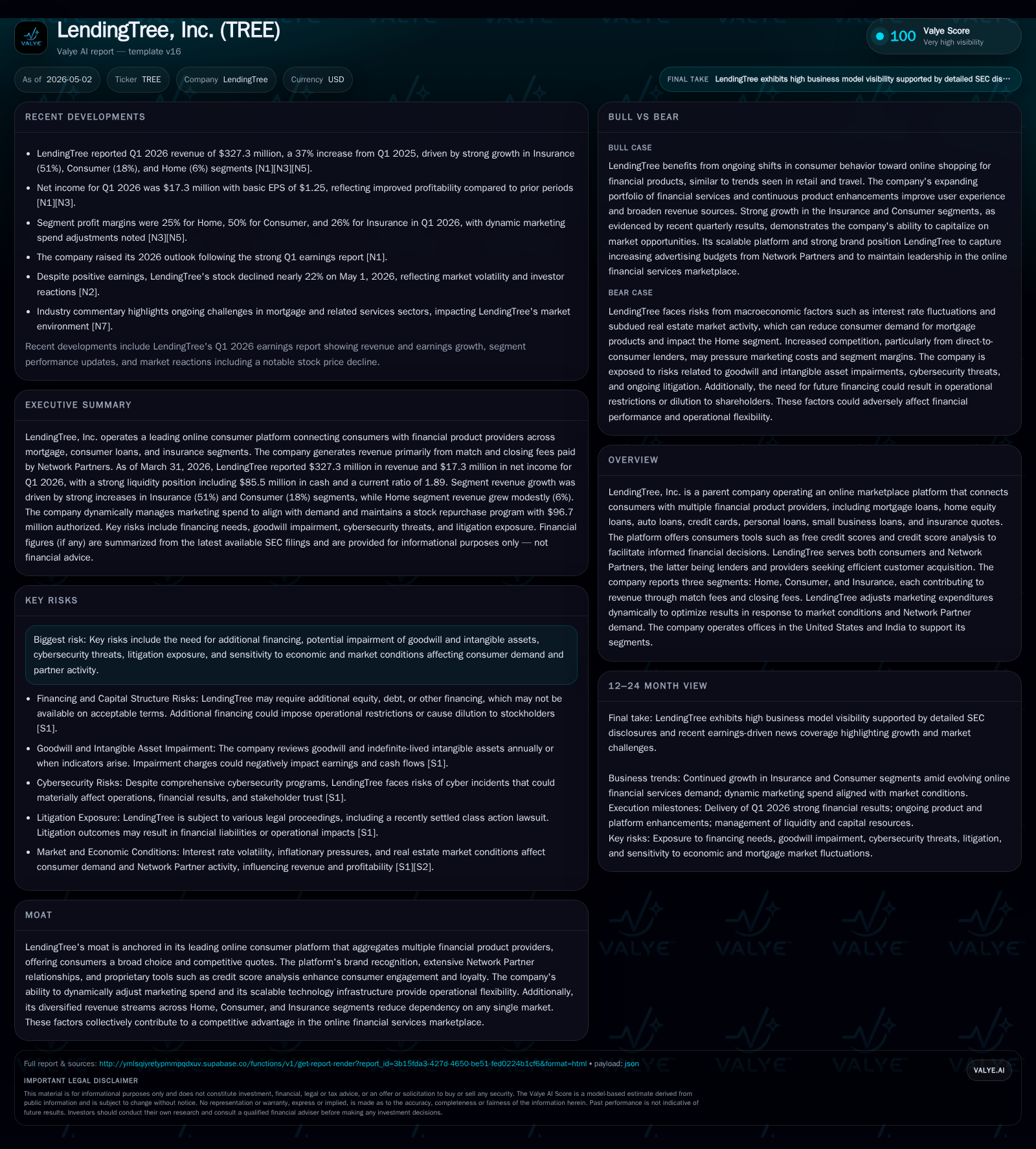
LendingTree reported robust Q1 2026 revenue growth driven by its Home, Consumer, and Insurance segments, with management raising full-year guidance. The company’s platform connects consumers with a broad spectrum of financial product providers, leveraging proprietary tools like free credit scores to boost engagement and transaction volume. LendingTree’s competitive moat rests on its brand strength, network effects from lenders ('Network Partners'), and operational flexibility in marketing spend. Despite promising growth catalysts, the firm faces risks from economic volatility impacting consumer borrowing and ongoing regulatory and cybersecurity challenges. Its current capital structure supports continued investment in growth initiatives without liquidity concerns.
Q1 2026 Operating Results Highlight Business Momentum
LendingTree’s latest quarterly filing (10-Q dated May 1, 2026) reveals sustained top-line momentum with revenue increasing by 18% year-over-year to approximately $308 million. This growth was fueled by solid performance across the Home segment (mortgages and home equity), the Consumer segment (auto loans, credit cards, personal loans), and Insurance segment (insurance quotes). These segments leverage fee-based revenue models including match fees when consumer inquiries are successfully connected to lenders and closing fees upon completed transactions.
Importantly, management raised full-year guidance following strong early-year results. The company underscored its ability to dynamically adjust marketing spend in response to lender demand shifts within a challenging macroeconomic context — a crucial lever for maintaining efficient lead acquisition costs while optimizing contribution margins. This adaptive performance marketing strategy drove an improvement in variable marketing margin during the quarter [S2][N1][N3].
Operating leverage was evident as non-variable selling expenses remained controlled during revenue expansion. Litigation contingencies declined significantly compared with prior periods [S2], reflecting resolution of legacy claims.
LendingTree’s Innovative Consumer Marketplace Model
Rooted in its annual disclosures (10-K March 2026), LendingTree operates a multifaceted online marketplace platform connecting consumers with diverse financial product providers—the so-called 'Network Partners'. Consumers access offerings ranging from mortgage loans to credit cards, personal loans, small business loans, and insurance quotes through a single digital interface.
Revenue is generated primarily via match fees paid by these Network Partners when leads result from consumer inquiries and closing fees earned upon finalized transactions such as loan closings. The platform also offers free credit score monitoring and detailed analysis tools that enhance user experience and empower informed decision-making.
This model creates two-way network effects: more consumers attract more lenders/providers seeking customer acquisition efficiency; more providers increase consumer choice breadth and competitive pricing. This ecosystem generates durable engagement driven by brand strength and proprietary analytic tools.
Moreover, segment diversification across Home loans (typically mortgage related), Consumer credit products (auto loans etc.), and Insurance mitigates concentration risk inherent in any single category or economic cycle exposure [S1].
Competitive Landscape and Industry Dynamics
The online lending marketplace is deeply fragmented with several direct competitors focusing on mortgage verticals or niche loan products. However, LendingTree's breadth across mortgages, consumer loans, and insurance provides appealing diversification absent in many peers who rely heavily on cyclical mortgage volume trends.
Market dynamics continue shifting as end consumers increasingly prefer online financial product shopping akin to established retail or travel industry models—a secular growth vector LendingTree aims to capitalize on. Regulatory scrutiny around data privacy and telemarketing practices impose compliance cost pressures but also raise barriers for new entrants.
Pricing power remains moderate: lenders determine match fee bids sensitive to supply-demand balance of leads; consumers benefit from transparent comparison shopping limiting overcharging potential. Switching costs rise primarily through platform familiarity rather than contractual lock-in.
Economic cycles influence consumer borrowing patterns—rising interest rates depress refinancing demand impacting Home segment volumes whereas Consumer credit tends to be somewhat more resilient but not immune [N10][N11][S1].
Catalysts for Growth Acceleration
Management commentary highlights key growth drivers including:
- Expansion into insurance verticals where quoting volume surged supported by dedicated sales teams [S2][N3].
- Performance marketing agility enabling real-time optimization of spend based on Network Partner demand signals—enhancing customer acquisition cost efficiency amidst volatile market conditions.
- Introduction and iteration of AI-driven credit analytics tools designed to increase platform stickiness through personalized offer recommendations.
- Pipeline development for new financial categories such as small business lending products poised for later-stage rollout.
- Enhanced data capabilities improving lead quality metrics which directly tie into monetization uplift potential.
These catalysts align with structural shifts toward digital-first financial services consumption alongside improving unit economics driven by scale [S2][N3].
Primary Risks and Growth Constraints
Despite operational strengths there are notable risks:
- Macro headwinds including rising interest rates can limit mortgage refinancing volumes hence curbing Home segment demand—potentially constraining near-term revenue growth.
- The company may require additional financing for expansion initiatives; while current cash flows suffice for twelve months plus operations [S2], future equity or debt raises could dilute existing shareholders or increase leverage.
- Goodwill or intangible asset impairments pose accounting risk if future cash flow projections weaken alongside slower industry growth.
- Cybersecurity exposures stemming from data-intensive operations represent ongoing concern requiring vigilant controls.
- Litigation risks remain despite recent settlement of Telephone Consumer Protection Act claims related to outbound telemarketing activities [S1][S2].
- Regulatory changes could alter permissible marketing practices or platform operations influencing lead generation effectiveness.
These constraints impose ceilings on growth velocity albeit manageable under current strategic positioning [S1][S2].
Key Developments to Monitor Ahead
Investors should track the following:
- Quarterly updates on full-year guidance revisions informed by loan volume trends across segments.
- Metrics indicating Network Partner additions or attrition rates reflecting competitive standing.
- Lead quality improvements validated through conversion rate KPIs post new AI tool deployments.
- Regulatory developments impacting online lending advertising or data usage policies that might necessitate operational adjustments.
- Execution on small business loan product launches expanding addressable market coverage.
Quarterly earnings calls will likely provide granular color around these vectors alongside management’s outlook framing [S2][N3].
Updated Financial Position and Liquidity Snapshot
Latest financial snapshot
| Metric | Value | Period |
|---|---|---|
| Cash & equivalents | $86mm | |
| 2026-03-31 | ||
| Total debt | $391mm | |
| 2026-03-31 | ||
| Net debt | $305mm | |
| 2026-03-31 | ||
| Current assets | $244mm | |
| 2026-03-31 | ||
| Current liabilities | $129mm | |
| 2026-03-31 | ||
| Current ratio | 1.89x | |
| 2026-03-31 |
Source: SEC companyfacts cache [F1].
As of March 31, 2026, LendingTree's liquidity position includes $85.5 million cash & equivalents against $390.9 million total debt resulting in net debt of approximately $305.4 million.
The company benefits from a recently refinanced credit facility totaling $475 million including a $75 million revolving line of credit with maturities extending to August 2030 offering capital flexibility for near-to-medium term strategic investments without immediate refinancing pressure [F1][S2]. This structure supports continued technology development spend alongside opportunistic share repurchases within allowed limits although no repurchases occurred during recent quarters due to prioritization of cash retention [S4].
Disclaimer: This analysis is for informational purposes only; it does not constitute investment advice or recommendations.
Disclaimer: This is research-only, informational analysis and not investment advice. It may include AI-generated interpretation and general industry context. Always verify important details using primary sources.

Comments