
Regional Management Corp. Outlines Growth and Risk Dynamics in Latest Quarterly Report
Q1 2026 results underscore Regional Management’s scalable lending platform amid evolving regulatory and legal risks shaping its operational outlook.
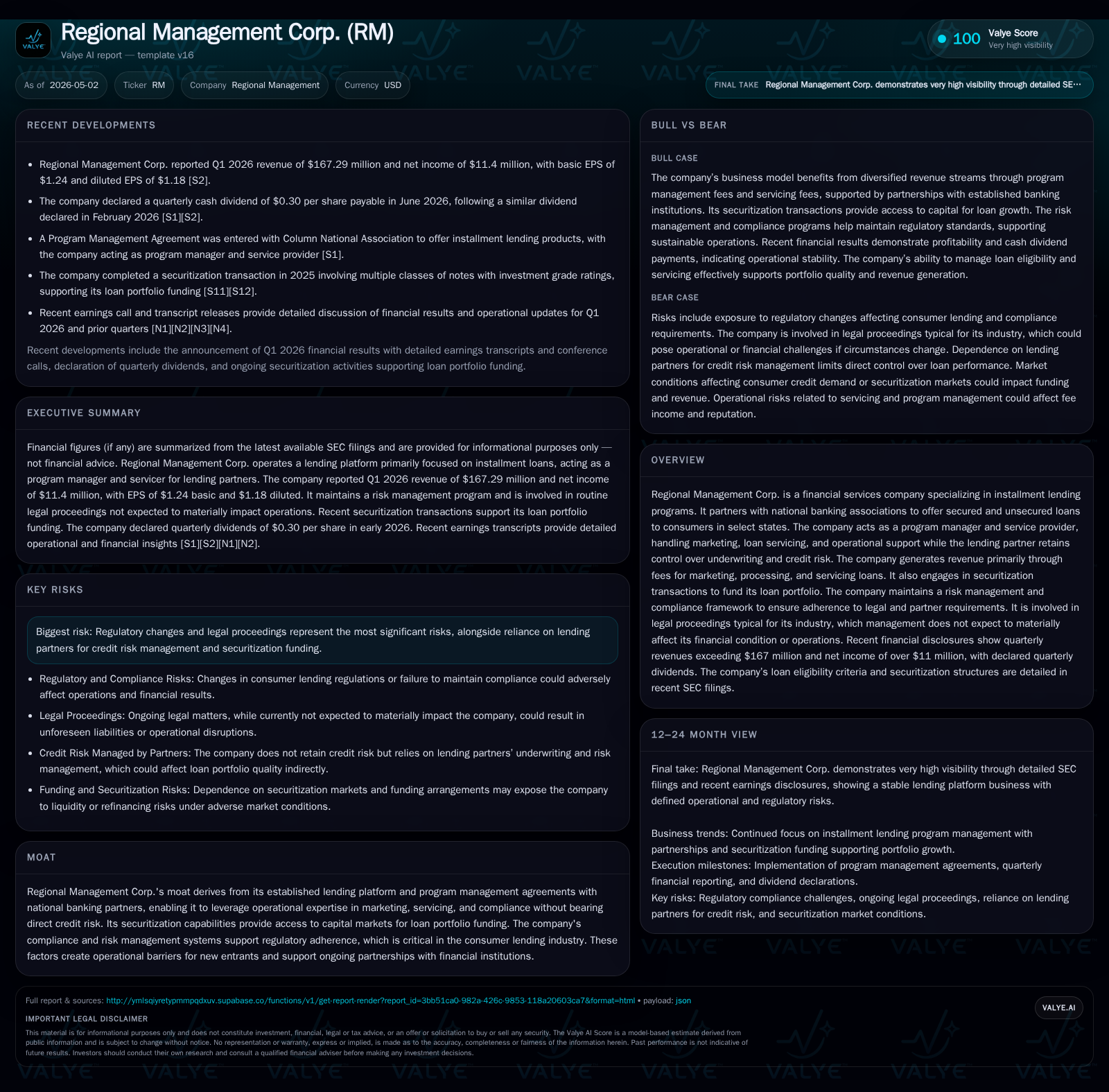
Regional Management Corp.'s latest 10-Q filing for Q1 2026 highlights steady fee revenue generation through its installment lending program management model, supported by ongoing securitization activities. The company continues to leverage partnerships with national banks, focusing on operational execution without assuming credit risk. While growth avenues remain concentrated on expanding partner relationships and securitization capacity, regulatory complexity and persistent legal proceedings remain critical watchpoints. Its capital structure reflects sizable securitization-driven debt, necessitating prudent liquidity management amid an evolving consumer credit landscape.
Q1 2026 Operating Update: Key Developments and Trends
Regional Management Corp.'s first quarter of 2026, as detailed in the May 1, 2026, 10-Q filing [S2], showcased a steady operating rhythm anchored by its core installment loan program management services. The company continued to generate revenue primarily through fees associated with marketing campaigns, loan processing, and servicing activities conducted on behalf of its banking partners. Recent disclosures affirm that loan origination volumes have remained consistent with prior periods as the company sustains its engagement within select regional markets where its lending programs operate.
The April 29 earnings call transcript [N1] and concurrent 8-K filing [S3] emphasized the stability of its partner bank collaborations while noting incremental improvements in operational efficiencies and customer outreach initiatives. No material shifts in underwriting or credit management were reported since these remain under bank control by design. This differentiated structure allows RM to focus on refining marketing effectiveness and servicing quality without absorbing credit losses directly.
Business Model: Partnership-Focused Lending with Operational Expertise
Regional Management’s business model uniquely positions it as a specialized program manager rather than a traditional direct lender. It collaborates closely with national banking associations who underwrite and assume the credit risk of consumer loans (secured and unsecured) originated through RM’s platform [S1]. The company’s value-add is multifaceted:
- Marketing and customer acquisition through targeted direct mail check campaigns and other channels;
- Loan servicing including payments processing, collections support, and customer service;
- Compliance oversight ensuring adherence to complex state-by-state consumer finance laws supporting partner requirements.
Revenue accrues predominantly from contractual fees paid by partner banks based on volume metrics such as loans originated and serviced rather than direct interest income or principal repayments. This structure insulates RM from credit loss volatility but ties its economics closely to volume throughput and operational performance.
Moreover, securitization transactions enable RM to fund loan portfolios by packaging receivables into asset-backed notes sold to investors [S16]. This capital market access expands capacity beyond warehouse funding lines allowing scalable growth without direct balance-sheet risk.
The robust compliance framework embedded within this model is critical given the fragmented regulatory environment across jurisdictions where RM operates. Maintaining strong governance safeguards partner relationships and underpins the company’s moat by raising barriers for new entrants unable to replicate such infrastructure efficiently.
Competitive Landscape and Industry Positioning
RM navigates an industry characterized by competitive pressure from direct installment lenders, fintech disruptors offering digital platforms, and large-scale consumer credit providers. Distinctly, RM's strength lies in its partnership orientation which transfers underwriting responsibility—and associated credit risk—to regulated banking institutions.
This separation allows RM to concentrate resources on operational excellence in marketing efficacy, loan servicing quality, and regulatory compliance. The strategic reliance on securitization transactions provides flexible access to capital markets unmatched by many smaller competitors or fintech entities lacking similar scale or investor relationships.
Regulatory compliance sophistication is another differentiator amid heightened scrutiny in consumer lending sectors. RM's systems help mitigate enforcement risks for its partners who increasingly demand stringent oversight capabilities given varying state laws governing interest rates, disclosures, and collections practices,[S1].
Overall, these attributes erect switching costs for banks reliant on RM’s integrated service platform while simultaneously deterring new entrants facing costly compliance setup hurdles.
Growth Catalysts: Expansion Opportunities and Portfolio Funding
Future growth for RM hinges on several vectors:
- New Bank Partnerships: Adding financial institutions willing to leverage RM’s turnkey lending platform broadens market reach.
- Geographic Expansion: Incremental entry into additional states matching RM’s regulatory comfort zone could unlock fresh borrower pools within existing product lines.
- Fee Revenue Leverage: Enhancements in servicing efficiency or value-added ancillary products increase fee yields per loan without increasing direct underwriting exposure.
- Scaling Securitization: Continuing issuance of asset-backed notes supports funding larger portfolios enabling higher volumes commensurate with origination gains [S16],[N1].
Metrics such as monthly new accounts originated under partner programs, servicing portfolio size growth, or securitization tranche sizes provide tangible KPIs aligning with these drivers. Management commentary suggests focus remains firm on disciplined expansion prioritizing underwriting prudence by partners alongside operational scalability enhancements [S3].
Risks and Constraints: Regulatory Environment and Legal Challenges
Key challenges confronting RM emanate chiefly from the complex regulatory framework governing consumer installment loans across diverse U.S. states. Variability in permissible charges, collection standards, and disclosure mandates necessitates constant monitoring and adaptive compliance measures that elevate operating costs [S2],.
Adding to this are ongoing legal proceedings customary within financial services; while management currently expects no material adverse impact upon resolution [S1], sustained litigations represent inherent uncertainty affecting resource allocation.
Counterparties’ underwriting decisions inject indirect risk exposure; deteriorations in economic conditions leading to elevated defaults may constrict lending appetite from partners with potential downstream effect on RM's fee income volume though it does not bear credit losses per se.
Finally, reliance on securitization markets exposes RM to capital availability cycles influencing portfolio funding flexibility.
Risk summary:
- Regulatory complexity increases compliance burden markedly;
- Legal actions typical of the sector add operational uncertainty;
- Partner-driven underwriting places volume dependence outside direct control;
- Capital markets fluctuations could constrain portfolio scaling temporarily.
Monitoring Points: What to Watch in Upcoming Quarters
Investors should track several critical variables influencing Regional Management's trajectory:
- Announcements of new bank partnerships or expansions within existing client agreements demonstrating business development momentum.
- Loan origination volumes trending quarter-over-quarter reflecting demand conditions within served states.
- Updates regarding any material legal settlements or regulatory changes impacting permissible program structures or cost profiles.
- Disclosures on securitization deal sizes or terms indicating appetite among fixed income investors for collateralized notes backed by RM-managed loans.
- Any adjustments or guidance revisions provided during quarterly earnings calls relating to fee revenue growth or operational efficiency metrics.
These markers collectively signal execution success against stated strategic priorities as well as emerging headwinds requiring mitigation efforts.
Financial Snapshot and Capital Structure
As of March 31, 2026, Regional Management reported total debt approximating $1.62 billion primarily attributable to asset-backed securitization facilities utilized for funding loan portfolios [F1]. Net debt closely mirrors this figure due to limited cash balances available for immediate offsetting.
This leverage profile underscores dependence on structured finance mechanisms intrinsic to its business model rather than conventional balance-sheet borrowing for operational purposes. Fee-based revenues correlated with servicing volumes generate predictable cash flow streams facilitating debt service obligations.
While recent revenue figures (circa $645 million trailing period) reaffirm sustained scale within installment lending program operations [F1], concise liquidity disclosures from the latest quarterly statements should be monitored carefully given dependency on capital markets access amid potential interest rate fluctuations.
This analysis synthesizes publicly filed SEC documents alongside recent earnings commentary without extrapolation beyond stated facts. It focuses on clarifying Regional Management Corp.'s operational dynamics shaped by its distinctive partnership-dependent business architecture within a regulated U.S. consumer lending environment replete with structural complexity.
Disclaimer: This is research-only, informational analysis and not investment advice. It may include AI-generated interpretation and general industry context. Always verify important details using primary sources.

Comments