
Arcos Dorados Hits New Profit Milestone Backed by Regional Market Resilience
Strong 2025 profitability backed by operational efficiencies and regional growth sets foundation amid Latin American macro challenges.
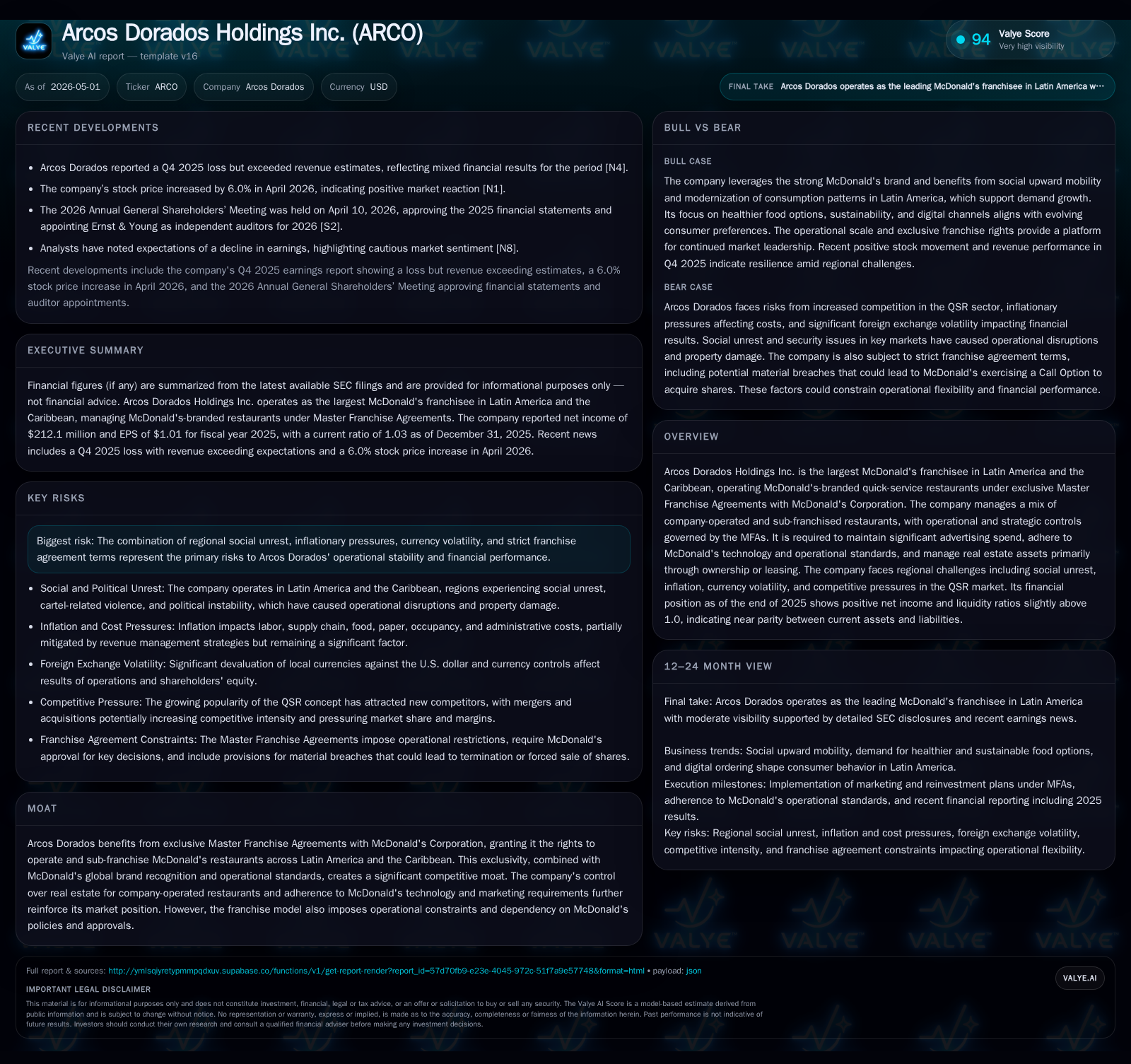
Arcos Dorados recently approved its 2025 financial statements reporting record Adjusted EBITDA of $575.2 million, driven by Brazil tax credits and efficiency gains. The company’s master franchise model for McDonald's in Latin America provides a unique competitive position, leveraging scale and brand exclusivity across over 2,500 restaurants. Growth is supported by digital sales penetration, restaurant expansion plans, and favorable demographic trends, balanced against risks from inflation, currency volatility, and social unrest. Executing on cost reduction and maintaining brand relevance are key near-term priorities.
2025 Profitability Breakthrough and Quarterly Highlights
Arcos Dorados recently held its Annual General Shareholders' Meeting on April 10, 2026, where the audited financial statements for the fiscal year ended December 31, 2025 were approved along with the Independent Auditors’ report by Ernst & Young [S2]. The year marked a new profit milestone for the company with Adjusted EBITDA reaching $575.2 million—a company record. This peak performance was boosted notably by a substantial tax credit in Brazil expected to enhance cash flows over the next five years [S3]. Additionally, the company finalized a strategic reduction in general and administrative (G&A) expenses via staff streamlining completed in Q1 2026 aimed at strengthening operational efficiency while positioning for shareholder value creation [S3]. These developments anchor a narrative of resilient profitability amid economic headwinds common in Latin America.
While gross margin pressures persisted in restaurant operations due to inflationary impacts on labor and supplies, the successful completion of cost rationalization initiatives reflects management’s capacity to adapt structure to market realities. The combination of underlying US dollar growth across all three geographic divisions reinforces that Arcos Dorados is stabilizing its fundamentals after macro disruption-induced sales softness in prior years [S3]. This operating update establishes a platform from which normalized revenue gains are expected to resume.
Operational Model: Master Franchise Strategy and Product Relevance
Arcos Dorados is the largest independent operator of McDonald’s-branded quick service restaurants (QSR) worldwide outside of McDonald’s Corporation itself. Under exclusive Master Franchise Agreements (MFAs), it holds rights across 21 Latin American and Caribbean countries to operate company-owned restaurants and grant sub-franchises [S1]. These agreements necessitate adherence to McDonald’s exacting technology integration standards, operational procedures, extensive advertising expenditures mandated to maintain marketing effectiveness, and controls over real estate assets either owned or leased.
The business model relies on leveraging the scale advantages accorded by exclusivity—more than 2,500 restaurants serve over four million guests daily—while balancing operational autonomy with corporate conformity [S3]. Product strategy has evolved with consumer trend shifts; offerings now include beverages, core meals, desserts, breakfast options alongside reduced-calorie and sodium items designed to capture increasingly health-conscious customers gaining traction throughout the region [S1]. Notably, promotions frequently tailored through digital platforms cater to price-sensitive segments expanding access across socio-economic strata.
This synergy between McDonald’s global brand franchise system strengths—such as supply chain sophistication and R&D—and locally nuanced execution underpins Arcos Dorados’ market relevance amid changing consumer preferences.
Competitive Moat: Brand Exclusivity and Market Dynamics in Latin America
Arcos Dorados holds a defensible competitive position rooted fundamentally in its exclusive Master Franchise Agreements. The lack of close substitutes with equivalent brand equity creates a significant barrier to entry within many territories [S1]. Scale matters meaningfully: The company operates via over two thousand restaurants across diverse markets including large urban centers in Brazil, Mexico, Argentina, and others—service breadth unmatched by smaller local QSR operators [S3].
Digital innovation bolsters demand-side engagement; approximately 61% of systemwide sales were generated through mobile app ordering, delivery channels, and self-service kiosks in 2025—demonstrating an ability to meet expectations around convenience and technology integration typical among younger consumers [S3]. The Loyalty Program implemented broadly also fosters repeat purchases through tailored offers reaching over 27 million registered users.
Nonetheless, this moat must be viewed cautiously given intensifying QSR competition in select markets where capital influx or consolidation among rivals could pressure pricing power. Inflationary forces elevate costs structurally across labor markets and ingredient sourcing while occupancy costs remain sticky despite pandemic-era adjustments [S1]. Currency fluctuations add complexity especially as McDonald’s royalties are paid in U.S. dollars but based on local exchange translations at payment times creating profit variability risks [S1].
Key Growth Drivers: Expansion Plans, Digital Channels, and Consumer Trends
Arcos Dorados aims to capitalize on both structural regional demand tailwinds and internal operational improvements as growth catalysts. A major growth driver is restaurant footprint expansion: After opening an impressive total of 102 new units in the full year 2025—surpassing guidance—the company targets an even more ambitious range of approximately 105-115 new openings for calendar year 2026 backed by a capital expenditure plan estimated between $275 million and $325 million funded internally from cash flow generation [S4][S3]. These incremental locations heighten brand reach across underpenetrated areas fueled by rising middle-class incomes.
Social upward mobility is an important secular theme positively influencing demand for quick service dining as consumers modernize purchasing behaviors beyond traditional food providers towards more accessible branded alternatives offering value propositions aligned with evolving lifestyle needs [S1]. Food product diversification focusing on healthier options with transparent sourcing addresses another consumer shift gaining momentum especially among urban millennials.
Digitization remains central; advances in mobile app functionalities combined with delivery partnerships extend customer convenience contributing to digital sales penetration now representing over sixty percent of systemwide revenue—a sustainable channel presumed critical to future growth considering global QSR trends toward omnichannel engagement strategies [S3]. Operationally, completed headcount optimizations early in 2026 sharpen margins while continuous productivity initiatives aim to maximize returns from invested capital.
Risks and Headwinds: Inflationary Pressures, Currency Volatility, and Social Factors
Despite encouraging progressions, Arcos Dorados contends with substantive region-specific risks constraining trajectory visibility. Inflation remains a persistent challenge elevating material input prices notably beef, dairy products, packaging materials as well as wage inflation driven by labor market tightness—directly impacting margins since many costs cannot be passed fully onto consumers without risking competitiveness or demand elasticity loss [S1][S3].
Foreign exchange volatility introduces earnings uncertainty given operations span numerous currencies prone to devaluation against the US dollar; coupled with exchange control regimes limiting repatriation flexibility this impairs cash flow management reliability especially out of high-inflation countries such as Argentina or Venezuela where accounting treatment also complicates earnings comparability. The MFAs further require payments denominated in USD exposing currency mismatch risk inherent in foreign revenue streams denominated locally but reported federally in dollars for financial statements purposes [S1][F1].
Operational disruptions arising from social unrest or political instability impact select markets adding unpredictability to opening schedules or temporary store closures reducing revenues intermittently. Franchise agreement restrictions impose compliance constraints that can restrict strategic agility; material breaches including payment defaults or failure to meet expansion commitments risk termination penalties or loss of exclusivity rights threatening long-term business continuity [S1][F1]. Finally increased competitive intensity fueled by new entrants leveraging mergers or fresh capital infusion may erode market shares or compress pricing power degrading profitability sustainably.
Outlook and Milestones to Monitor
Going forward into mid-2026 onward several milestones warrant close observation indicative of execution momentum or risk adjustments. Normalized sales growth resumption after Korea-like macroeconomic disruptions experienced previously constitutes a core benchmark consistent across management commentary signaling expected rebound aligned with ongoing improvements in regional economic conditions alongside product innovations [S3][N2].
Further streamlining effectiveness following Q1 headcount cuts will be critical in delivering expected margin improvement goals demonstrating operational leverage capacity under tightening cost structures. Monitoring cash conversion enhancements particularly related to realization timelines on Brazil’s tax credit benefit package projected over five year duration offers insight into sustained free cash flow quality underpinning dividend stability or debt servicing capability [S3][F1].
Restaurant opening pace relative to aggressive guidance provides tangible measures of development pipeline health supporting top-line expansion complemented by progressive digital sales growth metrics potentially amplifying average spend per guest reflecting higher engagement levels overall adoption rates through loyalty programs remain relevant leading indicators supporting retention efforts.
Tracking inflation pass-through strategies alongside commodity price hedge efficacy remains prudent given unpredictable external cost inputs dynamics while monitoring foreign exchange hedging programs' success mitigates reported currency impact volatility safeguarding reported earnings consistency reflected quarterly.
Financial Snapshot (as of December 31, 2025) [F1]
Latest financial snapshot
| Metric | Value | Period |
|---|---|---|
| Cash & equivalents | $373mm | |
| 2025-12-31 | ||
| Total debt | $1149mm | |
| 2025-12-31 | ||
| Net debt | $775mm | |
| 2025-12-31 | ||
| Current assets | $852mm | |
| 2025-12-31 | ||
| Current liabilities | $829mm | |
| 2025-12-31 | ||
| Current ratio | 1.03x | |
| 2025-12-31 |
Source: SEC companyfacts cache [F1].
| Metric | Value |
|---|---|
| Operating Income | $364.4 million |
| Net Income | $212.1 million |
| Cash & Equivalents | $373.4 million |
| Total Debt | $1.15 billion |
| Current Assets | $852.0 million |
| Current Liabilities | $828.7 million |
| Current Ratio | 1.03 |
| Net Debt (Total Debt - Cash) | $775.4 million |
The balance sheet presents comfortably positive liquidity indicated by a current ratio just above parity at 1.03 suggesting sufficient short-term asset coverage against liabilities while net debt levels remain elevated at approximately $775 million but consistent with manageable leverage below historical peaks given ongoing strong EBITDA performance serving as buffer against refinancing risk ahead.
Disclaimer: This analysis is based solely on publicly available information including SEC filings as referenced herein and does not constitute investment advice or recommendations.
Disclaimer: This is research-only, informational analysis and not investment advice. It may include AI-generated interpretation and general industry context. Always verify important details using primary sources.

Comments