
Tetra Tech Confronts U.S. Federal Aid Cuts While Driving Commercial and International Growth
After a sharp revenue contraction from USAID contract cancellations, Tetra Tech leans on commercial and international expansions supported by strategic acquisitions.
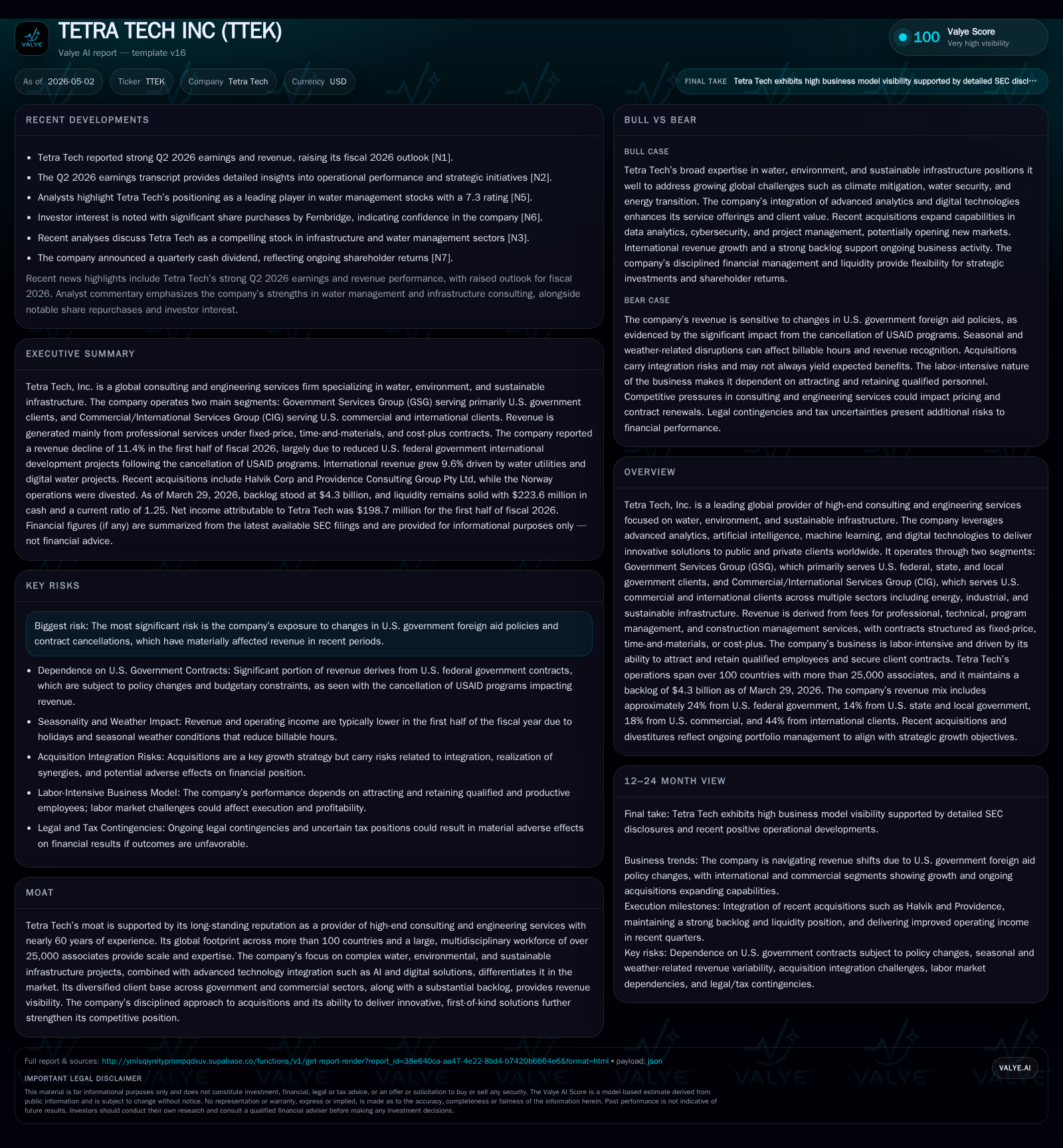
In its latest quarter, Tetra Tech experienced a significant revenue decline tied primarily to terminated U.S. federal government aid contracts, notably with USAID. Despite this, the company posted strong growth in its Commercial/International Services Group (CIG), driven by energy, water, and infrastructure projects worldwide. Tetra Tech's business model hinges on high-end consulting and engineering services delivered across government and commercial sectors, underpinned by advanced analytics and digital innovation. While its government segment faces near-term headwinds from foreign aid realignments, the firm's global footprint and acquisition strategy create durable growth avenues. Key watchpoints include contract backlog evolution, integration of recent acquisitions like Halvik, and execution on digital water initiatives.
Recent Operating Update: Sharp Federal Revenue Decline Amid Contract Terminations
Tetra Tech’s latest quarterly filing for Q2 fiscal 2026 (period ended March 29, 2026) reveals a pronounced revenue decline largely concentrated in its Government Services Group (GSG). Revenue fell approximately 20% sequentially year-over-year within GSG due to the cancellation of numerous USAID contracts following a U.S. executive order reevaluating foreign aid programs [S2][S16][S23]. Specifically, USAID-related revenues contracted from $283.9 million in Q2 fiscal 2025 to about $56.4 million in Q2 fiscal 2026, reflecting termination for convenience of nearly all such contracts effective immediately [S26].
Despite this near-term shock to federal development assistance streams, Tetra Tech's Commercial/International Services Group (CIG) posted resilient growth of roughly 6% in Q2 fiscal 2026 relative to the prior year [S23][S25]. Drivers included expanded activity in digital water utilities primarily within the United Kingdom, alongside contributions from recent acquisitions that broadened service offerings internationally [S16][S20][S24]. The firm's overall backlog increased slightly to $4.3 billion as of March 29, split evenly between segments ($2.1 billion GSG; $2.2 billion CIG), supporting revenue visibility amid the disrupted federal client landscape [S20][S24][S25].
Business Model: High-End Consulting Anchored in Science and Digital Innovation
Tetra Tech operates as a predominantly labor-intensive professional services firm specializing in consulting, engineering, program management, and construction management focused primarily on water, environmental management, sustainable infrastructure, energy transition, climate mitigation/adaptation, and technology-enabled solutions [S2][S20]. It generates revenue through various contract types—fixed-price agreements where clients pay a set amount for scopes of work; time-and-materials based on hourly labor rates plus expenses; and cost-plus models entitling reimbursement of allowable costs plus fees [S16].
The firm's value proposition centers on delivering complex “first-of-kind” solutions by integrating advanced analytics, artificial intelligence (AI), machine learning (ML), and digital platforms into project execution [S2]. This technology-led approach aims to improve project outcomes such as flood protection design precision or optimizing water utility operations through automation and data insights [N5]. Success heavily relies on domain expertise across multiple disciplines which supports client trust for tackling significant environmental or infrastructure challenges.
Labor productivity is crucial—with over 25,000 associates globally—and successful talent retention directly influences capacity to win new contracts as well as execute efficiently [S2]. Revenue growth is a function of billable hours multiplied by realized pricing rates adjusted for contractual terms. The mix of balanced fixed-price engagements combined with cost-reimbursable programs helps manage risk exposure while enabling margin improvements via overhead absorption across projects.
Industry Position: Diversified Client Base with Government/Commercial Split
Tetra Tech’s operational framework divides into two reportable segments: the Government Services Group (GSG), focusing largely on U.S. federal/state/local agencies including defense/civilian clients; and the Commercial/International Services Group (CIG) serving U.S.-based commercial enterprises along with customers across Canada, Europe, Asia Pacific (notably Australia/New Zealand), and Brazil [S16][S20][N2].
The government's segment contribution has historically been sizeable but is vulnerable to policy shifts such as U.S. foreign aid restructuring seen here with USAID program cancellations—a key near-term headwind [S26]. Meanwhile, CIG showcases ongoing diversification benefits serving sectors aligned with global sustainability ambitions including energy transition projects and urban infrastructure digitization [N5]. Geographic dispersion also buffers against local economic fluctuations.
The competitive environment involves other large engineering consulting firms such as Jacobs Engineering or AECOM competing across overlapping subsectors—yet Tetra Tech differentiates through its specialized focus on water/environmental sciences combined with leveraging emerging AI/digital capabilities to add innovative value [N3]. Its reputation built over six decades reinforces client relationships while a sizable backlog insulates against market volatility.
Growth Drivers
Accelerated Commercial & International Expansion: CIG’s growth trajectory is bolstered by increasing demand for consulting services in energy efficiency upgrades, renewable integration projects, industrial automation, and smart infrastructure—highlighted by successful penetration into UK digital water markets and Australian advisory sectors through acquisitions like Providence Consulting Group Pty Ltd [S24].
Acquisition Strategy: The second quarter acquisition of Halvik Corp enhances GSG’s cybersecurity and advanced analytics offerings aimed at U.S. federal defense/civilian customers complementing core engineering capabilities [S21]. Earlier transactions like Carron + Walsh (Europe) and SAGE Group (Australia) augment CIG’s service portfolio and geographic reach providing cross-selling opportunities [S24].
Technology Integration & Innovation: Continued investment in AI-driven environmental modeling tools boosts Tetra Tech’s ability to address climate-related infrastructure challenges that are increasingly prioritized by governments globally amid rising environmental risk awareness [N5][S2].
Backlog Stability & Contract Wins: Despite some contract terminations causing near-term pressure on federal revenues, overall backlog growth signals sustained demand pipeline—especially outside USAID funding realms—with performance obligations spread over multiple years offering medium-term revenue visibility [S20][S24].
Risks / Watchpoints / Growth Constraints
Federal Contract Volatility: The decisive reduction in USAID funded programs highlights exposure risk within GSG client portfolios sensitive to political/regulatory shifts concerning foreign aid policies. Termination for convenience clauses limit downside protection since contracts can be canceled promptly without penalties affecting billable work volumes [S26][S29].
Integration Risk from Acquisitions: Rapid acquisition pace introduces potential execution challenges around cultural alignment, realizing anticipated synergies especially within newly added cybersecurity/data analytic services requiring different operating models than traditional engineering consulting segments [S21][N2].
Labor Market Tightness: Recruiting and retaining skilled professionals remain critical to sustain utilization rates which influence both volume growth and margin profiles—industry-wide competition for niche technical talents could exacerbate wage inflation pressures impacting profitability.
Geopolitical & Currency Exposure: International revenues expose Tetra Tech to currency fluctuations predominantly involving Canadian dollar, Australian dollar, British pound sterling and euro; geopolitical events could disrupt project timelines or client budgets in certain regions affecting demand [S27].
What to Watch Next
Backlog Development Reports: Subsequent updates on contract awards post-USAID adjustments will clarify whether replacement federal contracts or Department of State programs offset recent cancellations [S20][N1].
Acquisition Synergies: Updates regarding Halvik integration progress alongside Providence Consulting impacts will signal ability to broaden service scope profitably within respective segments.
Margin Trajectories: Operating margins have modestly improved driven by better project execution and reduced lower-margin cost-plus revenues; maintaining or further enhancing margins amid top-line headwinds will be critical [S23][N1].
Digital Water & Sustainability Projects Scaling: Expansion pace of technology-enabled solutions like AI-powered water management could serve as bellwethers for sustainable long-term growth beyond legacy consulting projects.
Financial Profile Snapshot (Q2 Fiscal 2026 Ending March 29)
Latest financial snapshot
| Metric | Value | Period |
|---|---|---|
| Cash & equivalents | $224mm | |
| 2026-03-29 | ||
| Current assets | $1542mm | |
| 2026-03-29 | ||
| Current liabilities | $1229mm | |
| 2026-03-29 | ||
| Current ratio | 1.25x | |
| 2026-03-29 |
Source: SEC companyfacts cache [F1].
*Best-effort estimate from latest available data sequence given lack of updated debt figure post-2020; debt covenants confirm moderate leverage profile at ~1.32x EBITDA basis currently compliant per filings[S13][F1] **Total debt figure dated June 28, 2020; subsequent borrowings/restructuring exist but precise current debt disclosed only via covenant compliance metrics[S13]
Liquidity remains robust with over $220 million cash balances supplemented by $484 million undrawn revolving credit capacity providing flexibility for capital allocation including acquisitions, dividends ($0.072 per share declared quarter end), share repurchases totaling $100 million year-to-date along with working capital requirements [S3][S14][S20][F1]. Interest expense impact is manageable at ~5% weighted average borrowing rate.
Disclaimer: This analysis is intended solely for informational purposes reflecting publicly available SEC filings as of early May 2026 combined with sector-specific expertise insights held by Valye News analysts. It does not constitute investment advice or recommendations. Readers should conduct their own due diligence before engaging with securities discussed herein.
Disclaimer: This is research-only, informational analysis and not investment advice. It may include AI-generated interpretation and general industry context. Always verify important details using primary sources.

Comments