
enGene’s Pivotal Year: Regulatory Hurdles, Strategic Restructuring, and the High-Stakes Path to Bladder Cancer Commercialization
enGene Holdings, with its gene therapy candidate detalimogene targeting non-muscle invasive bladder cancer, faces a defining period as it approaches critical regulatory milestones, tests clinical durability, and executes a major operational reset. The company’s cash-rich balance sheet and strategic focus sharpen the risks and rewards ahead of a potential 2027 launch.
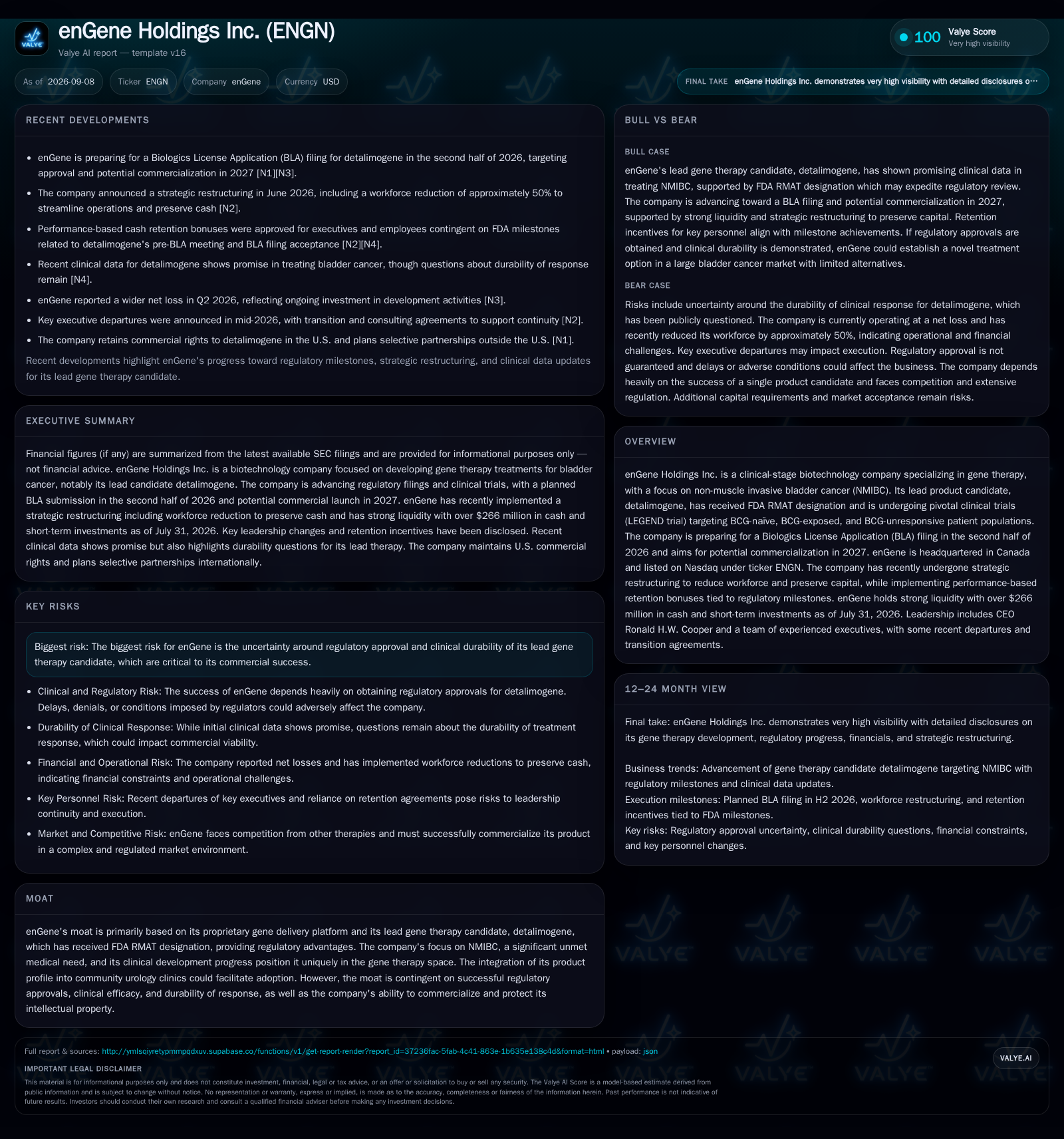
enGene Holdings is advancing detalimogene, its gene therapy for non-muscle invasive bladder cancer, toward a planned 2026 BLA filing and possible 2027 commercial launch. Amid a major workforce reduction and leadership changes, the company retains reported liquidity position and ties executive incentives to FDA milestones. While recent clinical data is promising, durability of response remains a key question, making regulatory outcomes and execution pivotal for value realization. [N1] [N2] [N3] [N4]
enGene Holdings stands at a critical juncture as it advances its lead gene therapy candidate, detalimogene, through late-stage clinical trials in non-muscle invasive bladder cancer (NMIBC). With a BLA filing targeted for the second half of 2026 and potential U.S. commercial launch in 2027, the company’s recent 50% workforce reduction and strategic restructuring underscore both its focus on capital preservation and the high-stakes nature of its near-term milestones. Despite reported liquidity position, enGene’s business outlook is tightly bound to regulatory outcomes and the clinical durability of detalimogene—factors that will determine whether it can transition from a development-stage biotech to a commercial oncology innovator. [N1] [N2] [N3] [N4]
Regulatory Milestones and Operational Reset Define enGene’s 2026 Outlook
enGene Holdings is preparing to file a Biologics License Application (BLA) for its lead gene therapy candidate, detalimogene, in the second half of 2026, with an eye on potential U.S. commercialization in 2027. This timeline is supported by the FDA’s RMAT designation, which may enable an accelerated regulatory review. To conserve capital and focus resources on this pivotal filing, enGene enacted a strategic restructuring in June 2026 that reduced its workforce by approximately 50%. Concurrently, the company approved performance-based retention bonuses for executives and key employees, explicitly tied to FDA milestones such as the pre-BLA meeting and BLA acceptance. These measures reflect a high-conviction bet on regulatory success, but magnify execution risk amid significant leadership transitions, as several senior executives have recently departed or are set to transition. As of July 31, 2026, enGene reported $41 million in cash and $225.3 million in short-term investments, providing a substantial liquidity buffer as it navigates this critical period. [N1] [N2] [N3] [N4] [S2]
Gene Therapy Economics: Capital Intensity, Revenue Potential, and Operating Leverage
enGene’s economics are tightly linked to the high-risk, high-reward dynamics of late-stage biotechnology. The company’s principal cost drivers are R&D, clinical trial execution, and regulatory activities, all of which have contributed to a net loss of $32.5 million in the latest quarter. With the completion of pivotal trials and a streamlined post-restructuring organization, operating leverage could improve if detalimogene is approved and commercialized. Revenue would likely be driven by pricing power typical of first-in-class or best-in-class oncology therapies—especially in indications with high unmet need like BCG-unresponsive NMIBC. However, actual pricing and uptake would depend on factors including durability of response, payer coverage, and the competitive landscape. The company’s current liquidity position reduces near-term financing risk, but commercial launch would require further investment in manufacturing scale-up, distribution, and medical affairs—costs that could escalate if the company retains U.S. rights and pursues a direct commercialization strategy. If international commercialization proceeds via selective partnerships, upfront or milestone payments could offset some capital needs, but would also reduce long-term revenue capture.
enGene’s Moat: Platform Promise Meets Competitive and Clinical Headwinds
enGene’s principal competitive advantage stems from its proprietary gene delivery platform and the RMAT-designated detalimogene, targeting a segment of bladder cancer with persistent unmet need. The ability to address BCG-naïve, BCG-exposed, and BCG-unresponsive NMIBC patients could allow for broad clinical positioning. However, the moat’s durability is contingent on demonstrating not just initial efficacy but sustained response—an area where recent data, while promising, still leaves durability questions unresolved. The competitive landscape includes both standard-of-care therapies (such as BCG and radical cystectomy) and a growing pipeline of immunotherapies, cell therapies, and gene therapies from established oncology players. Barriers to entry are high due to regulatory complexity and the need for robust clinical evidence, but switching costs for physicians and payers would only materialize if detalimogene demonstrates a clear and durable clinical advantage. The company’s U.S. commercialization strategy may allow for direct capture of value, but also exposes it to the full spectrum of launch execution risks and competitive reactions.
Breakthrough Approval and Commercial Execution Could Unlock Transformative Value
The most favorable path for enGene involves positive pivotal trial results confirming both initial efficacy and durable response for detalimogene in NMIBC, leading to a smooth and timely FDA review and approval in 2027. If the therapy demonstrates a meaningful improvement over current options, especially for BCG-unresponsive patients, payers may support premium pricing and rapid adoption among urologists and oncologists. enGene’s retention of U.S. commercial rights would maximize revenue per patient, and selective ex-U.S. partnerships could provide non-dilutive capital through upfront and milestone payments. Leverage from a leaner cost base post-restructuring would accelerate operating profitability, while the company’s platform could attract additional pipeline development or licensing opportunities. Confirmation of this scenario would come from consistently strong and durable clinical data, positive regulatory feedback, and evidence of payer and physician enthusiasm ahead of launch.
Gradual De-Risking: Navigating Approval, Launch, and Early Adoption Hurdles
The most plausible outcome is a stepwise de-risking process: enGene achieves BLA submission and, after regulatory review, obtains approval for detalimogene, but faces moderate launch friction. Adoption may be steady but not explosive, as physicians and payers await longer-term real-world durability data. Early revenues could be offset by ongoing commercialization and post-marketing commitments, and the company may need to further optimize its cost structure as it transitions from R&D to commercial operations. International expansion could progress through a mix of partnerships and licensing deals, with milestone payments helping to defray launch costs. Evidence supporting this outcome would include successful completion of regulatory milestones, initial product uptake in key academic and community centers, and measured but positive feedback from early adopters.
Durability Disappointments or Regulatory Setbacks Could Force Strategic Reassessment
The most adverse scenario involves disappointing durability of response in pivotal trial data or unforeseen safety signals, leading to regulatory delays, requests for additional data, or outright rejection of the BLA. In this case, enGene’s path to commercialization would be significantly impaired, eroding market confidence and forcing the company to consider deeper cost cuts, asset sales, or partnership/licensing arrangements on less favorable terms. Extended regulatory timelines could exhaust liquidity, necessitating dilutive equity raises or debt financing. Confirmation of this scenario would include negative clinical readouts, FDA requests for additional trials, or public statements from the company revising its regulatory and commercial timelines.
Milestones and Metrics That Will Determine enGene’s Transition to Commercial Stage
Progress and outcomes from the LEGEND pivotal trial for detalimogene, especially durability of clinical response and safety profile.
Timing and completeness of the FDA pre-BLA meeting and subsequent BLA submission in the second half of 2026.
Retention and performance of key executives following recent departures and transition agreements.
Updates on the company’s cash burn rate and liquidity position as it approaches commercialization, with a useful metric being quarterly net cash used in operations (if disclosed).
Announcements regarding U.S. commercialization strategy—whether enGene will pursue a direct launch or seek commercial partners.
Details and financial terms of potential ex-U.S. partnership or licensing agreements, which could provide non-dilutive capital.
Feedback from payers and key opinion leaders on detalimogene’s clinical value proposition and likely reimbursement environment.
Any additional pipeline progress or new indications that could diversify the company’s risk profile.
Disclaimer: This is research-only, informational analysis and not investment advice. It may include AI-generated interpretation and general industry context. Always verify important details using primary sources.

Comments