
Enovis CORP Faces Profitability Challenges Despite Broad Product Portfolio and Strategic Acquisitions
Enovis leverages its EGX system and acquisitions to grow revenue while contending with goodwill impairments and debt burdens.
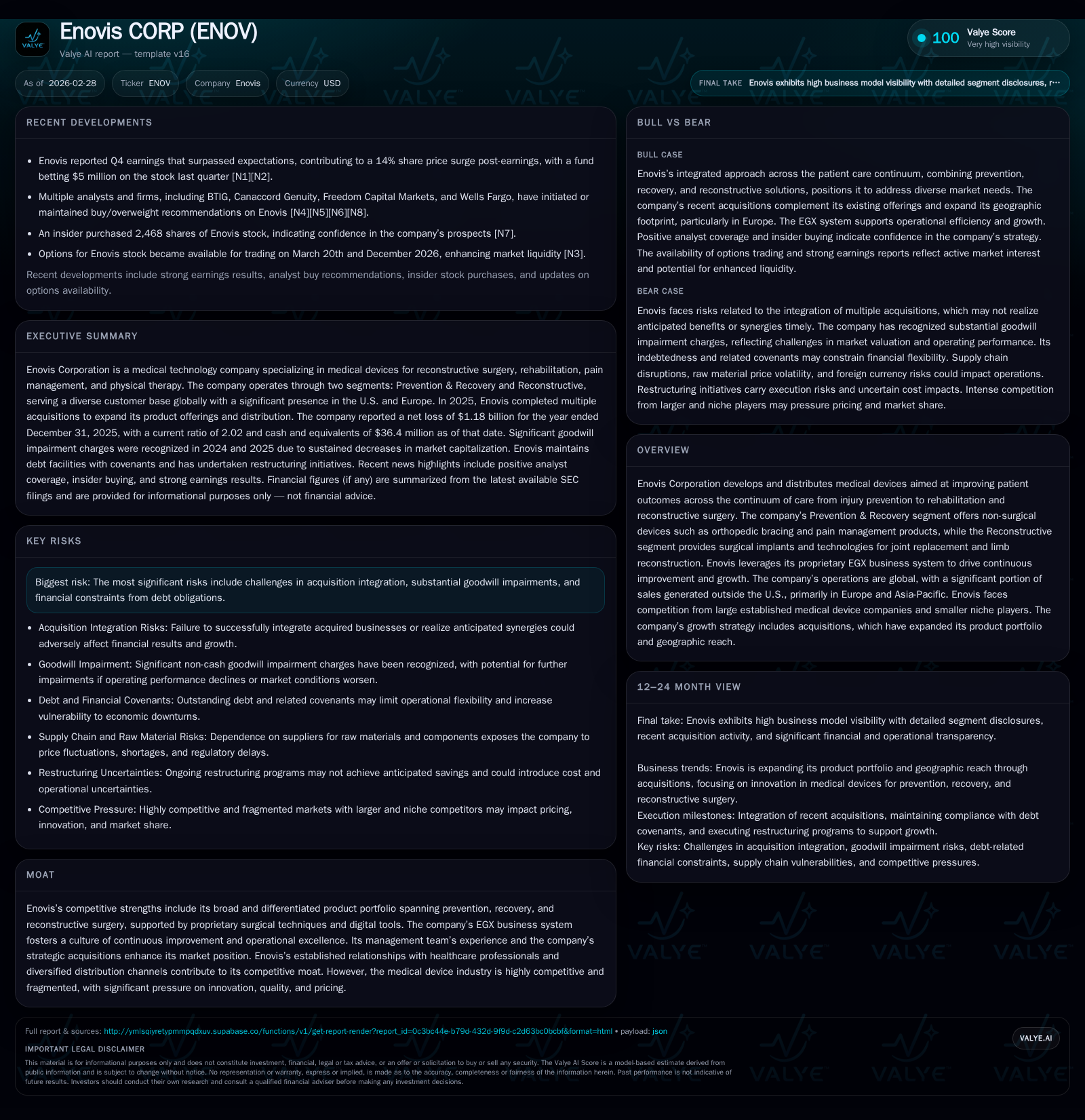
Enovis Corporation operates in the competitive medical device sector offering a diversified portfolio spanning prevention, recovery, and reconstructive surgery. While it has pursued growth through several acquisitions expanding its geographical footprint and product lines, the company posted significant operating losses in FY2025 due largely to goodwill impairments. Cash flow from operations improved notably, reflecting underlying business strength, but heavy debt levels and integration risks pose ongoing financial constraints. Enovis's ability to maintain growth hinges on successful integration of acquisitions, regulatory compliance, and innovation within a highly regulated market.
Company Overview
Enovis Corporation is a medical technology firm focused on clinically differentiated devices designed to improve patient outcomes across the care continuum—from injury prevention through rehabilitation to reconstructive surgery. It operates principally via two reportable segments: Prevention & Recovery (P&R), offering non-surgical orthopedic devices such as bracing, pain management equipment, and physical therapy aids; and Reconstructive surgery (Recon), providing surgical implants and technology for joint replacement and limb reconstruction. The company's global operations generate significant sales outside the U.S., especially in Europe and Asia-Pacific regions [S4][S10].
Central to Enovis’s operational approach is its proprietary Enovis Growth Excellence (EGX) business system—a combination of tools, processes, and organizational culture designed to instill continuous improvement across functions. This system aims to enhance patient outcomes while driving growth through disciplined execution of strategy and innovation [S4].
Historical Performance and Financial Overview
Over the four-year window ending FY2025, Enovis faced substantial challenges as indicated by worsening operating performance metrics along with noteworthy investments through acquisitions:
Historical performance (annual)
| FY | Net ($mm) | CFO ($mm) | OpInc ($mm) | Capex ($mm) | Net YoY |
|---|---|---|---|---|---|
| 2025 | -1184 | 217 | -1124 | 197 | -43.5% |
| 2024 | -825 | 114 | -776 | 181 | -2381.9% |
| 2023 | -33 | 135 | -66 | 122 | -150.2% |
| 2022 | -13 | -56 | -71 | 105 |
Source: SEC companyfacts cache [F1].
Capital returns and efficiency (annual)
| FY | Buybacks ($mm) | FCF ($mm) | ROE% |
|---|---|---|---|
| 2025 | 4 | 20 | -79.5 |
| 2024 | 5 | -67 | -32.2 |
| 2023 | 13 | -1.0 | |
| 2022 | -161 | -0.4 |
Source: SEC companyfacts cache [F1].
Source: Company financial disclosures [F1]
Significant non-cash goodwill impairment charges recorded in late FY2024 and FY2025 related to prior acquisitions have materially impacted reported earnings but not operating cash flows directly [S2]. These impairments explain much of the marked deterioration in operating income.
Despite these accounting losses leading to an approximate negative return on equity near -80%, operating cash flow improved substantially by over 90% year-over-year in FY2025 driven by stronger underlying operational results [F1]. Free cash flow remained positive after capital expenditures.
In calendar year 2025 alone Enovis completed seven acquisitions—four within its Reconstructive segment and three within Prevention & Recovery—aimed at broadening product offerings and expanding European distribution channels with complementary technologies [S4].
Business Model Detail
Prevention & Recovery Segment
This segment serves orthopedic specialists along with surgeons and allied healthcare professionals such as physical therapists and athletic trainers. Its products include orthopedic bracing (rigid/soft), hot-cold therapies for inflammation or pain management post-injury or surgery; bone growth stimulators; vascular therapy devices; electrical stimulators for pain control; compression garments; among others. Many devices are accessible for at-home use or athletic injury prevention.
Reconstructive Segment
Focused globally on surgical solutions enabling joint replacement—hip/knee/shoulder—as well as limb reconstruction including fixation for extremities. The product suite comprises differentiated implants plus instrumentation supported by proprietary surgical techniques alongside digital tools facilitating preoperative planning through postoperative recovery monitoring.
Both segments rely on diverse distribution models incorporating direct sales forces augmented by independent distributors across target geographies which include a broad range of healthcare facility types ranging from hospitals to specialty clinics [S10][S19].
Industry Context & Competitive Dynamics
Enovis operates in an intensely competitive medical device environment characterized by swift technological innovation coupled with pressure on pricing from payors demanding cost-effectiveness without compromising outcomes. Large incumbents such as Stryker Corp., Zimmer Biomet Holdings Inc., and DePuy Synthes (a J&J unit) hold commanding presence in reconstructive orthopedics alongside numerous nimble niche players focusing on specialized therapies or geographies.
Product acceptance heavily depends on maintaining relationships with leading orthopedic surgeons who shape clinical adoption curves through development collaborations plus training programs. Adherence to rigorous regulatory frameworks—especially FDA clearance in the U.S. and Medical Device Regulations across Europe—is necessary but time-consuming and costly. Compliance lapses or delays risk suspension or revocation threatening revenue continuity [S11][S20].
Growth Prospects & Challenges
Growth Drivers:
- Continued roll-out of innovative product variants leveraging proprietary surgical techniques and digital enhancements.
- Expansion into emerging markets within Asia-Pacific alongside deepening penetration of mature European markets leveraging recent acquisitions.
- Broadening of P&R offerings targeting increasing demand for non-invasive musculoskeletal treatment modalities fueled by aging demographics.
- Leveraging EGX-driven operational efficiencies producing quality improvements that differentiate customer value propositions.
- Integration synergies from recent acquisitions potentially unlocking cross-selling opportunities while expanding distribution reach.
Headwinds:
- The integration complexity inherent in multiple recent acquisitions introduces execution risk including retention of key talent critical to maintaining innovation pipelines.
- Regulatory uncertainties fostered by evolving EU MDR certifications required for continued market access could delay commercialization timelines or necessitate costly redesigns.
- Persistent goodwill impairment risk tied to acquired asset valuations indicating potential overpayment or shifting market dynamics reducing fair values [S1][S2][S6].
- Capital constraints due to existing leverage limiting ability to fund future sizable acquisitions without resorting to equity issuance which dilutes shareholders or costly debt raising that stresses interest coverage ratios [S7][S24].
- Competitive pressures forcing price discounts could erode margins especially in commoditized device categories within both P&R and Recon segments.
Capital Allocation & Financial Flexibility
At fiscal year-end December 31st, 2025 Enovis held approximately $36 million in cash equivalents against current liabilities nearing $600 million resulting in a current ratio around 2x reflecting reasonable near-term liquidity [F1]. The company’s credit facilities were amended in December 2025 extending maturity profiles out to December 2030 while adjusting covenant thresholds reflective of acquisition activity allowing some temporary leverage tolerance [S17][S24].
Capital expenditures increased moderately year-over-year consistent with expanding manufacturing capacity or upgrading facilities supporting new product introductions [F1]. Share repurchases remain minimal suggesting prioritization of debt repayment or reinvestment over capital returns during this phase of restructuring post-acquisition ramp-up.
Free cash flow generation was positive though relatively modest at roughly $20 million underscoring cautious balance sheet management amid high impairment write-downs masking underlying cash profitability gains [F1].
Regulatory & Legal Considerations
Enovis faces numerous compliance obligations including FDA Quality System Regulations governing manufacturing practices alongside international standards impacting supply chains particularly given nearly half of revenues originating outside the U.S.[S10]. Frequent audits may lead to interruptions or enforcement actions jeopardizing product availability if not managed meticulously.
Heightened scrutiny over marketing practices including physician payment disclosures under healthcare fraud laws imposes governance burdens especially for engaging surgeon consultants integral to product design and training programs [S5][S6][S9][S12][S25].
Internationally anti-bribery statutes like FCPA require robust internal controls particularly relevant following expansion into new jurisdictions via acquisition increasing exposure profiles [S8][S13].
Lastly product liability suits common across the medical device industry hover as contingent risks costing materially if insurance coverage proves inadequate amidst technical failures or adverse post-market events affecting patient safety [S14][S18].
What To Watch Going Forward (Analysis)
- Success metrics around assimilation of recent acquisitions measured through synergy realization timelines impacting margin progression.
- Progress toward certification renewals under MDR impacting Europe-based sales continuity crucial given substantial regional revenue exposure.
- Evolution of operating income trends assessing whether impairments mark past challenges fully absorbed or indicate ongoing valuation pressures.
- Cash flow health sustaining investment capability amid leverage limits influencing growth trajectory.
- Competitive responses potentially pressuring pricing requiring differentiated innovation or service bundles backed by EGX efficiencies.
- Pipeline indications related to product launches aided by surgeon collaborations shaping future growth legacies.
Summary Perspective
Enovis navigates a complex orthopedic medical device landscape armed with a diversified portfolio bridging prevention through reconstructive care supported by continuous improvement systems and recent strategic acquisitions augmenting scale chiefly in Europe. However substantial impairment charges rooted in acquisition valuations have strained earnings visibility delivering sizeable reported losses despite improving cash generation signaling core operational resilience.
The firm must balance leveraging its EGX-driven culture of excellence while managing integration complexity amid regulatory tightening globally plus repayment imperatives linked to sizeable outstanding debt facilities preventing full financial flexibility at present. While competition remains fierce from industry heavyweights demanding constant innovation cycles alongside disciplined go-to-market execution the foundation appears set for potential medium-term recovery contingent on mitigating external risks noted above. Enovis embodies many characteristic tensions of a consolidating medtech player grappling with growth via M&A amid valuation resets — how it executes during this transitional phase will shape its standing amongst peers going forward.
This report is prepared solely for informational purposes without regard to investment suitability; it does not constitute investment advice.
Disclaimer: This is research-only, informational analysis and not investment advice. It may include AI-generated interpretation and general industry context. Always verify important details using primary sources.

Comments