
Enzon Pharmaceuticals’ Transition from Royalties to Acquisition Vehicle Under Pending Merger with Viskase
Enzon Pharmaceuticals, formerly a royalty-based biopharma, is repositioning as a public acquisition vehicle amid an all-stock merger agreement with Viskase Companies.
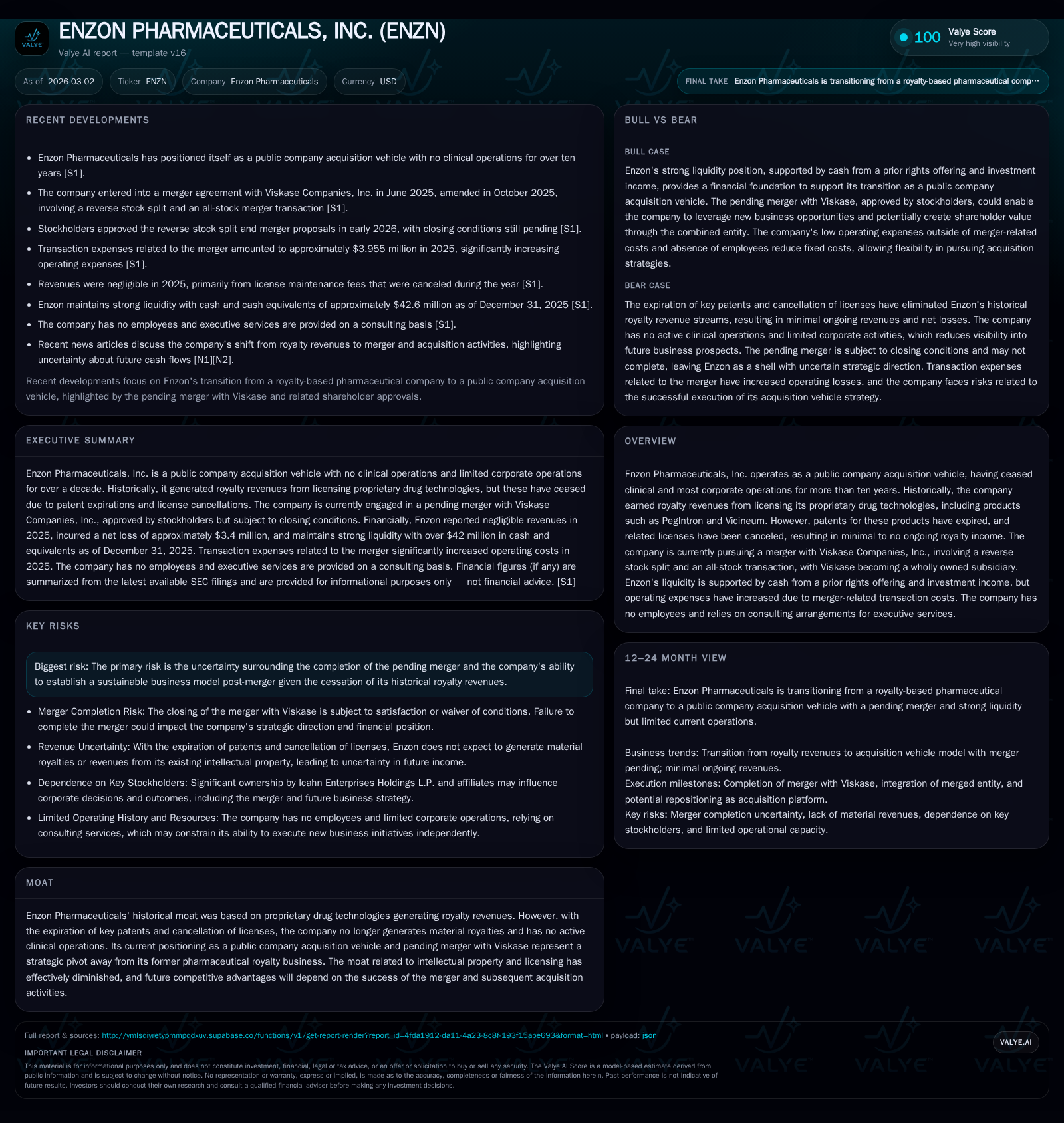
Enzon Pharmaceuticals has ceased clinical operations and royalty revenues following patent expirations and license cancellations. The company operates with no employees and relies on consulting for key executive roles. It entered an amended all-stock merger agreement with Viskase Companies, Inc., which would result in Viskase becoming a wholly owned subsidiary and Enzon rebranding accordingly. Financials show increased operating losses driven by merger transaction costs, minimal revenue from royalties or licensing, and liquidity supported by cash from a prior rights offering and investment income. Dividend payments on Series C Preferred Stock are suspended during the merger process, with unpaid dividends accruing as liquidation preference increases.
Historical Performance and Royalty Revenue Decline
Enzon Pharmaceuticals historically generated revenues through licensing its proprietary drug technologies, including PegIntron marketed by Merck & Co. and Vicineum. All related patents have expired—PegIntron’s patents expired globally by the end of 2024, while Vicineum’s license was canceled by Amgen, Inc. in 2025 followed by patent expiration [S1][S4][S22]. As a result, royalty income has effectively ceased: reported revenue remained flat at $26,000 in 2024 with no material royalties thereafter [F1].
For more than a decade prior to fiscal year-end 2025, Enzon maintained no clinical operations and operated with limited corporate activity [S1][S6]. Remaining income primarily derived from interest earned on cash reserves rather than royalties or milestone payments.
Financial Snapshot: Operating Losses Driven by Transaction Costs
Operating losses expanded sharply due to non-recurring transaction costs related to the pending merger with Viskase. Operating loss widened from approximately $1.3 million in 2024 to $5.3 million in 2025 [F1]. Net income declined from positive $0.78 million in 2024 to negative $3.41 million in 2025 [F1]. Merger-related transaction expenses totaled about $3.96 million in 2025 versus none in the prior year [S18].
Operating cash flow deteriorated to -$3.01 million in 2025 compared to positive $1.12 million in 2024 [F1]. Capital expenditures remain negligible reflecting the company's non-operating status.
Historical performance (annual)
| FY | Rev ($) | Net ($mm) | CFO ($mm) | OpInc ($mm) | Rev YoY | Net YoY |
|---|---|---|---|---|---|---|
| 2025 | 26000 | -3 | -3 | -5 | 0.0% | -538.2% |
| 2024 | 26000 | 1 | 1 | -1 | 0.0% | -43.3% |
| 2023 | 26000 | 1 | 1 | -1 | 0.0% | +838.2% |
| 2022 | 26000 | 0 | -1 | -1 |
Source: SEC companyfacts cache [F1].
Capital returns and efficiency (annual)
| FY | Div ($) | ROE% |
|---|---|---|
| 2025 | 1275000 | 135.0 |
| 2024 | 1275000 | 25.9 |
| 2023 | 1275000 | 39.2 |
| 2022 | -5.5 |
Source: SEC companyfacts cache [F1].
Dividend payments on Series C Preferred Stock were approximately $1.28 million annually but are currently suspended during the pending merger; unpaid dividends accrue as a liquidation preference accretion at an annual rate of 5% per share [F1][S15][S19].
Strategic Pivot: Merger Agreement as Growth Catalyst
With its pharmaceutical royalty model effectively ended, Enzon is repositioning as a public acquisition vehicle. On June 20, 2025, it entered into an amended all-stock merger agreement with Viskase Companies, Inc., an industrial operating company [S1][S6]. Key closing conditions include:
- A reverse stock split consolidating shares at a ratio of one-for-one hundred.
- Stockholder consents including approval of share exchanges related to Series C Preferred Stock conversion [S1][S27].
- Regulatory filings and reapplication for OTCQB listing after change of control.
Upon closing (pending), Viskase will become a wholly owned subsidiary of Enzon, with former Enzon shareholders holding approximately 45% of outstanding common stock and Viskase shareholders holding about 55%. Enzon will change its name to "Viskase Holdings, Inc." concurrent with this transition [S1][S6][S27].
This transaction marks Enzon’s exit from pharmaceutical IP licensing toward operating as an acquisition platform aligned with Viskase’s business.
Liquidity and Capital Structure Support Transition Period
Liquidity is anchored by cash proceeds of roughly $43.6 million raised via a rights offering in October 2020 through issuance of Series C Preferred Stock and common stock [S24][S19]. As of December 31, 2025, cash and equivalents totaled approximately $42.6 million compared to about $46.9 million at year-end prior year [F1]. Current liabilities remain low at around $731 thousand, yielding a strong current ratio above 58x [F1][S13].
Free cash flow remains negative due to recurring corporate expenses plus elevated merger-related costs but cash reserves provide runway through at least March 2027 if the merger does not close [F1][S5][S18].
Corporate Organization: Minimalist Operating Model Maintained
Enzon currently has no employees; executive officers provide services under consulting arrangements consistent with its role as an acquisition vehicle rather than an active pharmaceutical company [S4][S22]. Headquarters operate via leased office space supported by service agreements.
Risk Factors: Merger Execution and Post-Merger Viability
Risks center on satisfying closing conditions for the Viskase merger including shareholder approvals and regulatory compliance failures that could delay or prevent completion [S8][S14][S17]. Failure to close would leave Enzon without meaningful operating revenues beyond investment income.
Integration challenges post-merger include cultural alignment and operational consolidation risks. Tax net operating loss utilization may be subject to limitations under IRC Section 382 rules; management anticipates no significant impairment based on analysis [S23]. Ongoing royalty disputes such as those involving Merck concerning historic PegIntron royalties remain unresolved but carry negligible financial impact [S26].
Outlook: Key Milestones Ahead
While explicit earnings guidance is unavailable due to transitional status, key near-term developments include:
- Completion timing of the Viskase merger following shareholder consent deadlines.
- Impact of reverse stock split on share liquidity.
- Integration progress affecting operational stability post-merger.
- Dividend policy evolution for Series C Preferred Stock after the merger lockup period.
- Potential pursuit of acquisitions leveraging Enzon’s new platform status.
- Monitoring residual royalty or licensing revenue streams though expected immaterial.
The strategic pivot represents a fundamental shift away from legacy pharma licensing toward industrial acquisition operations with inherent uncertainties but potential growth opportunities through the combined entity.
This analysis is based solely on publicly available SEC filings through March 2, 2026 ([F1], [S1]-[S29]). It does not constitute investment advice.
Disclaimer: This is research-only, informational analysis and not investment advice. It may include AI-generated interpretation and general industry context. Always verify important details using primary sources.

Comments