
Equus Total Return's Strategic Shift: Evaluating the Transition to an Operating Company
Equus Total Return is moving from a traditional BDC model toward operating company status, facing execution risks amid continued losses.
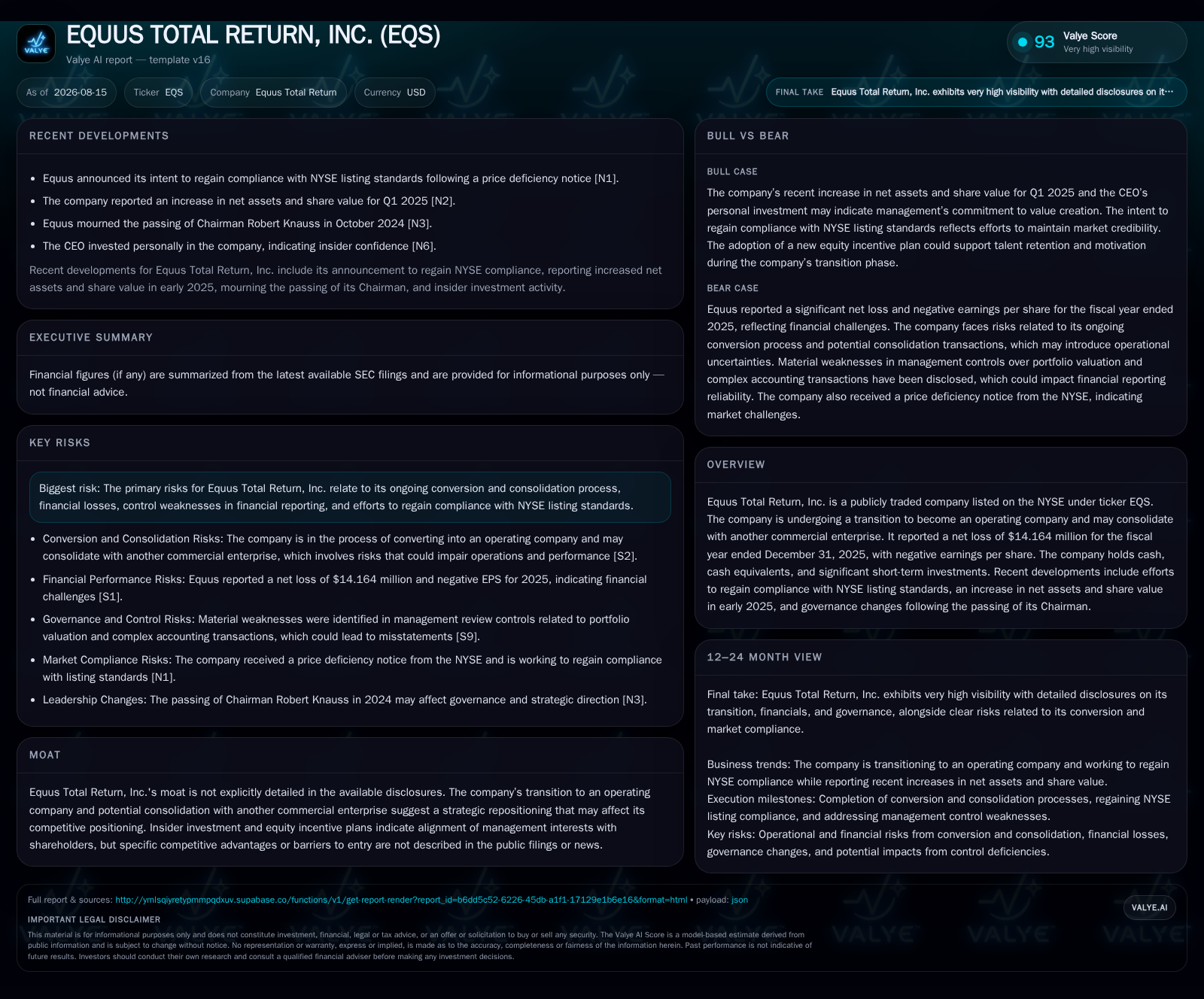
The latest 10-Q filing reveals that Equus Total Return, Inc. is actively pursuing a strategic transformation from a Business Development Company (BDC) investing in small and mid-sized firms’ debt and equity securities into an operating company, potentially consolidating with another commercial enterprise [S2]. This shift introduces expanded risks related to governance, regulatory compliance, and financial performance amid persistent net losses of $14.164 million for fiscal 2025 [F1]. Compared to established BDC peers known for stable dividend payouts and disciplined leverage, Equus's transition marks a fundamental change in its business model and risk profile [S1]. Key upcoming milestones on consolidation progress and NYSE compliance will determine whether the company can unlock new value beyond traditional portfolio income.
Latest Quarterly Operating Update: Transition Risks Take Center Stage
The August 14, 2026 Form 10-Q filing [S2] marks a pivotal update for Equus Total Return as it actively shifts its corporate identity from a classic Business Development Company toward becoming an operating company through consolidation with another commercial entity. This report notably broadens the risk disclosures tied to this transformation process. While previous filings focused on standard BDC-related risks such as credit quality and portfolio valuation volatility, the latest filing flags new contingencies related to transactional complexity, governance changes—including board adjustments following the Chairman’s passing—and the regulatory uncertainties of exiting the tightly regulated BDC framework. Such escalated risks directly affect valuation considerations since they cloud both operational durability and strategic clarity.
Importantly, the filing acknowledges that additional unknown or unquantified risks may emerge as the conversion proceeds. This forward-looking caution emphasizes that investors should not extrapolate stability solely based on historical BDC metrics but must consider transitional volatility effects. The company’s repeated reminders about comprehensive risk factors underscore heightened uncertainty typical of entities undergoing structural metamorphoses.
Equus's Capital Deployment Model: Evolution From BDC Income Generator to Operating Entity
Traditionally, Equus's business model aligned with the archetype of publicly traded BDCs focused on deploying capital into debt and equity securities of smaller enterprises—specifically companies with total enterprise values between $5 million and $75 million [S1]. These investments generated revenue streams mainly through periodic interest payments on debt instruments (including subordinated debt and convertible securities), dividend income on equity positions, and occasional capital appreciation from equity realizations or warrant exercises.
This legacy model is governed by strict regulatory constraints under the Investment Company Act of 1940 that require at least 70% of assets invested in eligible portfolio companies and impose leverage ceilings to limit risk exposure. Additionally, until late 2024, Equus elected for Regulated Investment Company (RIC) tax treatment under Subchapter M of the Internal Revenue Code—a key feature enabling avoidance of corporate-level income tax so long as qualifying income was distributed to shareholders.
However, Equus formally elected not to maintain RIC qualification starting in Q4 2024 [S1], exposing itself to regular corporate taxation going forward. This election materially alters the after-tax economics of its traditional investment income model. Without RIC benefits, maintaining profitability through passive interest/dividend income alone becomes more challenging.
Moreover, sourcing these smaller-company credits requires specialized due diligence capability due to information opacity and higher inherent idiosyncratic credit risk—as underscored by typical KPIs such as non-performing asset ratios and fair value versus cost-based valuations. The company's emphasis on holding loans to maturity where possible indicates a conservative valuation approach but also limits upside volatility.
BDC Industry Benchmarks: Peer Context on Leverage, Credit Quality, and Dividend Payouts
Industry leaders such as Ares Capital Corporation (ARCC) exemplify large-scale BDC operations that balance leverage efficiently—often maintaining debt-to-equity ratios around 0.7-1.0x with diversified portfolios across sectors designed for stable investment income yield. Similarly, Golub Capital BDC (GBDC) specializes in middle-market lending with disciplined credit underwriting that supports stable net asset value per share growth.
Main Street Capital Corporation (MAIN), notable for consistently stable dividend payouts, contrasts with Equus’s current inability to sustain distributable earnings given ongoing net losses. These peers benefit from established management teams deeply experienced in credit assessment coupled with stable capital raising access—advantages potentially undermined during Equus’s transition.
Strategic Consolidation Plans: Implications of Shifting Business Model Frameworks
The prospective consolidation outlined in recent filings [S2][S3] signals a profound departure from Equus’s prior identity solely as an external capital allocator toward inclusion into an operating commercial entity with presumably active business operations beyond financing functions. Such a transition inherently entails governance complexities including new control structures potentially altering board independence norms previously governed by SEC oversight targeted at investment companies.
Consolidated financial reporting will likely expand beyond traditional fair-value accounting for portfolio investments into full operating results disclosure encompassing revenue recognition from tangible product or service operations—introducing accounting complexities absent under pure BDC frameworks.
Operationally, integration challenges are expected as cultural blending between investment management activities and commercial enterprise operations demands different competencies from leadership teams—risks further compounded by regulatory demands including renewed NYSE listing standards compliance efforts described recently [S2].
Growth Opportunities in Transition: Unlocking Value Beyond Traditional Portfolio Investments
Post-consolidation growth could potentially unlock novel cash flow sources unrelated to passive investment returns by leveraging operational profits generated by the acquired commercial business lines—broadening capital raising avenues unrestricted by prior BDC leverage caps or distribution mandates. This flexibility might allow more aggressive reinvestment strategies enhancing longer-term shareholder value creation.
Moreover, detachment from RIC tax constraints post-transition permits retention of earnings supporting organic investing or debt reduction rather than mandatory distributions—offering financial resilience especially during economic downturns when portfolio credit stress traditionally rises.
However, this optimistic scenario remains contingent on successful completion of complex mergers combined with effective management execution vis-à-vis managing increased operational scope complexities noted above.
Risks Highlighted by Conversion: Credit, Regulatory, and Operational Challenges Ahead
Regulatory risks persist given NYSE listing standard non-compliance history necessitating remedial measures amidst active governance shifts triggered partly by executive succession following Chairman's death [S2]. Failures here risk delisting or market distrust consequences detrimental to liquidity.
Additionally undeniable are credit quality risks linked to investments in smaller or early-stage companies characterized by volatile or unproven business models susceptible to adverse economic cycles plus inherent difficulties valuing illiquid holdings fairly—all spelled out explicitly in annual risk factor disclosures [S1].
Operational risks also stem from internal control weaknesses disclosed around portfolio valuation processes and complex warrant accounting noted within recent auditor transitions [S16], raising concerns over financial reporting reliability during a sensitive structural change phase.
What Investors Should Watch Next: Milestones Critical for Validation of Conversion Thesis
Priority indicators for validating management’s thesis include timely announcements advancing consolidation timelines alongside transparent disclosures detailing newly combined entity’s financial results inclusive of operating segments beyond legacy portfolio income streams [S2][S3]
Equally important will be progress reports demonstrating resolution or mitigation of NYSE listing compliance deficiencies ensuring uninterrupted public trading viability.
Periodic net asset value updates following portfolio restructuring will serve as barometers quantifying extent of path away from traditional debt/equity investment holdings toward integrated operating assets.
Closer observer attention should also focus on evolving capital structures revealing leverage moderation or refinancing activities consistent with sustainable long-term funding policies supportive of an industrial-style operating firm.
Financial Profile Discussion: Losses, Liquidity, Leverage Status, and Cost Structure Outlook
Given absent RIC election since Q4 2024 resulting in corporate taxation exposure [S1], sustaining profitability through prior investment income mechanisms is unlikely prompting fundamental overhaul of revenue sources afforded only via consolidation with operational business units.
Operating expense trends remain opaque but intensified governance adjustments accompanying audit firm changes suggest elevated administrative costs during this phase—a common phenomenon among firms undergoing transformational resets that must be closely monitored for discretionary expense control efficacy going forward.
Disclaimer: This is research-only, informational analysis and not investment advice. It may include AI-generated interpretation and general industry context. Always verify important details using primary sources.

Comments