
EVI Industries’ Next Phase: Consumer Services Expansion Confronts Integration, Capital, and Recurring Revenue Dynamics
EVI Industries’ acquisition of Sudsies marks a strategic pivot into consumer garment care, layering new integration challenges and recurring revenue potential atop its established commercial laundry distribution business. The company’s ability to harmonize buy-and-build execution, manage liquidity constraints, and unlock synergies across distinct customer bases will define its multi-year outcome.
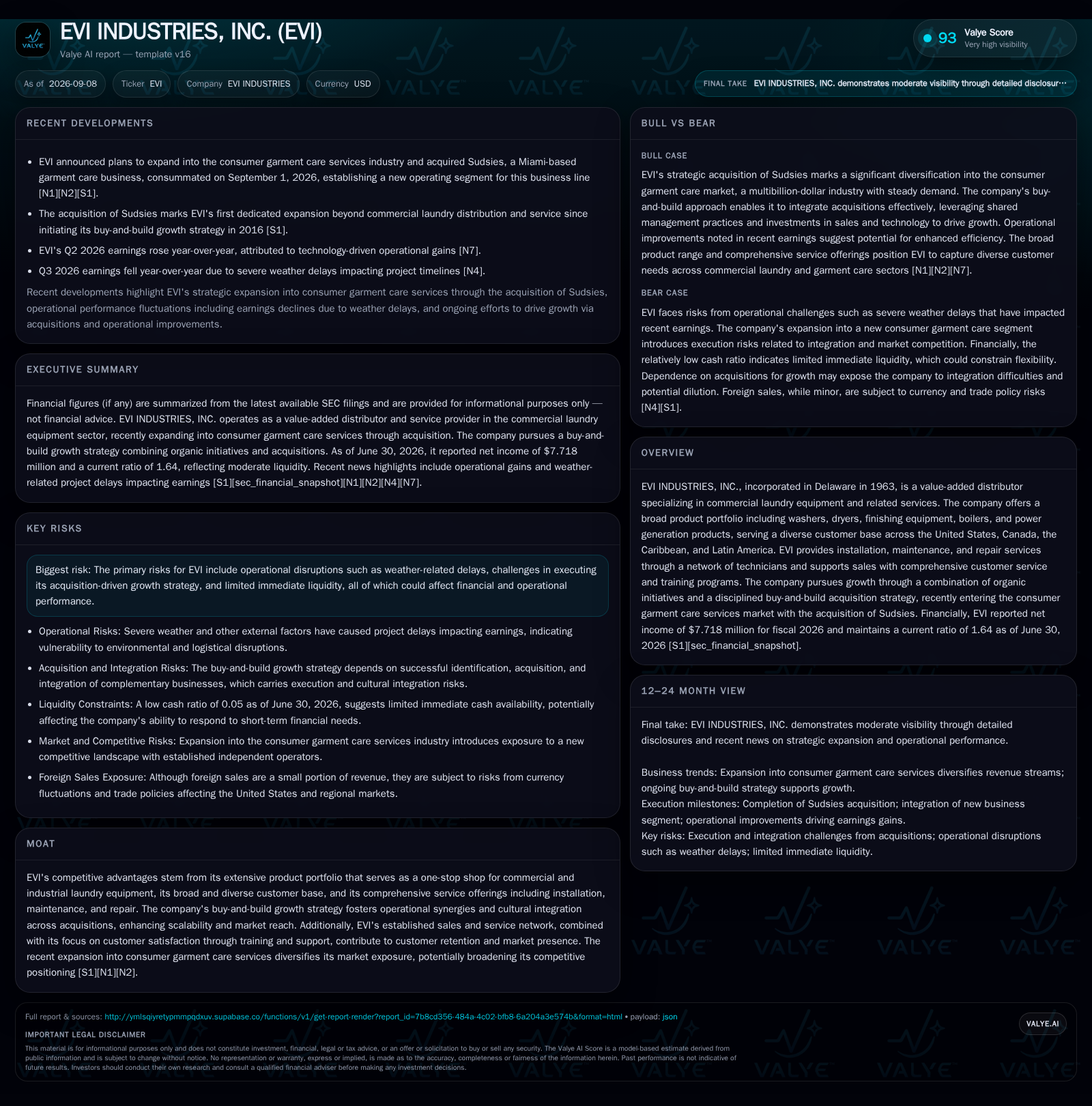
EVI Industries has diversified beyond commercial laundry with its $37.4M acquisition of Sudsies, entering the consumer garment care market—a sector characterized by recurring demand and highly fragmented competition. While EVI’s buy-and-build strategy and operational improvements have driven past earnings growth, the new segment introduces integration risks and liquidity pressures, given a low cash ratio (0.05) despite a solid current ratio (1.64). The company’s long-term trajectory will hinge on its ability to scale the consumer business, realize cross-segment synergies, and navigate the capital demands of continued acquisition-led growth. [S1] [N1] [N2] [N7]
EVI Industries’ $37.4 million acquisition of Sudsies marks a decisive move to diversify beyond its established commercial laundry equipment distribution and service platform. This expansion into consumer garment care—an industry defined by recurring demand but dominated by small, local operators—could unlock new growth vectors and recurring revenue streams. However, the transition brings fresh integration and execution risks, especially given EVI’s modest cash reserves and the operational complexities of uniting disparate business models. The company’s future now hinges on its ability to leverage buy-and-build discipline, drive operational improvements, and manage capital prudently as it pursues national scale in both commercial and consumer laundry markets. [S1] [N2]
Sudden Expansion: Sudsies Acquisition Redefines EVI’s Strategic Scope
EVI Industries’ acquisition of Sudsies for $37.4 million on September 1, 2026, marks its first foray into the consumer garment care sector, establishing a new operating division distinct from its commercial laundry equipment and service core. This move is significant as it broadens EVI’s addressable market into a multibillion-dollar, highly fragmented industry characterized by steady, recurring demand and dominated by independent, family-owned operators. The company now serves approximately 55,000 customers, primarily in the U.S., Canada, the Caribbean, and Latin America, but the Sudsies deal positions EVI to target direct-to-consumer revenue streams for the first time. [S1] [N1] [N2]
Financially, as of June 30, 2026, EVI reported net income of $7.718 million and maintained a current ratio of 1.64, but its cash ratio was just 0.05, highlighting limited immediate liquidity. Operationally, recent quarters have seen both earnings gains tied to technology-driven improvements and earnings declines due to weather-related project delays, underscoring the volatility inherent in EVI’s project-driven commercial business. [N4] [N7]
How EVI’s Model May Shift: From Equipment Distribution to Service Recurrence
EVI’s legacy economics are rooted in value-added distribution—selling, leasing, and servicing commercial laundry equipment along with related parts and accessories. Revenue is driven by equipment sales (potentially lumpy and project-based), recurring maintenance and repair contracts, and ancillary services such as installation and training. These activities tend to involve moderate gross margins, with operating leverage achievable as service and distribution networks scale. Working capital needs are significant, as inventory, receivables, and project execution tie up capital, and the company’s cash ratio signals little buffer for shocks or opportunistic investments.
The Sudsies acquisition introduces a new economic layer: consumer garment care services. This segment is typically characterized by higher revenue recurrence, as consumers regularly require cleaning, alterations, and repairs. However, margins can be compressed by labor intensity and local competition. If EVI can professionalize and scale these operations—standardizing processes, leveraging procurement, and cross-selling to commercial clients—it may unlock higher-margin, more predictable cash flows. The critical unknown is the pace and cost of integrating a fragmented, service-heavy business into EVI’s more transactional, equipment-focused model. Success could lead to a mix shift toward services, enhancing revenue stability but increasing execution complexity.
Fragmented Markets and One-Stop Ambitions: Where EVI Stands
EVI’s traditional competitive position is anchored in its broad product portfolio, one-stop shop model, and comprehensive service offerings for commercial laundry customers. This breadth, combined with experienced sales and service personnel, supports customer retention and cross-selling. In the commercial segment, EVI competes with other regional and national distributors, equipment manufacturers with direct sales channels, and local service providers.
The consumer garment care industry, newly entered via Sudsies, poses a different challenge. This market is highly fragmented, with most competition coming from small, independent operators lacking scale or significant brand presence. EVI’s stated ambition is to build a national-scale business in this field, but doing so requires not only acquisition and integration of local operators, but also differentiation through service quality, technology adoption, and possibly brand-building. The question is whether EVI’s operational playbook—successful in commercial distribution—can translate to a consumer-facing, service-centric market where switching costs are low and local relationships matter. Substitution risk is moderate: while technology could automate some garment care tasks, the core service is likely to remain labor-intensive and location-bound.
If Integration Delivers: Recurring Revenue and Multi-Segment Synergies
In a favorable scenario, EVI successfully integrates Sudsies, professionalizing and scaling the consumer garment care business while maintaining operational discipline in its commercial core. The company leverages its procurement, technology, and management systems to improve margins and service consistency at acquired consumer operations. Cross-segment synergies—such as shared logistics, unified customer service, and cross-marketing between commercial and consumer clients—could further enhance efficiency and open new revenue streams.
Evidence supporting this scenario would include: rising consumer segment revenues, improved operating margins, successful expansion into new metropolitan areas via further acquisitions, and stable or rising free cash flow despite ongoing M&A. A shift in revenue mix toward recurring service contracts and visible customer retention rates in the consumer segment would further validate the thesis. If EVI can establish a recognizable consumer brand or unique service offering, it may capture share from fragmented local competition and command premium pricing.
Incremental Progress with Integration Hurdles and Capital Constraints
The most plausible outcome is that EVI achieves moderate growth by integrating Sudsies and pursuing further acquisitions, but faces typical buy-and-build hurdles: integration friction, cultural alignment challenges, and the slow professionalization of acquired consumer operations. Revenue becomes more diversified, but margin improvement is gradual as the company invests in systems, personnel, and process upgrades.
Liquidity constraints—reflected in the low cash ratio—may force EVI to pace acquisitions conservatively or seek external financing, potentially diluting returns. Commercial operations remain susceptible to project delays (e.g., weather disruptions), while the consumer segment requires ongoing investment to standardize and scale. The result is a business that grows in breadth but sees only incremental improvement in earnings quality and predictability unless integration and execution are especially strong. Confirmation would come from steady, if unspectacular, revenue and earnings growth, and evidence of improving but not yet industry-leading margins.
When Buy-and-Build Stalls: Integration Risks and Liquidity Pinch
In a negative scenario, EVI’s expansion into consumer garment care proves more disruptive than accretive. Integration of Sudsies and any subsequent acquisitions could be hampered by cultural mismatches, operational missteps, or inability to professionalize local businesses. Consumer customers, less sticky than institutional clients, may prove difficult to retain or upsell, especially if service quality or local reputation suffers during transition. Meanwhile, commercial project delays (e.g., from weather or supply chain issues) continue to cause earnings volatility.
Liquidity stress becomes acute if operating cash flows are insufficient to cover working capital needs or acquisition outlays, especially given the current low cash buffer. The company could face the need to raise expensive external capital or curtail its growth ambitions. Downside evidence would include integration setbacks, margin compression, customer attrition in the consumer segment, rising debt, or an inability to fund new acquisitions without dilutive financing.
What Will Test EVI’s Buy-and-Build Consumer Expansion Thesis
Revenue growth and margin trajectory in the consumer garment care segment post-Sudsies acquisition—if disclosed—will help gauge integration success and recurring revenue potential.
Operating cash flow generation versus working capital and acquisition funding needs, highlighting whether the business can self-fund its expansion or will require outside capital.
Pace, size, and terms of any additional consumer garment care acquisitions, including whether EVI can maintain discipline and avoid overpaying in a fragmented market.
Customer retention and satisfaction metrics in the consumer segment—a useful metric would be churn rate or net promoter score compared to industry norms.
Progress on cross-segment synergies, such as shared logistics, procurement, or technology platforms, and whether these drive measurable efficiency gains.
Gross and operating margin trends across both commercial and consumer segments, indicating whether integration and scale are translating into profitability improvements.
Liquidity ratios and short-term debt levels, especially after acquisition outlays, to monitor for any emerging capital constraints.
Evidence of brand development or national account wins in consumer garment care, as signs of progress toward scale and differentiation.
Disclaimer: This is research-only, informational analysis and not investment advice. It may include AI-generated interpretation and general industry context. Always verify important details using primary sources.

Comments