
EvoAir Holdings Advances Eco-Friendly HVAC Amid Liquidity Challenges and Market Expansion
The company focuses on eco-friendly HVAC technologies in Asia while navigating financial constraints and diverse growth initiatives.
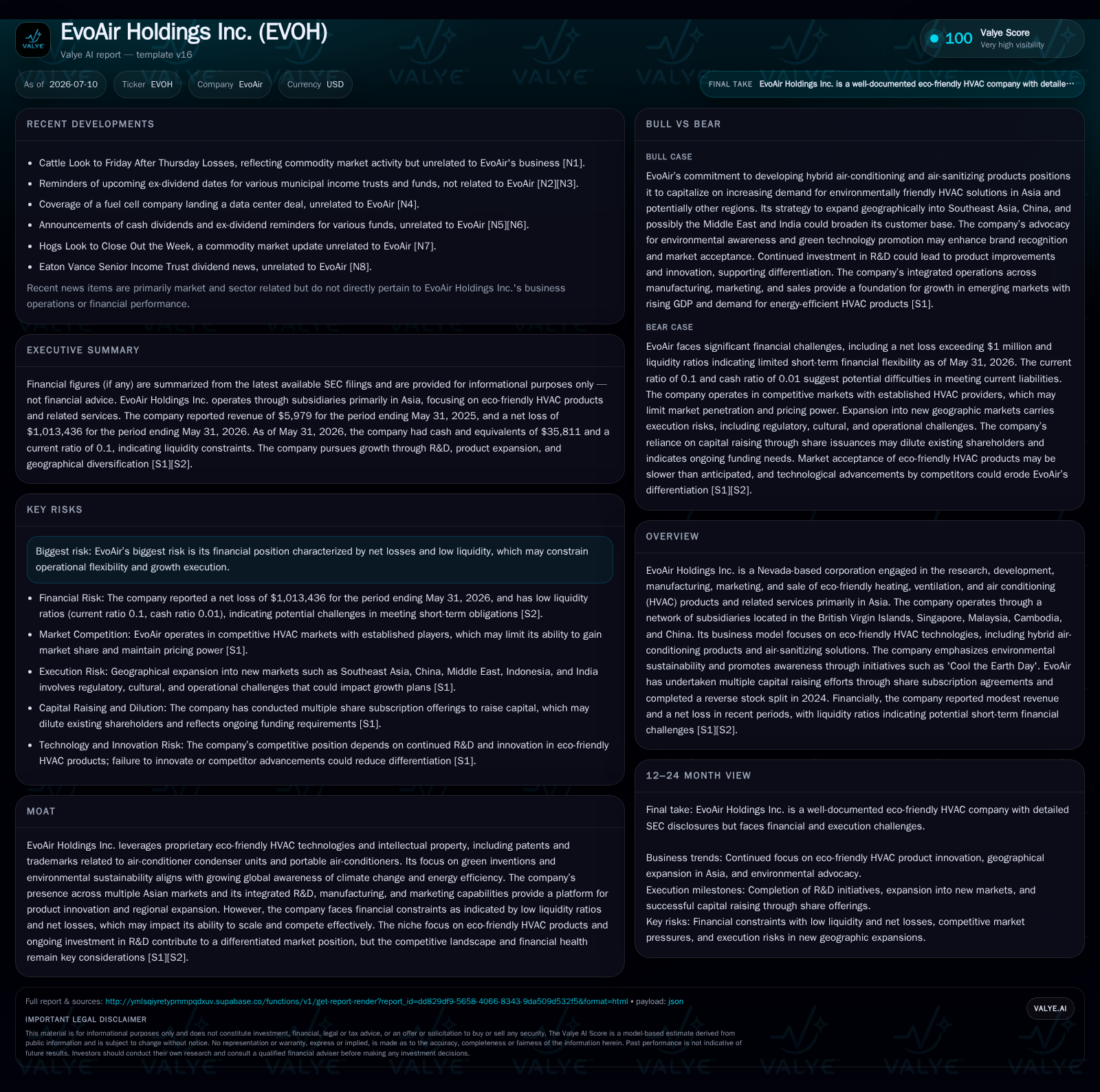
EvoAir Holdings Inc. reported continued development of its eco-friendly HVAC product lines and geographic footprint across Asia as of the latest quarter ending May 31, 2026 [S2]. Despite modest revenue generation, the company operates with a very low current ratio and ongoing net losses that highlight liquidity constraints [F1]. Its business model combines proprietary green HVAC innovations with OEM partnerships, manufacturing plants in Malaysia and China, and targeted sustainability branding, positioning it ahead in an emerging but capital-intensive segment [S1]. Key risks remain in scaling operations amid financial limitations, but management is pursuing market diversification and Nasdaq uplisting to support growth [S2,S11].
Recent Operating Update
EvoAir Holdings' latest quarterly filing through May 31, 2026, emphasizes a strategic push toward revenue diversification across varying customer segments including retail, commercial, industrial clients as well as private label and licensing opportunities [S2]. This indicates a shift from reliance on a narrow clientele to a broader base addressing multiple market niches—a critical move given the capital-intensive nature of HVAC manufacturing. However, the filing also confirms sustained net losses continuing prior trends and liquidity pressure evidenced by a dismal current ratio of approximately 0.1 at period-end May 2026 versus liabilities significantly exceeding current assets [F1]. This reflects working capital challenges that could constrain day-to-day operations unless remedied by fundraising or operational improvements.
Business Model Overview
EvoAir designs, manufactures, markets, and sells eco-friendly heating, ventilation, and air conditioning (HVAC) products primarily across Asian markets through a network of subsidiaries strategically placed in Malaysia (EvoAir Manufacturing) and China (WKL Guanzhe Green Technology Guangzhou) among others [S1]. The company’s core offerings focus on hybrid air-conditioning technologies—such as its EvoAir™ Coolpressor line—and portable air-conditioners under the e-Cond EVO™ brand supported by proprietary patents covering condenser units and related components.
Revenue generation arises from direct sales of branded HVAC equipment supplemented by OEM partnerships producing complementary indoor blower units for integrated system solutions. This dual channel approach combines product sales with licensing/OEM arrangements that could diversify revenue streams if scaled effectively. The firm also commits to sustainability branding programs such as “Cool the Earth Day” to cultivate an environmental image aligned with evolving regulatory demands for energy efficiency.
Industry Structure and Competitive Positioning
Within the eco-friendly HVAC equipment manufacturing industry—a sector characterized by high fixed costs in R&D innovation and manufacturing plants—EvoAir competes against established global peers such as Daikin Industries, Mitsubishi Electric, Carrier Global Corporation, Johnson Controls, and Lennox International; firms known for deeper pockets, expansive distribution networks, strong brand equity, broader product portfolios, and substantial R&D budgets.
Despite scale disadvantages reflected in modest revenues (~$135K reported for fiscal year ending August 2024) compared to these giants [F1], EvoAir’s geographic focus on fast-growing Southeast Asian markets combined with a patent-backed product niche positions it within a growing subsegment fueled by rising climate awareness and tightening energy regulations. However, its ability to effectively utilize manufacturing capacity (approximately 30,000 square feet split between Malaysian and Chinese facilities) remains an open question since evidence suggests fragile operating margins exacerbated by small scale production [S1].
Growth Drivers
Multiple factors underlie EvoAir’s growth strategy. First is geographic expansion: Management targets replication of its existing business model deeper into Southeast Asia as well as exploratory moves into India and the Middle East—markets experiencing urbanization-led demand for energy-efficient HVAC systems [S23].
Second is product line enhancement to broaden offerings meeting diverse climate control needs beyond core condenser units — potentially increasing average selling prices (ASP) and improving margin profiles [S2,S11]. Third is revenue stream diversification via engagement with project-based clients alongside retail/commercial customers plus licensing deals aimed at leveraging intellectual property without proportional capital expenditure increases
These initiatives respond directly to observed industry drivers such as government incentives promoting green technology adoption and rising corporate environmental responsibility commitments.
Risks & Watchpoints
Additionally, competition from large incumbents presenting advanced hybrid systems could erode pricing power or hamper market share gains outside current niche segments. Regulatory environments—while supportive via energy standards—may also impose costly compliance or slow time-to-market hurdles amid rapid technological obsolescence risks.
Finally, dependence on OEM partners requires careful management since these relationships influence distribution breadth but also expose EvoAir to potential contract concentration or renegotiation challenges affecting order backlog stability.
What to Watch Next
Upcoming milestones include monitoring sequential changes in order backlog volumes linked to diversified customer segments cited in recent management commentary [S2], which would confirm progress on revenue broadening strategies. Observing improvements in operating income would signal enhanced cost control or scale benefits materializing from capacity utilization gains in Malaysia/China plants.
Additionally, tracking whether the planned Nasdaq Capital Market uplisting yields tangible capital inflows will be key for alleviating liquidity constraints permitting intensified R&D investments or marketing expenditures needed to build market share [S11,S17]. Product launch announcements relating to updated hybrid or portable green HVAC models will further indicate pipeline vitality compared to peer innovation levels.
Financial Profile Discussion
As of May 31, 2026 balance sheet data illustrate significant financial stress: cash & equivalents stood at $35.8K against current liabilities over $4.4 million resulting in a critically low current ratio approximated at 0.1—dramatically below industry norms where ratios near or above 1 are standard for operational continuity [F1]. Persistent net losses exceeding $14 million recorded up to August 2025 compound concerns about solvency absent imminent financing actions [F1,S17].
Despite these headwinds, incremental capital raises through share subscription agreements since late 2021 alongside equity injections into subsidiaries support short-term funding needs though not yet sufficient for sustained growth acceleration [S5,S21]
This analysis synthesizes EvoAir Holdings’ latest regulatory disclosures to offer insight into its evolving position within the eco-friendly HVAC sector. While strategic initiatives around product innovation and geographic diversification address meaningful market opportunities related to energy efficiency trends in Asia-Pacific regions, ability to overcome liquidity bottlenecks presents a critical challenge for translating potential into scalable financial performance. Investors should focus on upcoming operational KPIs tied to order volume expansion and balance sheet strengthening events as directional indicators.
Disclaimer: This report does not constitute investment advice but aims solely at providing an informed company & industry analysis based on publicly available filings.
Disclaimer: This is research-only, informational analysis and not investment advice. It may include AI-generated interpretation and general industry context. Always verify important details using primary sources.

Comments