
Digital Transition and Institutional Sales Cycles Shape Educational Development Corp's Outlook
EDUC’s latest quarterly results highlight ongoing profitability pressures amid strong liquidity in a shifting educational publishing landscape.
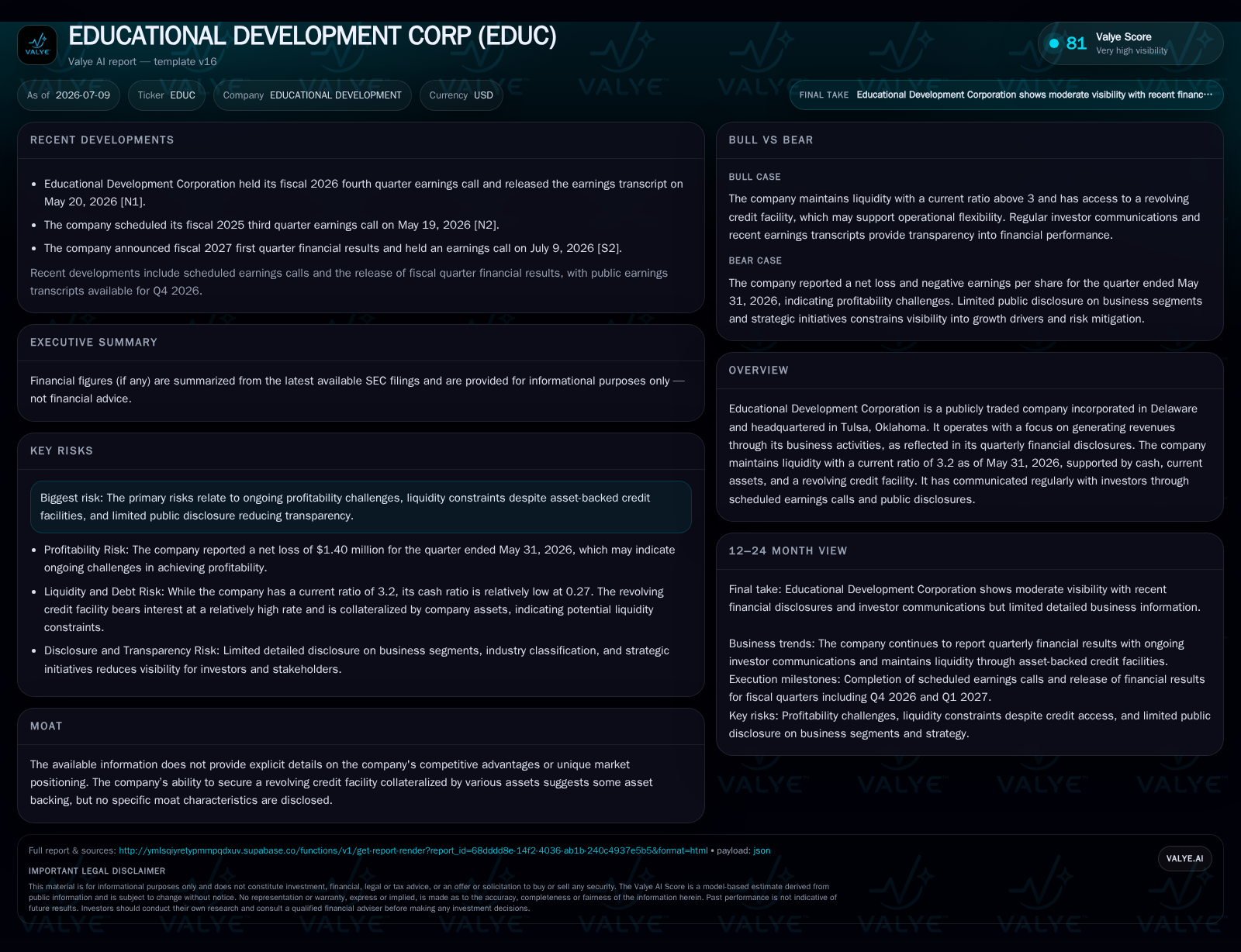
Educational Development Corporation’s fiscal 2027 Q1 report reveals continuing net losses despite a healthy current ratio of 3.2, underscoring profitability challenges common in the educational publishing industry’s digital transition. The company’s revenue streams balance direct-to-consumer sales, institutional contracts, and licensing agreements, all influenced by cyclical purchasing patterns and evolving product mixes from print to digital learning materials. While liquidity is bolstered by asset-backed revolving credit facilities and cash reserves, margin pressure from digital adoption and institutional budget cycles remain key constraints shaping near-term performance.
Q1 Fiscal 2027 Results Confirm Lingering Profitability Pressures Amid Solid Liquidity
Educational Development Corporation's fiscal 2027 first quarter financial disclosures reaffirm its position within the challenging low-margin educational publishing sector. As of May 31, 2026, the company reports a robust current ratio of approximately 3.2 supported by $19.4 million in current assets against $6.06 million in current liabilities [F1]. Despite this liquidity cushion, EDUC continues to grapple with operational profitability headwinds reflected in a net loss around $3.1 million for the quarter ended February 28, 2026 [F1],[S2]. This juxtaposition illustrates the firm’s capacity to fund near-term operations but underscores persistent earnings pressure common among publishers navigating the incremental costs of digital transition.
The solidity in liquidity stems partially from its revolving credit arrangement secured against receivables, inventory, fixed assets, and land [S16], which frames financial flexibility important in managing working capital amid fluctuating institutional payment cycles. However, ongoing net losses persist despite this buffer highlighting structural headwinds linked to evolving product economics.
Navigating Revenue Streams: Balancing Institutional Sales, Direct Consumers, and Licensing Income
EDUC derives revenue through multiple channels consistent with educational publishing norms: direct sales to consumers (e.g., retail book buyers), substantial institutional contracts with schools and libraries that align closely with curricular mandates, and licensing or royalty agreements granting usage rights to educational content [S1]. This diversification reflects sector-standard monetization approaches intended to mitigate concentration but remains sensitive to buyer behavior.
Institutional purchasing introduces pronounced cyclicality given reliance on academic calendar budgeting cycles and curriculum standard updates that dictate timing of bulk orders. This often leads to lumpy revenue realization across quarters—a known phenomenon among peers such as Scholastic Corporation. CUSTOMER CONCENTRATION risks are embedded in these dynamics since delayed school budgets or funding shifts can materially impact order flows.
Licensing revenues offer supplementary income streams but face competitive pressures from proliferating free or low-cost digital content platforms undermining pricing power. Royalty agreements contribute incremental margins but their extent relative to core print/digital sales varies depending on contract portfolio and content appeal.
Print Legacy Meets Digital Disruption: Implications for EDUC's Product Mix and Margins
Like many education-focused publishers transitioning from traditional print-heavy portfolios toward digital learning materials integration, EDUC encounters margin dilution risks endemic in this evolution. Print publishing entails significant fixed production and distribution costs yet benefits from established workflows; conversely digital materials promise lower per-unit fulfillment costs but require upfront investments in technology platforms, content adaptation, and user engagement tools.
This product mix shift inexorably affects gross margin profiles—digital formats tend to exert downward pressure because while material cost is lower per unit shipped/downloaded, developmental expenses elevate R&D spending creating operating leverage challenges. Peers such as Houghton Mifflin Harcourt and McGraw Hill report similar patterns where blended portfolio strategies seek equilibrium between stable print licensing revenues and growth-oriented digital subscriptions or services.
EDUC’s filings hint at ongoing efforts balancing these competing demands without specifying exact segment metrics [S1],[S2], leaving margin trajectory an important operational marker going forward.
Competitive Dynamics: EDUC in Context of Major Educational Publishers’ Digital Transitions
Although EDUC operates on a smaller scale relative to titans like Pearson PLC or Scholastic Corporation, it contends within a fragmented market landscape featuring intensified digital disruption. Large incumbents aggressively invest in proprietary educational technology platforms integrating adaptive learning tools aimed at K-12 districts—shifts creating pricing pressure on traditional content-focused providers.
Moreover, channel diversification away from solely bookstore wholesalers toward online retailers or direct institutional contracts expands distribution complexity. The threat from open educational resources (OER) further compresses pricing power especially for digital content licenses.
Competitively, EDUC must negotiate these sector-wide trends without evident scale advantages or unique moat disclosures; this implies reliance on efficient cost structures, niche content appeal or client relationships for differentiation—as are typical levers for small-to-mid-tier peers adapting to such environments.
Drivers Powering Growth Potential: Curriculum Changes, Digital Adoption, and Market Expansion
Growth vectors for firms like EDUC usually derive from external demand catalysts including frequent curriculum standards revisions requiring updated materials—these mandate republishing cycles ensuring recurrent revenue opportunities. Additionally, rising penetration of digital learning platforms in schools expands addressable markets for multimedia offerings beyond print catalogs.
Broader market expansions into lifelong learning segments or professional development present emerging avenues supported by government funding increments targeting education modernization. Although no company-specific initiatives are detailed here due to lack of direct evidence [S1], these macro drivers form foundational assumptions underpinning sector optimism.
Subscription models or partnerships with edtech companies remain promising but unconfirmed revenue sources that could supplement cyclical institutional contract volatility over time.
Risks from Demand Concentration, Inventory Management, and Pricing Pressures Under Watch
Key risks inherent in EDUC’s environment include elevated customer concentration where sizable institutional purchasers influence revenue stability; slow receivables turnover linked with public education funding delays present working capital stress possibilities [S19],[S2]. Inventory management complexity escalates amid shifts between physical books—which require warehousing—and digitally deliverable products that bypass inventory but involve technological upkeep.
Pricing challenges intensify as online retailers exercise discounting power while free/open content alternatives erode license fee elasticity. Legislative or regulatory shifts impacting curriculum standards can suddenly alter demand profiles necessitating agile content development cycles.
These factors collectively tighten gross margins and heighten return rates—an operational KPI meriting continuous monitoring given its impact on both top-line durability and capital efficiency.
"Signals to Track": Upcoming Guidance, Milestones, and Execution Benchmarks for Fiscal Year Progression
Critical indicators for evaluating EDUC’s trajectory will include segmentation trends showing growth acceleration in digital product revenue versus traditional print sales; progression toward improved gross margins signaling successful cost absorption related to new media formats; improvements in accounts receivable turnover reflecting stabilized institutional payor behavior; alongside sequential volume upticks aligned with procurement calendars.
The company maintains investor communication rhythm through quarterly earnings calls as confirmed by filings dated July 9, 2026 [S3], providing venues where management may disclose progress on strategic initiatives such as channel diversification or licensing expansions.
Monitoring these operational markers will clarify whether digital adoption efforts translate into sustainable cash flow improvements mitigating legacy model erosion effects.
Financial Profile Discussion: Liquidity Balance Sheet Strength with Ongoing Net Loss Challenges
Educational Development Corporation reports zero long-term debt as of February 28, 2026 combined with a cash & equivalents balance exceeding $1.66 million as of May 31, 2026 supporting a strong liquidity posture despite operating losses [F1].[S2] This absence of leverage reduces financial risk enabling flexibility in navigating uneven demand cycles inherent in educational publishing.
However,the recurring net loss near $3.1 million during the same period underlines ongoing profitability constraints emblematic of industry-wide low margin structures exacerbated by investments into digital content transitions. Sustained negative earnings compound working capital pressures notwithstanding the revolving credit facility collateralized by various assets established March 6, 2026 [S16], underscoring the importance of monitoring operational cash flow conversions closely over coming periods.
In summary,the interplay between robust liquidity measures and persistent net income deficits paints a nuanced picture requiring careful execution against evolving market demands contrasted with fixed cost absorption from legacy operations.
This analysis integrates recent SEC disclosures alongside broader industry context defining Educational Development Corporation's operating environment without presuming company-unique proprietary advantages absent direct evidence. The steady liquefaction accompanied by profit challenges aligns EDUC's profile with typical mid-market players negotiating the transition from print-centric models toward digitally enhanced educational offerings amid cyclically sensitive institutional demand patterns.
Investors should observe forthcoming quarterly updates focused on revenue segmentation shifts,kpi trends around margin expansion,and the efficacy of diversified distribution strategies relative to established peer benchmarks within educational publishing sectors.
Disclaimer: This is research-only, informational analysis and not investment advice. It may include AI-generated interpretation and general industry context. Always verify important details using primary sources.

Comments