
EACO CORP's Industrial Hardware Distribution Strength Amid Stable Liquidity and Currency Risks
Recent quarterly results highlight EACO CORP’s solid revenue generation in industrial hardware distribution, supported by a broad product portfolio and geographic reach.
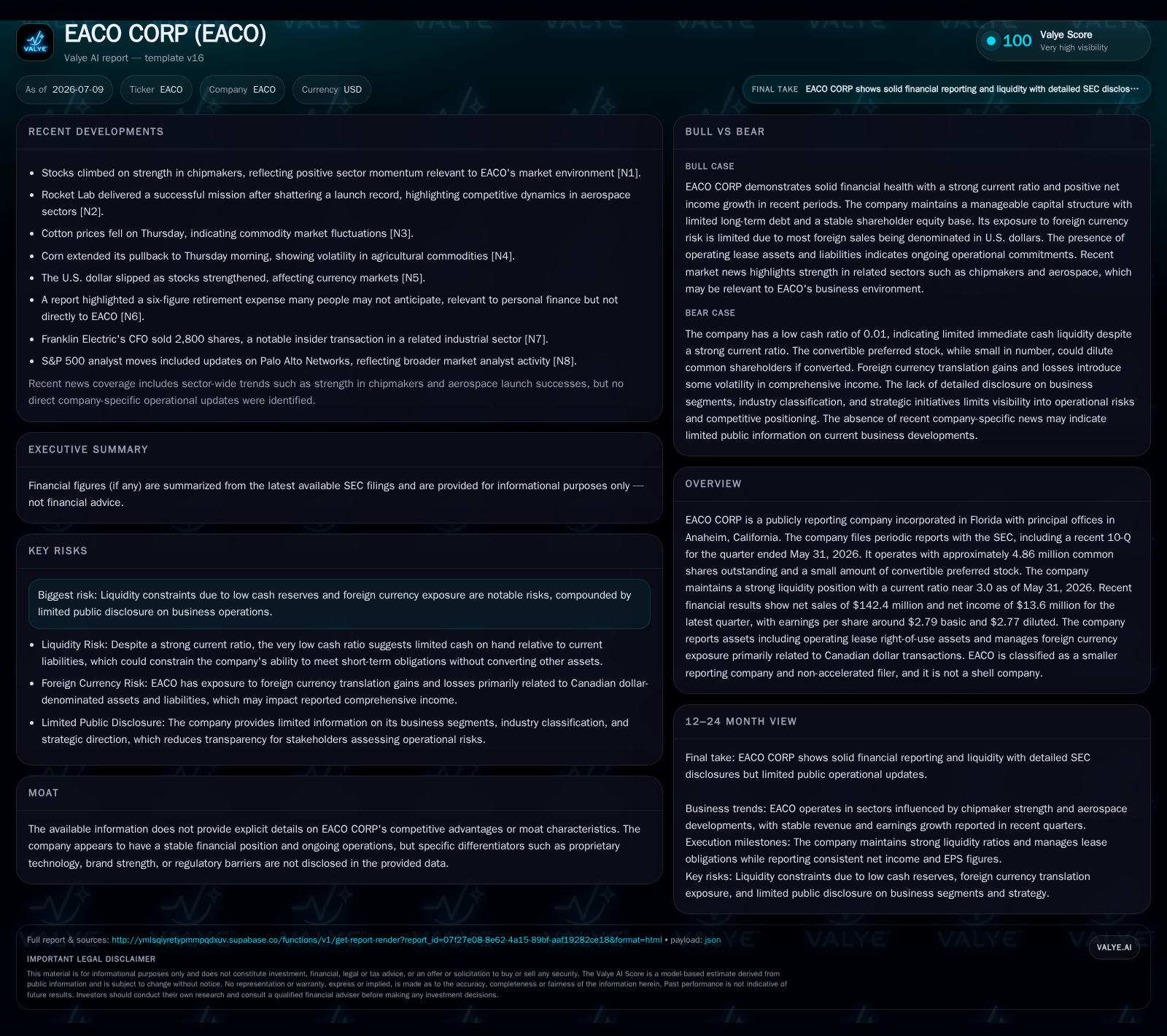
EACO CORP reported net sales of $142.4 million and net income of $13.6 million for the quarter ended May 31, 2026, underpinned by its operations as a distributor of electronic components and fasteners serving diverse manufacturing sectors. The company maintains a healthy liquidity profile with a current ratio near 3.0 but faces ongoing foreign currency exposure primarily from Canadian dollar transactions. Its business model hinges on efficient supply chain management across multiple sales offices and distribution centers in North America, with expansion potential tied to manufacturing sector demand and operational efficiency. Key risks include currency fluctuations, inventory management challenges amid technology shifts, and limited transparency on competitive differentiation.
Recent Operating Update
EACO CORP’s third quarter fiscal 2026 results, for the period ended May 31, 2026, demonstrate operational stability with net sales of approximately $142.4 million and net income of $13.6 million, or about $2.79 per basic share [S2], [S3]. These results reflect steady demand across its industrial hardware distribution portfolio, primarily managed through its wholly-owned subsidiary, Bisco Industries. Bisco operates an extensive network comprising 51 sales offices and seven distribution centers strategically located across the United States and Canada, complemented by international sales offices in the Philippines and Mexico, enabling broad geographic coverage and access to diverse manufacturing sectors [S1], [S14].
EACO’s revenue recognition aligns with standard industrial distribution practices: contracts are established via customer purchase orders, and revenue is recognized upon shipment of physical products such as electronic components and fasteners, emphasizing a transactional sales model rather than recurring or service-based revenue streams [S2]
Business Model: Downstream Distribution with Emphasis on Supply Chain Efficiency
EACO operates as a downstream distributor within the industrial hardware supply chain, sourcing electronic components and fasteners from manufacturers and reselling them to end-user manufacturers across multiple sectors including aerospace, communications equipment fabrication, marine, circuit board production, instrumentation, computer hardware, and general industrial equipment [S14], [S7]. This diversified customer base helps mitigate sector-specific cyclicality and leverages economies of scale through inventory pooling and logistics coordination.
The company’s monetization relies heavily on volume throughput, underpinned by efficient supply chain management. High inventory turnover ratios enable rapid replenishment cycles while maintaining sufficient safety stock to ensure reliable order fulfillment. The distribution centers play a critical role in minimizing lead times, which is vital for customers employing just-in-time (JIT) manufacturing strategies that reduce their working capital tied up in inventories.
Revenue growth drivers include expanding the active customer base, increasing average transaction sizes through upselling higher-margin products such as specialized fasteners or advanced electronic components, improving order fill rates via logistics enhancements, and geographic expansion to access new markets [S2]. Contract terms typically involve standard purchase orders with revenue recognized at shipment, making operational efficiency and inventory management key levers for profitability
Industry Structure and Competitive Positioning
Within the industrial hardware distribution sector, EACO competes alongside established players such as WESCO International (broad industrial supplies), Anixter International (electronic components), Fastenal Company (fasteners and industrial supplies), Arrow Electronics (electronic components), and Avnet, Inc. (component supply chain solutions). Competition is primarily based on breadth and depth of product portfolio, geographic reach, service levels including technical support for complex components, and logistics capabilities.
EACO’s scale, with over 50 sales offices and multiple distribution centers, provides a competitive advantage over smaller regional distributors by enabling better inventory availability and shorter lead times. The company manages a single operating segment, reflecting an integrated approach to resource allocation and performance evaluation across its consolidated distribution business [S20]. While no proprietary technology or unique intellectual property is disclosed, the company’s extensive footprint and service capabilities contribute to its competitive positioning.
Growth Drivers and Key Performance Indicators
Several structural growth vectors align with EACO’s business model:
- Expansion in Served Manufacturing Sectors: Increasing complexity and automation in aerospace, communications, and industrial equipment sectors drive demand for specialized fasteners and electronic components.
- Adoption of Just-in-Time Inventory Models: Customers’ focus on lean inventories creates opportunities for distributors who can provide reliable, multi-location stocking and responsive logistics.
- Geographic Footprint Expansion: Growth potential exists in extending presence beyond North America into emerging markets in Asia-Pacific and Latin America.
- Product Portfolio Diversification: Introducing higher-margin product lines and value-added services can enhance gross margins and average transaction sizes.
- Supply Chain and Logistics Enhancements: Investments in warehouse automation and digital order management improve order fill rates and reduce days inventory outstanding (DIO), positively impacting cash flow.
Key operating metrics to monitor include revenue growth driven by customer acquisition and wallet share expansion, gross margin stability or improvement reflecting pricing and product mix, inventory turnover ratios indicating supply chain efficiency, order fill rates as a measure of customer service, and the size of the active customer base reflecting market penetration.
Risks and Operational Challenges
EACO faces several risks inherent to the industrial hardware distribution sector:
- Foreign Currency Exposure: Approximately 25% to 28% of international sales are denominated in Canadian dollars, exposing earnings to USD/CAD exchange rate fluctuations that can affect reported revenues and margins [S11], [S20]. The remainder of foreign sales are in U.S. dollars, mitigating broader FX risk.
- Inventory Obsolescence: Rapid technological changes in electronic components pose risks of inventory aging and obsolescence. Effective demand forecasting and provisioning policies are essential to manage markdowns and write-offs [S23].
- Pricing Pressure: The fragmented distribution market exerts competitive pricing pressure, necessitating operational efficiency in procurement and cost control to maintain margins.
- Liquidity and Leverage: While liquidity remains strong with a current ratio near 3.0, cash balances are relatively modest at $758,000 against total debt of approximately $4.1 million, resulting in net debt near $3.36 million [F1], [S2]. This leverage level requires prudent working capital management to avoid liquidity strain.
- Limited Differentiation: The absence of disclosed proprietary capabilities or unique competitive advantages may limit defensibility against aggressive competitors.
What to Watch Going Forward
- Quarterly revenue trends relative to end-market demand in aerospace, electronics, and industrial sectors to gauge structural growth sustainability.
- Inventory turnover and days inventory outstanding metrics as indicators of supply chain agility and obsolescence risk management.
- Management commentary on foreign currency hedging strategies and their effectiveness in mitigating CAD-related earnings volatility.
- Announcements regarding geographic expansion, including new sales office openings or entry into emerging markets.
- Gross margin trends reflecting shifts toward higher-margin specialized products versus commodity hardware.
- Operating income stability as a measure of cost discipline amid inflationary pressures.
Financial Profile and Capital Structure
EACO maintains a well-capitalized financial position suitable for an industrial hardware distributor managing significant working capital tied up in inventory. As of May 31, 2026, the company reported cash and equivalents of $758,000 and total debt of approximately $4.1 million, resulting in net debt of about $3.36 million [F1]. Current assets stood at roughly $220 million against current liabilities near $73.6 million, yielding a current ratio of approximately 2.99, which supports operational liquidity and short-term obligations [F1], [S2].
The company’s capital structure reflects moderate leverage consistent with sector norms, balancing the need to finance inventory and receivables with maintaining financial flexibility. Operational cash flows have benefited from disciplined accounts payable management and limited accruals, contributing to a cleaner balance sheet [S16]. This financial foundation positions EACO to pursue growth initiatives, including geographic expansion and supply chain investments, provided external economic conditions remain favorable.
This analysis is based on SEC filings through July 9, 2026, including the latest quarterly Form 10-Q and related event filings. It integrates operational, financial, and strategic insights grounded in verified data without speculative forward-looking statements.
Financial Snapshot
As of May 31, 2026, EACO reported cash and equivalents of $758,000 and total debt of $4.1 million, resulting in net debt near $3.36 million [F1]. Current assets of $220 million and current liabilities of $73.6 million yield a current ratio of approximately 2.99x, indicating solid liquidity
Disclaimer: This is research-only, informational analysis and not investment advice. It may include AI-generated interpretation and general industry context. Always verify important details using primary sources.

Comments