
PriceSmart Expands Latin America Footprint While Managing Currency and Supply Challenges
Membership growth, supply chain enhancements, and digital investments underscore PriceSmart’s strategic progress in emerging markets.
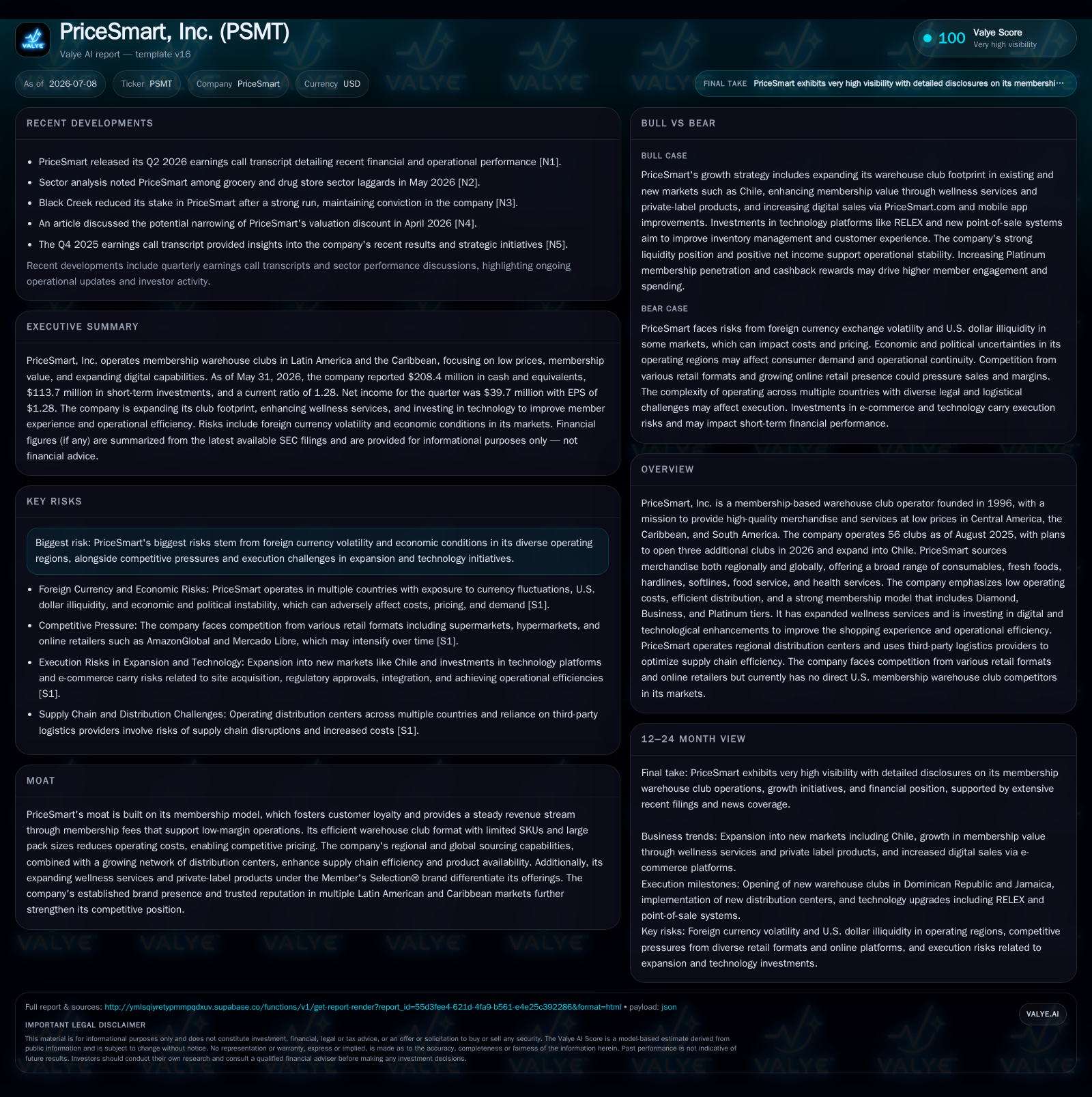
PriceSmart, a membership warehouse club operator predominantly serving Latin America and the Caribbean, reported on its third quarter 2026 operations highlighting steady expansion with three new clubs planned in Jamaica and the Dominican Republic. The company leverages its membership model alongside regional distribution centers to maintain competitive pricing amid currency volatility and inflationary pressures. Its strategy includes digital shopping enhancements and wellness service expansions, positioning it well against peers like Costco and Sam's Club. Key risks remain currency fluctuations, political instability, and execution in new market entries.
Recent Operating Update
PriceSmart's Q3 fiscal 2026 report filed July 8 underscores its continued expansion strategy with plans to open three new warehouse clubs—two in Jamaica (Montego Bay and South Camp Road) and one in the Dominican Republic (La Romana)—increasing its club count from 56 to 59 by year-end [S2][S3][S1]. These openings deepen PriceSmart’s footprint in key Caribbean markets where it already holds strong brand recognition and membership loyalty. This physical growth is supported by investments in its regional distribution center network, which enhances inventory throughput and supply chain resilience necessary to sustain bulk sales volume and competitive pricing.
The company operates in a challenging macroeconomic environment marked by persistent foreign currency volatility and inflationary pressures across its Latin American and Caribbean markets. Over 80% of PriceSmart’s merchandise sales are denominated in local currencies, exposing the company to exchange rate fluctuations against the U.S. dollar, which remains the currency for most of its imported goods procurement [S1]. Notably, U.S. dollar illiquidity in markets like Trinidad, driven by central bank currency controls, complicates the conversion of local currency receipts into dollars needed to fund imports, increasing foreign exchange risk and potentially constraining product availability [S1][S15]. PriceSmart mitigates these risks through targeted financing arrangements and strategic pricing adjustments to offset cost inflation while maintaining value for its members.
Business Model
PriceSmart operates a membership-driven warehouse club format tailored to emerging Latin American and Caribbean markets, serving over two million member accounts across tiered memberships including Diamond, Business, and Platinum levels [S1][S26]. Membership fees, which represent roughly 1.7% of net merchandise sales, contribute nearly 37% of operating income, providing a critical margin buffer that supports PriceSmart’s low retail gross margins typical of warehouse clubs [S1][S26]. This revenue stream stabilizes cash flow and underpins the company’s ability to offer bulk merchandise at prices closer to cost than traditional retailers, fostering strong customer loyalty and high membership renewal rates.
The merchandise assortment is curated to include consumables (notably fresh foods), hardlines, softlines, and health-related services, complemented by private label products such as Member’s Selection®, which enhance margins and provide differentiation in markets with limited product variety [S1][S25]. Approximately half of the merchandise is sourced regionally within Latin America and the Caribbean, supporting local supplier partnerships and reducing lead times, while the remainder is imported from global suppliers primarily in the U.S., Europe, and Asia to ensure a broad and competitive assortment [S1][S25]. This dual sourcing strategy balances local preferences with cost competitiveness and inventory turnover efficiency.
Digital transformation is a core pillar of PriceSmart’s omnichannel strategy. Its e-commerce platform, PriceSmart.com, along with mobile applications, facilitates home delivery and Click & Go® curbside pickup, addressing evolving consumer preferences for convenience and safety [S1]. These digital channels not only extend the company’s reach beyond physical clubs but also improve fulfillment cost per order and inventory management. Additionally, PriceSmart’s expansion of wellness services—including optical centers, pharmacies, and audiology clinics—adds incremental revenue streams and increases foot traffic by bundling health-related services with bulk merchandise purchases, enhancing member engagement and lifetime value [S1][S26].
Industry Structure and Competitive Position
Within the membership warehouse club retail sector, PriceSmart distinguishes itself through its focused geographic concentration on emerging Latin American and Caribbean markets, where large-scale U.S.-based operators like Costco Wholesale Corporation and Walmart’s Sam’s Club have limited presence. While PriceSmart’s scale—56 clubs with planned growth to 59—is modest compared to Costco’s global footprint, it benefits from first-mover advantages and strong brand equity in these markets, which foster high membership renewal rates and switching costs.
PriceSmart’s regional distribution centers provide supply chain agility and inventory turnover advantages over smaller local competitors lacking such infrastructure. This network supports SKU rationalization and mitigates inflation-driven cost pressures by enabling alternative shipping routes and faster merchandise throughput [S1]. Competition arises not only from international warehouse clubs but also from discount grocery chains and emerging e-commerce bulk sellers targeting price-sensitive consumers prioritizing value and assortment breadth.
Growth Drivers
PriceSmart’s growth trajectory is supported by several key drivers:
- Geographic Expansion: The addition of new warehouse clubs in Jamaica and the Dominican Republic strengthens presence in urban centers with growing middle-class populations. The company is also advancing plans to enter Chile, a market identified for multiple future clubs, which could diversify geographic risk and extend its emerging market footprint [S1].
- Membership Base Development: Growth in membership accounts, including tier upgrades, drives recurring membership fee revenue—a high-margin, predictable cash flow source. Digital platforms streamline membership sign-ups and renewals, improving retention and lifetime value [S26].
- Private Label Penetration: The Member’s Selection® private label line enhances gross margins and provides exclusive products tailored to local tastes, reducing reliance on imported branded goods and improving inventory turnover.
- Digital Shopping Enhancements: Investments in e-commerce and fulfillment capabilities reduce friction costs per order, increase average transaction size, and enable omnichannel sales growth beyond physical club visits.
- Wellness Services Expansion: Optical, pharmacy, and audiology services diversify revenue streams and increase customer traffic, differentiating PriceSmart from traditional warehouse clubs.
- Supply Chain Efficiencies: The regional distribution center network optimizes inventory turnover and shrinkage rates, mitigating inflationary cost pressures and shipping disruptions [S1].
Risks, Watchpoints, and Growth Constraints
PriceSmart’s international operations expose it to several material risks:
- Currency Volatility: Fluctuations in foreign exchange rates materially impact U.S. dollar-reported sales and profits. Persistent U.S. dollar illiquidity in certain markets constrains import funding, potentially causing product shortages or margin compression [S15][S28].
- Political Instability: Periodic civil unrest and protests, such as those recently in Panama and Guatemala, disrupt store access and reduce transaction volumes temporarily, impacting same-store sales and customer traffic [S15][N1].
- Execution Risk: Expansion into new markets like Chile involves regulatory complexities and capital investment, with success dependent on effective localization and operational execution.
- Inflationary Pressures: Rising commodity and freight costs challenge PriceSmart’s ability to pass through price increases without dampening unit sales or membership renewal rates.
- Competitive Dynamics: Growing competition from established global warehouse clubs expanding into emerging markets and from digital bulk grocery providers could pressure market share and pricing.
What To Watch Next
Key near-term milestones and metrics to monitor include:
- The successful opening and ramp-up of the three new warehouse clubs in Jamaica and the Dominican Republic during late 2026, with early sales and membership adoption rates serving as indicators of execution effectiveness.
- Membership renewal rates post-holiday season, reflecting member satisfaction amid inflationary pressures and competitive alternatives.
- Growth in digital channel sales, including online order volumes and Click & Go® curbside pickup adoption, signaling the effectiveness of omnichannel integration.
- Foreign exchange translation impacts on Q4 financial results, especially given ongoing currency volatility in Caribbean markets.
- Progress on Chile market entry, including regulatory approvals and site acquisitions, which would validate the company’s longer-term expansion strategy.
Financial Profile Discussion
As of May 31, 2026, PriceSmart held $208 million in cash and equivalents against $180 million in total debt, resulting in a net cash position of approximately $29 million and a current ratio of 1.28, indicating solid near-term liquidity and financial flexibility to support ongoing expansion and operational investments [F1]. This balance sheet strength is notable given the company’s exposure to currency and inflation risks in emerging markets and underpins its capacity to invest in distribution infrastructure, digital transformation, and wellness service expansions.
PriceSmart’s financial metrics reflect the typical membership warehouse club model, where membership fee revenue provides a stable, high-margin income stream that supports low gross margins on bulk merchandise sales. The company’s operating leverage benefits from scale economies in procurement and distribution, while inventory turnover and shrinkage management remain critical to sustaining profitability in inflationary environments.
Disclaimer: This is research-only, informational analysis and not investment advice. It may include AI-generated interpretation and general industry context. Always verify important details using primary sources.

Comments