
CHS INC Leverages Agricultural Scale and Joint Ventures to Manage Commodity Cycles
CHS INC’s July 2026 quarterly results underscore its operating scale, joint venture strategy, and liquidity management amid commodity and regulatory challenges.
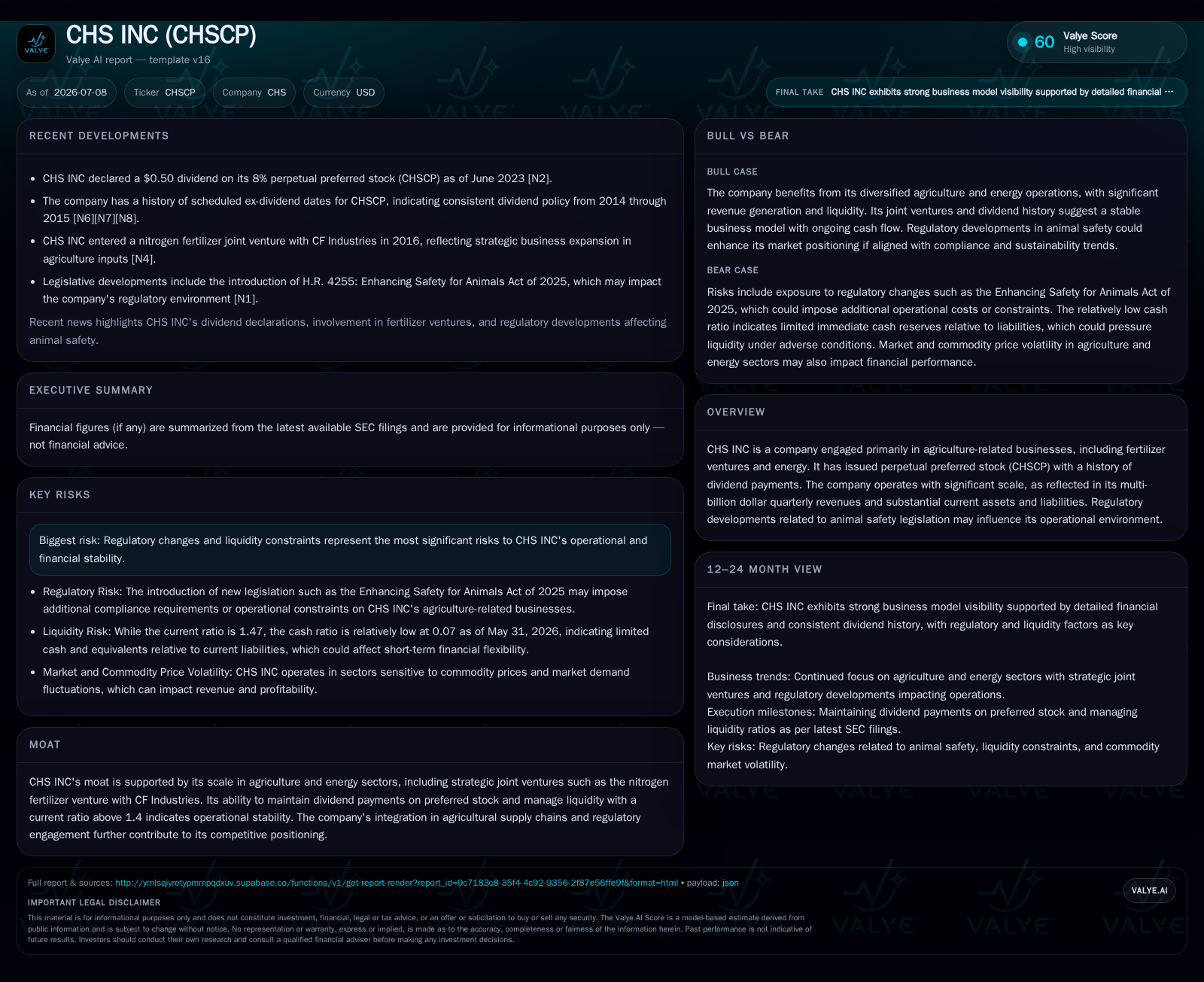
In its latest quarter, CHS INC maintained stable operating income leveraged by its diversified agriculture and energy businesses, including a key nitrogen fertilizer joint venture with CF Industries. The company's integrated supply chain supports expansive farmer and cooperative customer relationships, cushioning against cyclical commodity price swings. Despite regulatory risks linked to animal safety legislation, CHS exhibits sound liquidity with a current ratio near 1.5 and continues preferred stock dividend payments, signaling financial discipline. Upcoming metrics on production volumes and regulatory developments will be pivotal to validate ongoing resilience.
Latest Quarter Insights Confirm Scale-Focused Operating Model
CHS INC's latest quarterly filing dated July 8, 2026, confirms that the company continues to leverage its substantial scale across agriculture-related operations to sustain operating income in a challenging commodity price environment. The company reported stable operating income supported by its fertilizer production and energy segments, reflecting disciplined cost management and operational execution amid input cost inflation and market cyclicality [S2]. This stability is underpinned by CHS’s integrated supply chain and strategic joint ventures, which collectively enhance its ability to manage commodity price volatility and maintain margin resilience [F1].
Integrated Fertilizer and Energy Offerings Drive Revenue Streams
CHS generates significant revenue through its core fertilizer production—particularly nitrogen fertilizers—and energy supply services tailored for agricultural operations. Its customer base primarily consists of cooperatives and farmer groups that depend on reliable crop inputs for planting and harvesting cycles. The company’s product portfolio includes nitrogen-based fertilizers produced in partnership with CF Industries, as well as energy products that support farm operations such as fuel and propane [S2]. This integrated offering enables CHS to capture multiple value points across the agricultural supply chain, reinforcing customer loyalty through quality assurance and timely delivery despite commodity price fluctuations.
Agricultural Supply Chain Integration Underpins Competitive Position
A key competitive advantage for CHS lies in its vertical integration—from raw material sourcing and fertilizer production to distribution networks serving cooperative customers. This integration optimizes inventory turnover and enhances pricing power relative to less integrated peers, who may rely more heavily on spot market sourcing or lack cooperative channels [S2]. The company’s established relationships with farmer cooperatives create switching costs that support customer retention, while its scale allows for operational leverage in managing capital expenditures and working capital. These factors contribute to CHS’s ability to navigate commodity-driven market constraints more effectively than competitors.
Joint Ventures as Catalysts for Production Efficiency and Scale
Strategic joint ventures are central to CHS’s approach to expanding production capacity without incurring disproportionate capital intensity. The prominent nitrogen fertilizer joint venture with CF Industries exemplifies this strategy, allowing CHS to benefit from shared technological expertise, risk mitigation, and economies of scale in fertilizer production [S2]. This partnership supports critical operating KPIs such as production volumes aligned with seasonal crop demands and capacity utilization rates, which are essential for assessing operational efficiency. By leveraging this JV model, CHS strengthens its position in the fertilizer cost curve and maintains control over supply chain dynamics, enhancing its resilience to commodity price swings.
Growth Drivers Centered on Market Demand and Operational Leverage
Looking ahead, CHS’s growth drivers include rising global demand for agricultural commodities driven by population growth and dietary shifts that increase the need for higher crop yields per hectare. The expanding adoption of advanced fertilizers and crop inputs further supports volume growth. Additionally, regulatory environments that favor sustainable agricultural inputs may provide tailwinds if compliance costs remain manageable [S2]. Operational efficiencies, such as improved capacity utilization at fertilizer plants and optimized energy supply logistics, can enhance margins if commodity prices stabilize or improve. Key metrics to watch include realized pricing per ton of fertilizer sold, production volumes at joint venture facilities, and capacity utilization rates.
Key Risks: Commodity Volatility, Regulatory Shifts, and Liquidity Management
Commodity price volatility remains a primary risk, impacting both revenue realizations and input costs within CHS’s fertilizer and energy businesses. The lag between raw material procurement—such as natural gas for nitrogen fertilizer production—and final sales pricing can compress margins during price swings [S2]. Regulatory risks also persist, particularly from evolving animal safety legislation that could impose operational constraints or increase compliance costs, potentially affecting capital expenditures and supply chain operations [S2]. Liquidity risks are mitigated by CHS’s current financial position, but the capital-intensive nature of fertilizer production and energy supply requires ongoing liquidity management to support working capital and capital expenditures.
Upcoming Indicators: Production Metrics, Regulatory Developments, and Dividend Sustainability
Near-term monitoring should focus on quarterly fertilizer production volumes, which serve as timely proxies for revenue momentum and operational efficiency [S3]. Realized input pricing and joint venture performance metrics will provide insight into margin trends and cost management effectiveness. Regulatory announcements related to animal safety and agricultural practices will be critical to assess potential operational impacts and compliance costs. Additionally, the company’s ability to sustain preferred stock dividend payments across multiple series, as demonstrated by uninterrupted dividends through July 2026, reflects financial discipline and balance sheet strength [S28].
Financial Profile Discussion: Liquidity and Debt in Context
As of May 31, 2026, CHS reported cash and equivalents of approximately $498 million against total debt of about $1.98 billion, resulting in net debt near $1.5 billion [F1]. The company’s current assets of roughly $9.94 billion exceed current liabilities of approximately $6.77 billion, yielding a current ratio of 1.47, which is notable for a capital-intensive agribusiness sector [F1]. This liquidity position supports ongoing capital expenditures for maintenance and selective growth initiatives without immediate refinancing pressure. The maintenance of regular dividends on multiple classes of cumulative redeemable preferred stock further underscores CHS’s financial strength and prudent capital allocation amid cyclical market conditions [S28].
Overall, CHS INC’s large-scale agribusiness framework, combined with strategic joint ventures such as the CF Industries nitrogen fertilizer partnership, fortifies the company against agricultural commodity cycles while preserving liquidity buffers essential for sustained operations. Continued monitoring of joint venture execution metrics, production volumes, and regulatory developments will provide critical forward-looking insights into the company’s operational resilience and financial health.
Disclaimer: This is research-only, informational analysis and not investment advice. It may include AI-generated interpretation and general industry context. Always verify important details using primary sources.

Comments