
Exyn Technologies Advances Autonomous Mapping with AI and Defense Focus Amid Liquidity Challenges
Recent filings highlight Exyn’s strategic emphasis on AI software enhancement and defense applications while revealing financial constraints typical of an emerging tech firm.
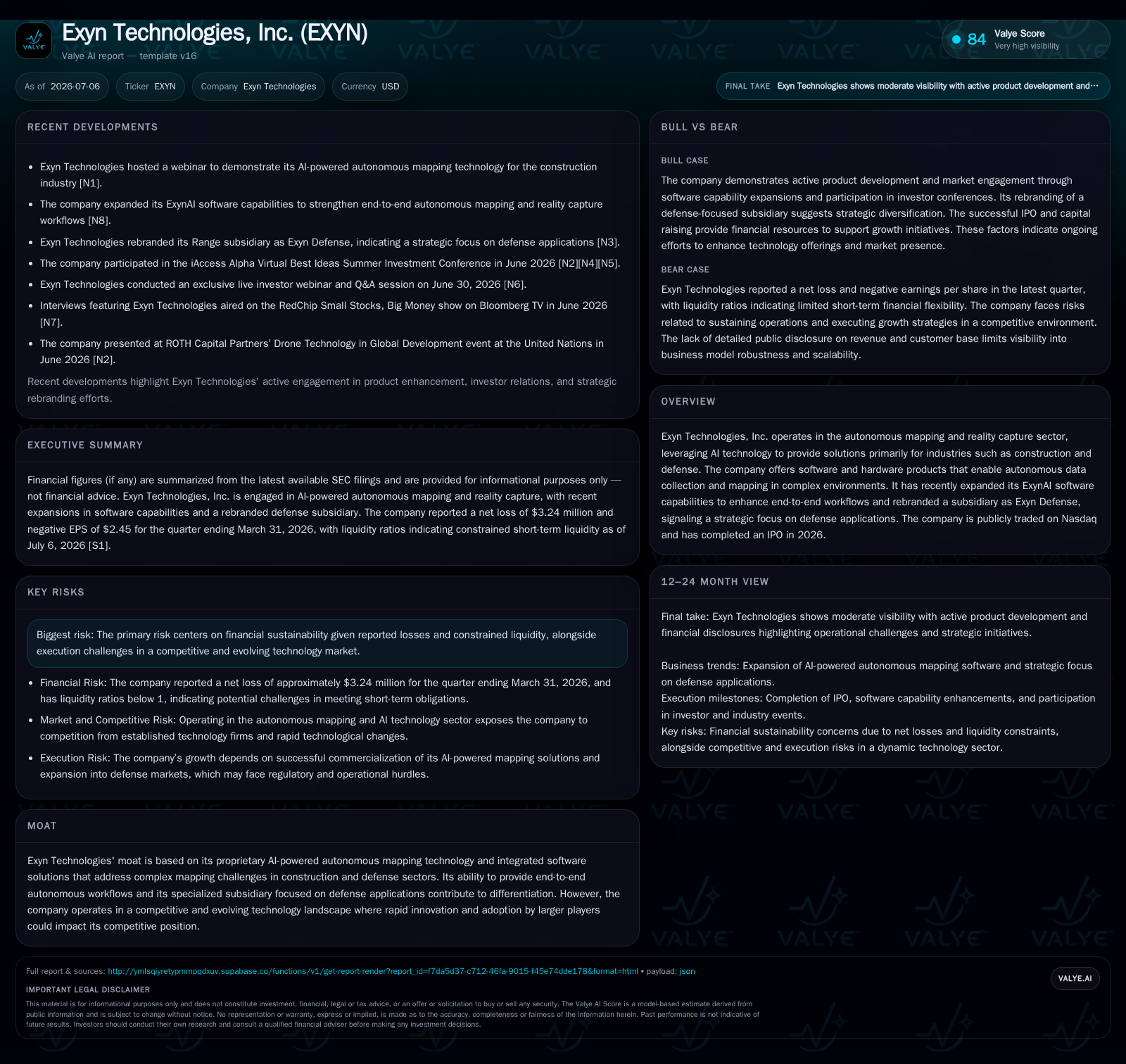
Exyn Technologies, a public company specializing in AI-powered autonomous mapping and reality capture, recently expanded its ExynAI software platform and rebranded a subsidiary to bolster its defense market positioning. These moves underscore the company’s drive to capture growing industrial and defense sector demand for autonomous spatial data solutions. However, despite its technology differentiation, Exyn’s liquidity constraints and operating losses signal ongoing financial pressure common in capital-intensive innovation cycles. Monitoring contract traction and cash-flow metrics will be key to assessing durability of growth.
Recent Operating Update: Strategic Moves during Capital Constraints
Exyn Technologies’ latest quarterly filing dated July 6, 2026 [S2] confirms continued operational strides focused on expanding autonomous system capabilities while grappling with financial headwinds. The quarter concluded with an operating loss of approximately $2.87 million and net income at negative $3.24 million as of March 31, 2026 [F1], reflecting the heavy research and development investments typical in early-stage technology firms within the autonomous mapping sector. Concurrently, the company reported $7.39 million in cash reserves against total debt of $8.08 million leading to a precariously low current ratio of roughly 0.24 [F1], illustrating tight near-term liquidity that requires prudent financial management.
Supporting this, an event filing on June 22 details a Side Letter Agreement establishing structured installment repayments totaling over $1.4 million related to prior note amendments with Evergreen Capital Management [S3]. This arrangement provides temporary relief by forestalling default penalties while extending payment timelines in three equal installments across June to August 2026. The company also issued equity considerations as part of this deal to secure additional flexibility in capital structure management [S3].
These developments collectively mark Exyn Technologies’ pragmatic navigation through cash flow challenges during an aggressive growth agenda centered around its core AI-driven autonomous mapping solutions.
Business Model: Integrated Hardware-Software Offering Targeting High-Value Industrial Clients
Exyn operates at the intersection of hardware manufacturing—autonomous drones equipped with sensor fusion technologies like LiDAR—and proprietary AI software platforms that deliver real-time 3D mapping and reality capture services. Revenue generation hinges on multiple streams: one-time sales of integrated robotic data collection units; recurring software subscriptions for ExynAI’s workflow automation capabilities; professional services including customized data processing; and longer-term contracts especially within government or defense sectors.
The recent expansion of ExynAI’s software capabilities demonstrates the company’s commitment to enhancing end-to-end autonomous workflows that improve ease of deployment, system reliability, and integration with client operations such as construction site monitoring or defense reconnaissance missions [N8]. This holistic approach seeks to reduce customer deployment cycle times and increase mission uptime—key KPIs for industrial automation clients heavily reliant on precise spatial data analytics.
The niche focus on complex environments where manual surveying is hazardous or inefficient reinforces Exyn's value proposition amidst peers who may concentrate solely on either drone hardware or software platforms. The rebranding of its subsidiary as Exyn Defense reflects a strategic pivot to deepen engagement with government agencies demanding cutting-edge autonomous mapping systems capable of operate under stringent regulatory constraints and security requirements [N3].
Industry Structure and Competitive Position
The autonomous mapping industry is characterized by rapid innovation fueled by advances in AI-powered navigation algorithms, sensor technologies, and the growing adoption of SaaS models facilitating scalable updates. Key competitors include drone manufacturers like Skydio and DJI who excel in hardware reliability; software leaders such as Matterport known for intuitive spatial mapping platforms; workflow integrators like Hexagon AB specializing in construction technology ecosystems; and defense-focused contractors like FLIR Systems that deliver specialized unmanned systems.
Exyn’s moat rests primarily on technological differentiation from proprietary AI algorithms enabling fully autonomous missions even in GPS-denied or complex indoor/outdoor environments—a critical advantage over semi-autonomous peers that require significant manual intervention or pre-mapping efforts. Its integrated platform approach helps embed its products within client workflows more seamlessly than aftermarket add-ons.
Nonetheless, sustained competitiveness demands continuous R&D investment given risks from rapid technological obsolescence faced industry-wide alongside increased scale advantages enjoyed by larger incumbents.
Growth Drivers
Several secular trends underpin demand for Exyn's offerings:
- Increasing automation adoption in construction sites aiming to enhance safety, reduce labor costs, and accelerate project timelines fuel demand for robotic data collection.
- Elevated government budgets for defense technology modernization spur procurement of autonomous drones capable of tactical mapping under harsh conditions.
- Advancements in AI sensor fusion improve mapping accuracy and reduce operator burden, expanding use cases into mining, infrastructure inspection, and disaster response.
- Transition toward SaaS licensing models fosters recurring revenue streams from software subscriptions with potential upsell through feature expansions.
- Integration potentials into digital twin initiatives permit real-time updates to virtual infrastructure models aiding predictive maintenance.
- Global expansion into emerging industrial regions where labor shortages elevate business case economics for robotic mapping versus legacy surveying.
These drivers are reflected in corporate communications promoting webinars tailored for construction industry application demos [N1] and participation at global drone technology forums spotlighting interoperability enhancements [N9].
Risks and Watchpoints
Despite promising technology traction, Exyn faces substantial execution risks:
- Financial sustainability is fragile given recurrent quarterly net losses exceeding three million dollars coupled with a modest cash buffer relative to liabilities.[F1], [S3]
- Customer adoption depends heavily on capital-intensive purchases or extended contractual commitments from conservative industrial operators requiring proof points on system robustness and ROI.
- Supply chain disruption risks impact timely delivery of key components including LiDAR modules integral to hardware performance stability.
- Regulatory scrutiny around autonomous aerial systems varies by jurisdiction imposing compliance complexities possibly delaying deployment cycles.
- Fierce competition from tech giants or established defense contractors threatens market share gains especially if rivals bundle offerings within broader enterprise ecosystems.
- Integrating rapidly evolving AI capabilities without alienating existing customer bases presents product-market fit challenges common during technology transition phases.
Stakeholders would benefit from tracking quarter-over-quarter shifts in customer renewal rates for ExynAI platform subscriptions as a signal of stickiness, alongside updates on deployments within defense verticals following the subsidiary rebranding announcement.
What to Watch Next
Key forthcoming indicators shaping Exyn’s trajectory include:
- Announcements regarding new customer contracts or pilot completions particularly within expanded defense engagements under “Exyn Defense” brand identity.
- Quarterly updates quantifying increases in number of autonomous missions completed signaling field validation at scale.
- Software subscription metrics such as renewal rates or average contract size evidencing deeper ecosystem penetration versus one-time hardware deals.
- Cash flow improvements stemming from executed repayment plans combined with any capital raises or strategic partnerships enabling longer runway extension.[S3]
- Product launch timelines refining AI features enhancing mapping accuracy or reducing deployment time aiming at raising switching costs against competitive offerings.[N8]
Overall execution pace against these milestones will influence how credibly Exyn can translate its AI-enabled autonomy advantages into durable commercial success amid evolving market dynamics.
Financial Profile Discussion
Exyn Technologies’ financial snapshot as of Q1 2026 reveals typical early-stage tech company characteristics marked by substantial operating losses ($2.87 million) offsetting initial commercialization efforts [F1]. While positive gross margins are often expected from scalable SaaS components over time, they remain diluted presently by sizeable R&D expenditure necessary to maintain technological leadership.
Liquidity analysis highlights vulnerabilities due to a current ratio approximating 0.24—the ratio of current assets ($4.53 million) against sizable current liabilities ($18.6 million) suggests stressed short-term funding position that could constrain operational flexibility absent successful capital raises or improved receivables conversion [F1]. Total debt stands near $8 million balanced against nearly $7.4 million cash holdings yielding modest net debt levels but still limiting buffer room [F1].
The recently executed Side Letter arrangement enabling installment payments totaling roughly $1.4 million payable through August provides tactical breathing space yet underscores pressing need for steady revenue inflows or financing alternatives to stabilize balance sheet health [S3]. Absent clear pipeline visibility or accelerated revenue build-out momentum, financial sustainability remains a key watchpoint warranting cautious scrutiny.
In aggregate, though Exyn's commitment to advancing integrated AI-powered solutions positions it well within a growth industry segment ripe for disruption by automation technologies, near-term financial constraints impose critical pressure necessitating disciplined execution against growth milestones.
Disclaimer: This analysis is based solely on publicly available information as cited, without provision of investment advice.
Disclaimer: This is research-only, informational analysis and not investment advice. It may include AI-generated interpretation and general industry context. Always verify important details using primary sources.

Comments