
Lindsay Corporation Navigates Contract Complexities and Inflationary Pressures in Dual Irrigation and Infrastructure Markets
Strong liquidity and specialized technology support Lindsay’s diverse agricultural irrigation and infrastructure safety business.
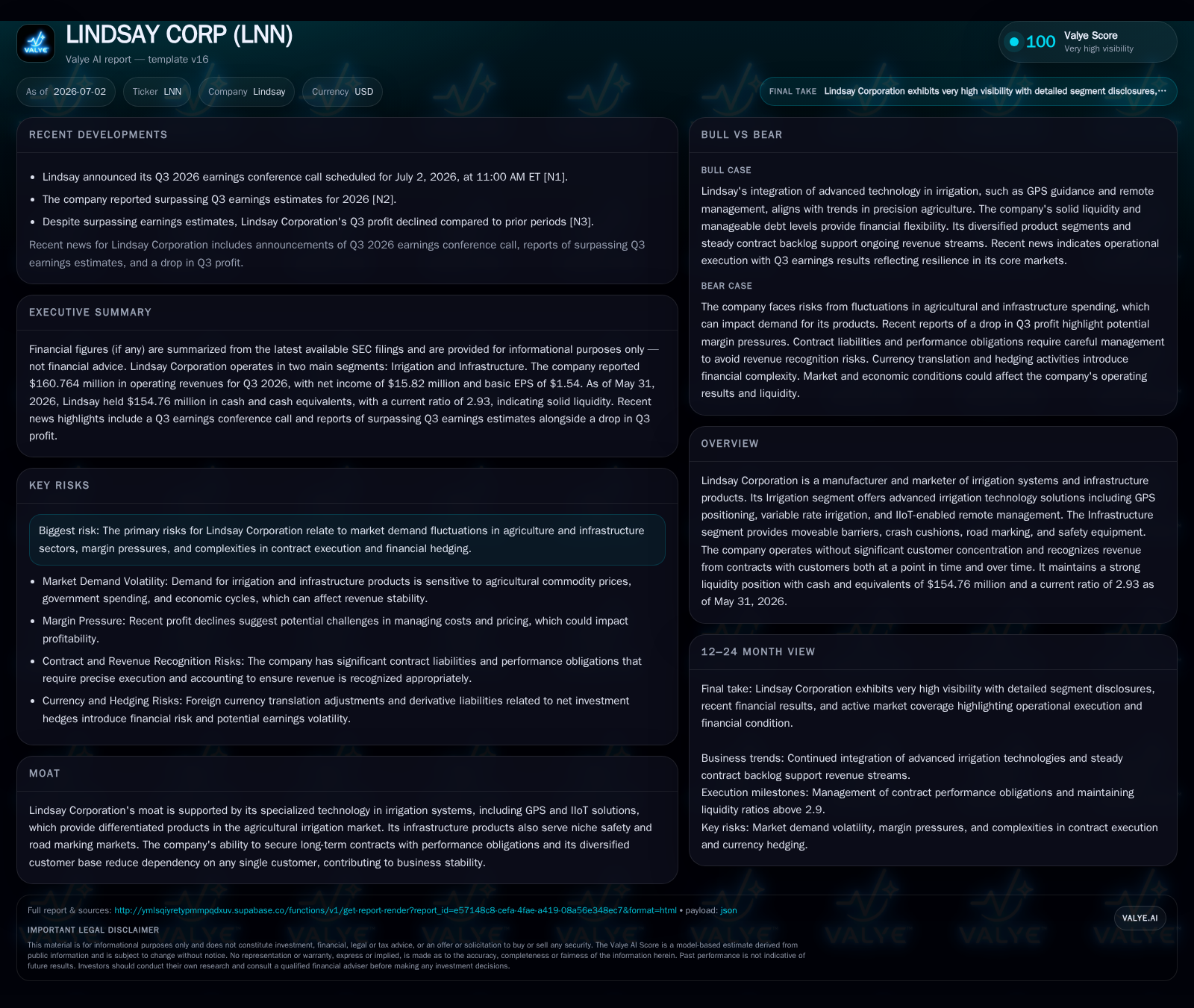
Lindsay Corporation’s latest quarterly results highlight the company’s resilience amid margin pressures from raw material costs and ongoing contract execution complexities. Leveraging its strong market position in precision irrigation—featuring GPS and IIoT integration—and a complementary infrastructure portfolio of safety barriers and road marking systems, Lindsay sustains stable performance supported by long-term contracts and a diversified customer base. While cyclical demand patterns and regulatory exposures persist as risks, management’s maintenance of a robust liquidity position underpins operational flexibility. Key to future growth is expanding precision irrigation adoption and infrastructure safety regulation enforcement.
Recent Operating Update
Lindsay Corporation’s Q3 fiscal 2026 filing dated July 2, 2026, reveals ongoing operational nuances in contract revenue recognition integral to its dual-segment business model [S2]. The company reported unsatisfied performance obligations of approximately $40.5 million at May 31, 2026, predominantly expected to be fulfilled within the following year, underscoring the importance of milestone-based billing structures in both irrigation installations and infrastructure projects [S27]. Contract liabilities rose notably to $25.3 million from prior periods, indicating increased advance payments—a factor requiring close monitoring as it affects near-term revenue realization patterns.
Concurrent earnings announcements show the company surpassing profit estimates despite margin challenges related to raw material price volatility—a common theme across capital goods manufacturers [N2]. Management emphasized maintaining strong customer relationships through technologically differentiated offerings such as GPS positioning in irrigation pivots and IIoT-enabled remote management platforms that enhance water-use efficiency [N1].
Business Model Analysis
Lindsay operates two distinct but complementary segments: Irrigation and Infrastructure. The Irrigation segment manufactures advanced center pivot irrigation systems incorporating precision agriculture technologies like variable rate irrigation enabled by GPS positioning and IIoT connectivity. These technologies allow farmers to optimize water application per acre dynamically, responding to soil variability—a compelling value proposition amid rising global water scarcity concerns.
Revenue generation here stems primarily from hardware sales of irrigation equipment supplemented by long-term contracts for installation and service maintenance. Notably, revenue recognition exhibits complexity due to contracts extending beyond a year with multiple performance milestones triggering billing events [S27]. This mix of point-in-time hardware sales and over-time service contracts impacts revenue consistency but also builds recurring service revenue streams enhancing margin stability.
The Infrastructure segment offers moveable safety barriers, crash cushions, road marking equipment, and related safety products designed for government agencies and contractors focused on highway safety compliance. These products tend to be sold via direct contracts that may span construction phases or maintenance schedules [S2]. The coexistence of these two segments allows Lindsay to capitalize on both cyclical agricultural equipment demand tied to planting seasons and infrastructure spending cycles influenced by public budgets.
Operational margins depend critically on raw material prices (steel, electronics) constituting significant cost drivers for heavy equipment manufacturing. Price pass-through capabilities are moderated by competitive dynamics where product innovation cycles play a role in justifying premium pricing.
Industry Structure and Competitive Position
Lindsay’s niche lies at the confluence of agricultural equipment manufacturing with embedded precision technologies and infrastructure safety product supply—an intersection inhabited by several larger but more specialized peers.
Compared with Valmont Industries, which commands broader scale in center pivot irrigation manufacturing worldwide, Lindsay distinguishes itself through technology integration emphasizing precision water management aided by GPS/IIoT. Deere & Company represents a formidable competitor given its expansive footprint across general farm machinery and precision ag tech; however, Deere's focus is broader while Lindsay maintains tighter specialization in irrigation solutions plus an added Infrastructure unit servicing transportation safety.
Another point of comparison is Trimble Inc., which offers extensive GPS-based precision agriculture technology but does not manufacture irrigation hardware. This technological complementarity highlights Lindsay’s strategic balance—offering physical equipment embedded with advanced control systems proprietary enough to create moderate entry barriers but still susceptible to technological obsolescence risk if pace of innovation slows or competitors catch up.
Infrastructure safety competitors such as 3M provide safety-related products like road markings but operate fundamentally different supply chains focusing more on consumables than large engineered barrier systems.
Growth Drivers
Precision irrigation adoption remains central for growth amid increasingly urgent agricultural water conservation needs driven by climate change-related variability. Adoption rates escalate as farmers seek data-driven crop management enabled by Lindsay's IIoT remote system management offerings. Expansion into emerging markets with growing agricultural sectors presents additional avenues for volume growth.
On the infrastructure side, heightened governmental emphasis on transportation safety standards bolsters demand for compliant barriers and crash cushions. Regulatory enforcement tightening often precipitates renovation or upgrade cycles for aging road networks conducive to long-term contracts.
Technological advancements underpinning both segments—from enhanced GPS accuracy improving variable rate irrigation control to materials innovations extending barrier durability—open up incremental product differentiation opportunities supporting premium pricing.
Long-term service agreements providing installation support and maintenance services create recurring revenue streams that improve overall margin profiles; these contracts also deepen customer engagement reducing churn risk.
Risks and Watchpoints
Demand cyclicality linked closely to agricultural commodity price swings poses persistent top-line volatility risks for the Irrigation segment. Infrastructural budget fluctuations tied to political cycles mean Infrastructure revenues can experience episodic softness depending on public spending priorities.
Raw material cost inflation remains a key margin pressure source given steel price volatility impacting both heavy machinery components and barrier manufacturing inputs. The ability to implement effective pricing strategies without damaging competitive positioning remains critical.
Contract execution risk manifests through complex multi-year projects requiring milestone achievement verification before recognizing revenue—misestimations here can affect reported profitability metrics [S27]
Emerging legal risks arise from pending lawsuits concerning infrastructure safety products suggesting exposure to potential remediation liabilities; current accruals stand near $10.6 million but unresolved regulatory outcomes may raise future charges [S2]
Technological obsolescence risk is tangible given rapid advances in agricultural IoT solutions; failure to keep pace could erode differentiation advantage. Environmental compliance demands also necessitate vigilant monitoring as non-compliance poses operational disruptions or financial penalties.
What To Watch Next
Key milestones include quarterly updates on backlog evolution—particularly unsatisfied performance obligations—to gauge forward revenue visibility given significant contract-billing complexity [S27]. Monitoring warranty claim rates will provide insight into product quality trends impacting brand reputation.
Management commentary during upcoming earnings calls regarding raw material cost pass-through success will signal margin trajectory adjustments amidst macro inflationary pressures [N1]
Regulatory developments pertaining to environmental remediation plans or litigation outcomes related to Infrastructure products represent critical risk disclosures likely influencing provisions or contingent liabilities [S2]
Innovation pipeline progress especially around expanded IIoT functionalities within irrigation systems will be essential for sustaining pricing power against competitive incursions.
Geographic diversification trends showing increased penetration in emerging markets would confirm successful international expansion efforts balancing North American cyclicality effects.
Financial Profile Discussion
As of May 31, 2026, Lindsay holds robust liquidity with cash plus equivalents totaling approximately $154.8 million against current liabilities near $163.7 million resulting in a healthy current ratio of 2.93 [F1], signaling solid short-term solvency supporting operational agility.
Total debt primarily comprises long-term obligations with a current portion of approximately $89 thousand as of May 31, 2026 [S2]. Net inventories valued using LIFO and FIFO methods totaled approximately $145.9 million at May 31, 2026 [S2]. Environmental remediation contingencies are accrued at about $10.6 million reflecting prudent conservative accounting given ongoing remediation planning uncertainties [S2].
Overall free cash flow stability supported by recurring service revenue streams enhances the capacity for incremental R&D investment crucial for maintaining leadership in precision agriculture technology integration alongside infrastructure product upgrades.
This analysis synthesizes publicly filed data alongside industry structural insights without offering investment research views or forecasts. All references pertain strictly to documented SEC filings or credible news reports as cited.
Disclaimer: This is research-only, informational analysis and not investment advice. It may include AI-generated interpretation and general industry context. Always verify important details using primary sources.

Comments